The Year of the Thousand Splendid Grass-Fed Steaks

OLYMPUS DIGITAL CAMERA

Where’s the beef? It’s right here. In my freezer.

“You have some boxes of eyeballs on your back porch,” said Casey, stepping into the kitchen for dinner. I’d picked up the “eyeballs” earlier that afternoon and left them outside while I plugged in our upright freezer for the first time since we purchased it six years ago. (We’d been using it as a liquor cabinet.) The temperature outside trumped the average freezer, so the porch seemed like a logical stopping point for the beef as I worked my mind around the reality of purchasing a quarter of a cow.

When friends and I first entertained the possibility of buying grass-fed beef from a local farmer, one quarter seemed reasonable. I’m familiar with cows. I often run past their pastures; I talk to them and admire their liquid eyes and long eyelashes, their shaggy, luscious winter coats. I know how big they are. The abundance of meat I received was, nevertheless, jarring. Discussion, I realized, is nebulous; three large cardboard boxes, overfilled with beef parcels wrapped in white butcher paper, are concrete. It’s humbling to consider the bounty of a single cow.

While I tamped down the stress of my beefy new world, shoving liquor bottles into temporary housing, Casey chuckled at the dining table, shoulders quaking. “Hey,” she said, calling to me. “You want some rump with that?” Two seconds later: “How many burgers would you like with your cow?” She kept laughing. “Jules,” she said. “You know I’m gonna have mad jokes about this, right?”

I don’t think I’ve eaten this much beef in my life. My family has yet to discover an affinity for burgers or meaty sauces. My food truck/catering dream has not suddenly materialized. I sifted through the parcels, making a list of what the cow provided. As I stared down at the boxes, I questioned my sanity.

Casey looked at me – my pale, sweaty face; knit brows; frown broader than a cow’s hind end – and stopped laughing. She stood up and hugged me. “Remember why you did this, Jules,” she said, holding my frantic gaze. “Tell me again why you wanted to do this.” I did this because I could. What could be more sustainable, ethical, and beneficial to a local, independent economy than this awe-inspiring, prolific cow?

Vocalizing my intent undid the panic loop. I asked myself:

Who raised the cow? Joe Ray, a family friend and local farmer.
Where did the cow grow up? About five miles from my house, on grassy pastures in the outskirts of Moroni, Utah.
Was the cow treated humanely? Yes.
Did the cow die humanely? Yes, insofar as any animal reared for consumption can die.
Who processed the meat? Circle V Meats in Spanish Fork, Utah.
Who inspected the meat? Utah 5.
Can the grocery store answer any of these questions? No.

The cost-benefit analysis:
The beef cost $2.67 per pound prior to processing, which raised its cost to $3.38 per pound. Our locally sourced, grass-fed cow yielded approximately 467 pounds of meat in total, which means that one quarter contained about 115 pounds of:

1 package top round steak
2 packages sirloin tip roast
3 packages T-bone steak
5 packages cubed steak*
2 packages sirloin steak
3 packages rib steak
2 packages stew meat
3 packages chuck roast
2 packages rump roast
1 package tenderloin
49 pouches ground beef**

* My daughter, Rory, loves country-fried steak, so I requested a larger proportion of cubed steak than my friends did. Rory and I will learn how to cook the dish together.

** Casey and I estimated each pouch to contain ½ pound of ground beef, though others say each pouch weighs a pound. It’s difficult to tell for sure, because the pouches are frozen solid and could be use as weapons in case of a zombie apocalypse. So, the quantity I received could be anywhere between 25 and 50 pounds of beef, which is, by any estimate, a holy crap ton.

Let the year of the thousand splendid grass-fed steaks begin.
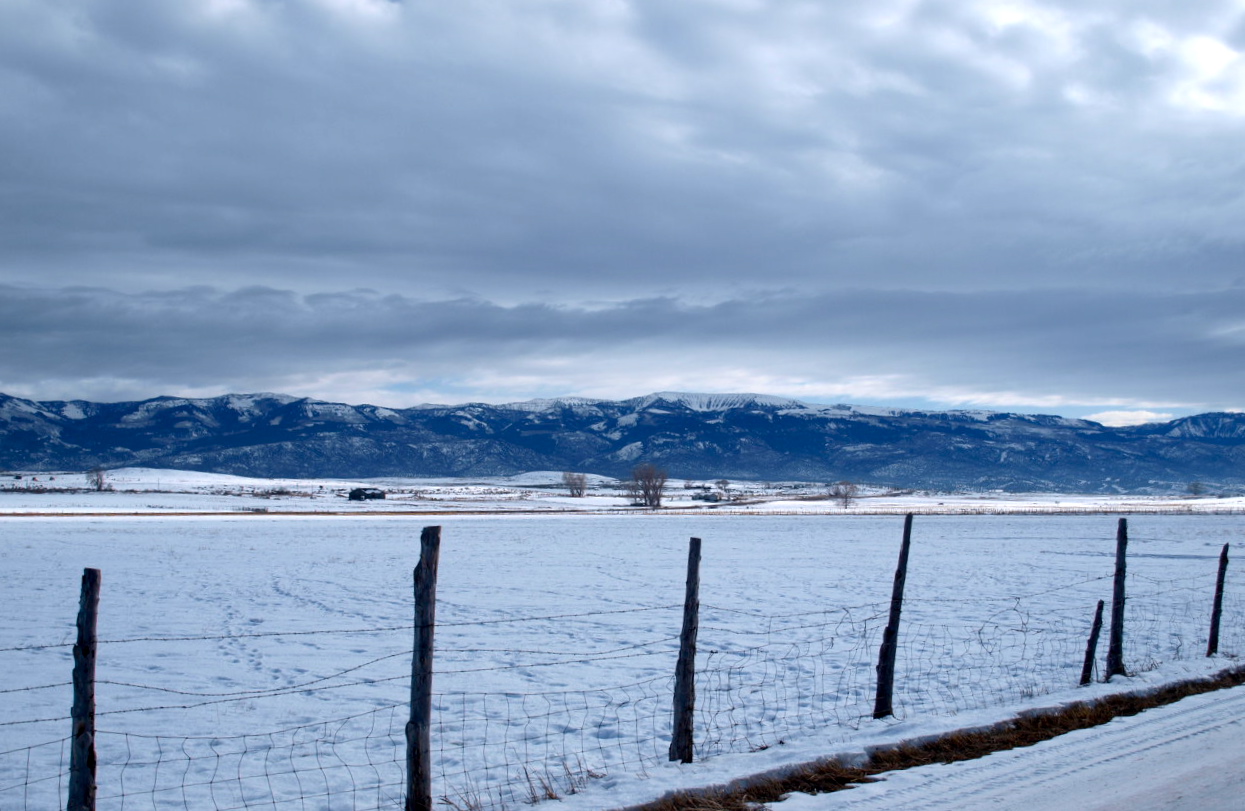
Joe Ray's pastures.

Joe Ray’s pastures.

© Julia Moris-Hartley 2014
2 Comments

Filed under food, literature, travel

Back to Beginnings

OLYMPUS DIGITAL CAMERA

Shot at night in low light with a flash… and four friends willing to be scalded in the process of capturing a single good photo. This, to me, signifies true love.

In this new year, I find myself going back to beginnings. Eater Provocateur started as a creative outlet for my inner MFK Fisher, a vehicle for self-expression with the side benefit of bringing culinary joy to others.  Entering the teaching arena diverted my energy, dividing my attention inequitably: scales tipped towards the classroom, leaving behind the whispered remnants of a blog, dusted with shreds of faded photographs past.  These days, I write as often as I can (which is not as regularly as I would like). I cook only rarely, and my camera and my food intersect awkwardly, like lovers who have grown apart but still try to maintain the pretense of an intimate relationship. Thinking of my forsaken blog causes me to wince.

Friends advise that I shouldn’t worry about my absence from the electronic world. They are, in ways, right – isn’t it more important that I engage as a human being among fellow humans? Logically, this makes sense, but it doesn’t ease the guilt of abandonment or the mourning for the lost solace of each passing day. A blog is like a child or a spouse: it requires constant, devoted attention. The reciprocation, once provided, sustains the giver. Deprived of such dynamics, the partners stray. I have been wandering in the weeds.

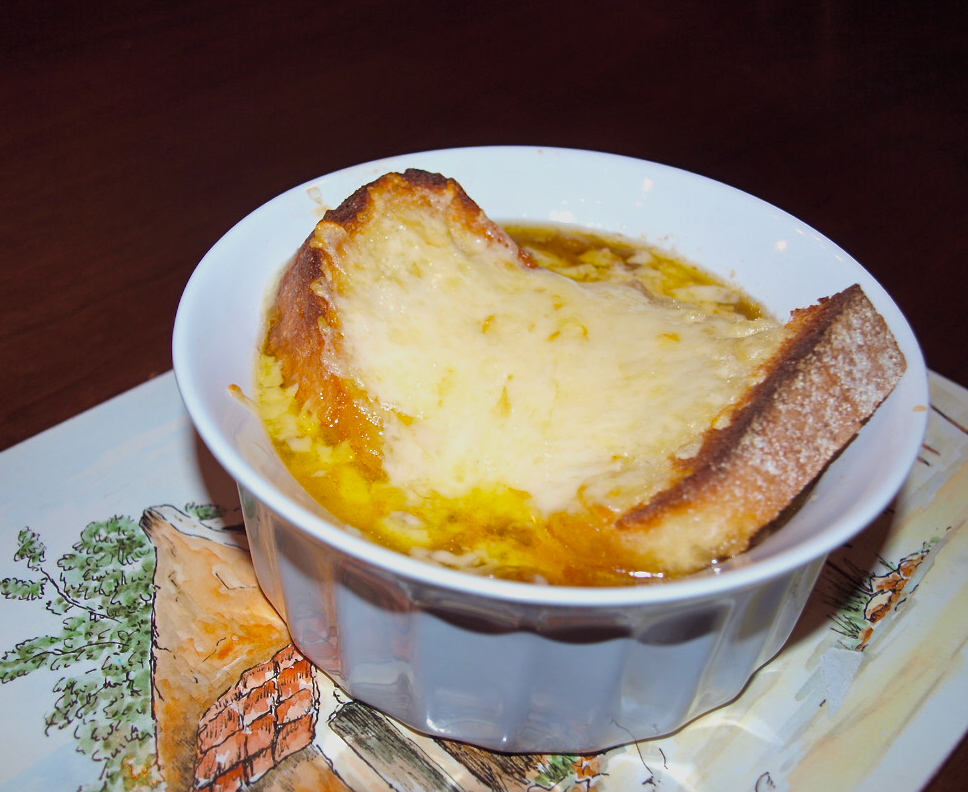
Nevertheless, I am blessed with friends who want, earnestly, to help keep me on track. If I make French onion soup, with toasted baguettes topped with bubbling smoked Gouda, they rally around me in support, armed with oven mitts and professional-grade cameras… a boon to a girl who started a blog with an Elph and a dream.

So I’m going back to my roots. I used to think an ambitious person could market herself in the food world and succeed according to the effort she put forth. Adulthood, and Amanda Hesser’s Food52 advice to budding food writers, convinced me otherwise. Realistically, the reach of my writing is constrained by the economic sensibilities of geographic distribution. Publishing trends and books sales are similarly disheartening. The modern literary forum is so different from that which fostered MFK Fisher and Julia Child. That knowledge is, reluctantly, and maybe must be by necessity, okay with me.

I’m still a girl with a food dream. It would be awesome to one day realize my life in terms of writing about food for a greater purpose; I’m just not there yet. I couldn’t have started this blog without the help of the friends and readers who buoy me, without those shouts of support right from the beginning. Thank you for joining me on this blog’s journey so far. Let’s make this a great year to get back to our roots… together.

Happy New Year!

© Julia Moris-Hartley, 2014

1 Comment

Filed under food, literature, travel

I Heart…

OLYMPUS DIGITAL CAMERA

…Because I Call Them on a Saturday Night and They Are Gracious

A group of friends went to dinner in an early celebration of Mother’s Day. They hired baby-sitters for their children; they coordinated a carpool to a city an hour’s drive north, where they had made reservations at Communal, a restaurant that boasts locally sourced, seasonal menus. At Communal, they ordered wine, appetizers, and six entrees, which they shared, family-style, in an amber-lit, partitioned room. Some partook of dessert, which was also shared. The friends split the bill without quibbling, and tipped their servers well. One of the men offered to drive everyone home. Hunger sated, spirits buoyed, they returned.

I was fortunate to be part of this dining experience. My friends and I live in a rural area with limited dining options, so planned events – I call them food pilgrimages – provide us with rare moments of socio-culinary joy. The details of this meal have since faded into an overall impression: the food was delicious; we had a great time. But one dish stood out: skirt steak with roasted piquillo peppers.

I could not stop thinking about the steak the following day and well into the evening, so I called the restaurant about twenty minutes before they closed. To my delight, one of the chefs agreed to talk with me. I apologized for the late hour and asked if he had a couple of moments. He assured me that he did, then he told me how the dish was made: ingredients, pointers, and all. Dear chef, had you been standing next to me, I would have kissed you.

*

… Because They Know How to Make An Experience Unforgettable

My friends, Casey and Laura, occasionally abduct me for a girls’ night out. Recently, we ventured to Chef’s Table, which is located in Orem. Chef’s Table is an eight-year recipient of the Best of State Award in Fine Dining. The restaurant is a luxury that we, on school salaries, can afford only on choice occasions, so we tend to make the most of them.

When we arrived, they seated us in the east room, which has floor to ceiling windows overlooking Provo Canyon. The setting sun blushed against the grey, striated upper crags of the Wasatch front, shrouding the lower valley in evening shade. We nestled into comfortable leather chairs amidst the tinkle of forks and low conversations.

One of our servers brought us a basket of warm, doughy rolls with a side of kalamata butter. We promptly ate them all. Casey, bedecked in a long grey dress and her signature red lips, ignited as the rush of umami engulfed her. We began to talk more animatedly, debating what to order. Which appetizers sounded the best to share? (Three cheese fondue with sourdough crisps and onion soup gratinée.) What entrée were we least likely to replicate at home?  (Lamb with white beans and sausage goulash; mushroom stuffed filet with ‘whipped’; and sirloin steak with truffle frites.) What type of wine should we drink? (Ravenswood Red Zinfandel.)

A change rippled through the dining room sometime in between the second round of rolls and the uncorking of the wine. The room quieted. Other diners, mostly couples, were watching us as we sampled from each other’s plates: spoons swooping, glasses tippling, murmuring in a near-rapturous state. It occurred to us that three boisterous women, high on delicious food and wine, might pose a date night anomaly. Glancing mischievously at one another, our eyes made a silent pact to provide our fellow diners with the entertainment they sought. Unapologetic foodies, we murmured louder.

By the time our entrees arrived, we didn’t really care what the couple seated across from us – who ate their entire meal one-handed, their opposite hands entwined in a sustained, tabletop embrace – thought. I turned my back to the balding man among the party of six in the corner of the room. He had actually leaned forward in his seat, neck craned, ear cocked in our direction. Casey playfully returned the favor. “Maybe we should invite him to join us,” she mock-whispered.

Our servers offered us countless rolls and unending butter; they refilled our glasses, removed plates, replaced silverware, and inquired about our satisfaction with each dish. I think our antics secretly amused them, though the befuddled hostess may have lamented her placement choice. Perhaps we’ll warn her next time: Beware! Foodies Gone Wild! On that night, however, our fleeting celebrity was well worth the cost of the performance.

*

… Because Making Others Happy Makes Them Happy

Joe, the chef de cuisine at the school where I work, rides a motorcycle and rocks out in a band. He recently got his last name tattooed on his forearm in large cursive letters, and is someone to whom I might turn if I needed food advice, special ingredients, or, perhaps, the name of a hit man.

Chef Joe is one of the most generous people I know. On my daughter’s birthday, he posted a big colorful sign in the cafeteria. He offers food samples and overages he can’t use to anyone who will take them. He’s given me honeycomb and Thai peanut marinade; he’s even given me duplicate cooking books, because he knows I share his love of food and because he has excellent taste in aspiring food writers who live in his immediate vicinity. Generosity isn’t an air or obligation for him; it’s his manner of being.

I can attest to Joe’s generosity specifically, but in my experience many food people share this quality. I do, as do my food-loving friends. I have yet to meet an ungracious chef. Generosity of spirit marks those who love to share their meals: it compels us to commune, to inquire, to enjoy and delight. Our spirits are propelled by the appreciative gestures and smiles of our efforts. It makes Joe happy to make others happy. It makes me happy to make you happy.

*

… Because They Give Me A Reason To Write

To all my friends in food: Thank you for helping to make the world a happier and infinitely more delicious place. Thank you for giving me direction and literary purpose. Happy, happy Thanksgiving!

I thank you!

I thank you!

Leave a comment

Filed under food, literature, travel

The Hunting Incident

It started out well enough...

It started so innocently…

“Mom, can we bring the pup?” asks Kai, gazing up with expectant hazel eyes, the freckle under his left eye illuminated in early afternoon sun. I glance at our dog, Coco: a small whitish mass of downy fluff and energy, her tail alert and wagging.

“Sure,” I say. “She’s part of the family, too, right?”

My children, Kai and Rory, exclaim “Yay!” in unison. Kai takes Coco’s leash from its hook in the laundry room, attaches the leash to Coco’s black collar, and stands and salutes, saying, “Ready for takeoff, ma’am!” Rory follows suit, also saluting. She giggles. Her freckled cheeks giggle with her.  The dog sneezes.

We open the door to a gentle easterly fall breeze, and pile into the car for a hike in nearby hills.

*

Our valley had its first snow a few days earlier, ironically, on the calendar’s first day of autumn: snow sheathed the higher rocky crags, and icy confetti dotted our driveway.  I mused on Mother Nature’s harsh whims, knowing better but nevertheless pressing a grey smudge of bitterness on my heart.  The weather gave us a short reprieve, and I seized the chance to venture out – with the kids, the dog, and the camera – in search of changing leaves.

We drove to Power Plant Road, and started up a trail that leads to a peak overlooking the valley. Kai offered to walk Coco so that Rory and I could take pictures. We passed two hunters dressed in dark camouflage suits, a common sight during the annual hunting season.  They knelt in the dirt with their backs to us, rinsing their hands in a stream of snow run-off, and talking in low, deep voices.  We continued up the trail with Kai and Coco in the lead. Kai stopped abruptly.

“Mom?” he asked. “Mom, what’s that?”  He pointed.

“What’s what?” I said, unzipping the camera bag and wrestling out the camera.  My eyes followed Kai’s finger and saw a bright red leg, deftly removed of skin, with muscle, bone, and hoof in tact.  A precise cube of venison steak lay in the dirt by my feet; stringy maroon entrails scattered along the path in the short distance between us.

“Is that blood, mom?” asked Kai, who is squeamish about everything related to internal anatomy. He presses his hands to his eyes during portions of movies or television shows that involve the handling or manipulation of flesh. “Sorry,” he says, genuinely apologetic. “It’s just that it makes me feel yucky inside.”  He gags at the sight of blood and prefers to eat things that grow from the earth.

Around us, autumn’s leaves succumbed to winter; they changed colors, but the colors were muted and pale.  The deer leg offered the brightest hue for miles.  I looked at Kai, who stared at the neatly severed leg with uncharacteristic calm. His arms strained to hold Coco, the only hunter among us, pawing at the dirt and sniffing furiously.  The sun shone warmly on my skin, but I felt chilled.  Distant gunshots pierced the air.

“Come on back down, you guys,” I said, as coolly as I could, though even I felt yucky inside. “Don’t let the dog get that meat,” I added.

The hunters had left; clouds of dust swirled in the wake of their four-wheelers.  I have never hunted, but I was puzzled.  Why would anyone leave such a huge portion of meat behind after going to the trouble of killing the deer?  Would the hunter return to claim what remained?  We did not linger to find out.

*

When I was a child visiting my grandfather in Idaho, we said grace before meals. Grandpa spent most of his career working in Africa as a physician and missionary for the Lutheran church.  He dreamt in vivid detail and often recounted his dreams at the breakfast table: wild tales of hunting and harrowing near-death experiences, the tableau of his memories translated into the larger-than-life adventures of his subconscious mind.  Grandpa hunted and fished for sustenance as well as survival. Saying grace was his way of honoring the providence of his Lord.  The naked affront of flesh on the trail brought his voice back to me.

We thank you, Lord, for this meal we are about to receive and for the blessings you give to us each day…

Heavenly Father, we thank you for the sustenance you provide to our bodies and to our souls…

Come, Lord Jesus, be our guest. Let these gifts to us be blessed…

*

Winter brings deer down from the mountains into our high desert valley.  Their trails scissor the deep, impacted snow.  They nibble at bare hedges and bound fences easily.  The deer congregate in clusters, trotting past the house, lingering underneath the trampoline with luminous black eyes, watchful but emboldened.

Coco invariably barks at them.  I’ve seen Coco confront a doe, who held eye contact with the dog, lifting and lowering her head repeatedly as if to say, Don’t cross me, runt. I suspect the doe’s powerful hooves would trump Coco’s teeth in a fight.  Exiles of the snow, the deer seek what sustenance they can find, wherever and however they can find it.

There was a time when I, the reformed Yankee, frowned upon hunting. But time and knowledge changed me.  If deer in our valley proliferated unchecked, they would render our gardens bare without so much as a guilty exhale, clearing trees and shrubs of foliage, chewing lettuces flat to the ground. My friend – a true Renaissance man who bakes his own bread, bottles wine from grapes and fruits he’s grown, and gardens by principle – lost acres and months of gardening effort to a single family of deer last year despite preventative barriers. The deer ravaged his extensive garden overnight.  Deer graze everything, and they reproduce rapidly.  They multiply, despite their high rate of roadside casualties. Do I see myself hunting?  No, but I understand the practicality of hunting in my area.

*

As a meat eater, albeit an occasional one, I acknowledge my complicity in the demise of animals who, while not hunted, are born and raised to give their lives for my supper.  I may not wield the gun, but I purchase and consume the spoils.  The plastic-wrapped parcels I buy are a different version of the same primal hunger.  Meat is flesh; organs are organs. The bare leg on the trail confronted me with this humbling reminder.

My grandfather died years ago, and my practice of saying grace at the table died with him.  His spirit has not left me, however, so instead I practice gratitude, sprinkling my thanks on plates of crunchy fried chicken and seasoning my meals with care.

The deer distressed me. Is it common for hunters to leave unwanted meat? Are deer legs undesirable cuts, and if so, why go to the trouble of skinning an entire leg only to leave it, carelessly strewn in the woods? Why make the effort of killing the animal, only to waste such a considerable part of it?  It struck me as an appalling lack of regard: towards other humans and, more importantly, the deer itself. I think I heard my grandfather’s voice that day to tether me, to remind me of what it means to be grateful.  His voice rustled through the pale leaves, whispering condolences for a loss wholly lacking grace.

© Julia Moris-Hartley, 2013

4 Comments

Filed under food, literature, travel

Pickled Peppers

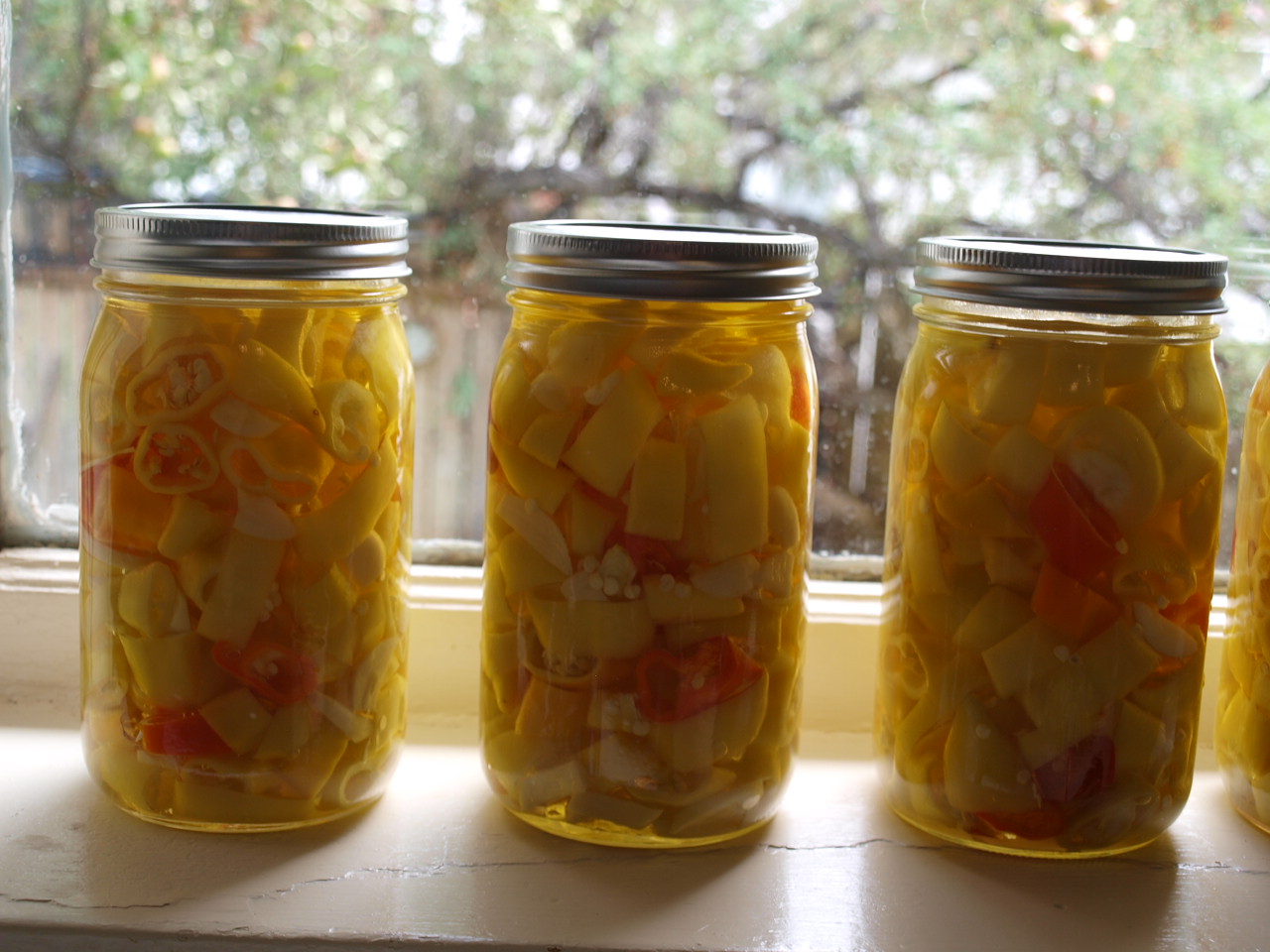
My friends and I have been pickling Hungarian wax peppers for the last two weeks. Feeling Peter Piper-ish, I conducted dutiful research into pecks of peppers (a peck translates to roughly two dry gallons) and into the well-known tongue twister, whose origin stems from an English pronunciation handbook that veritably sings the praises of assonance and alliteration.  But, now that I’ve been through the process of pepper picking, preparing, brining, and bottling, I’m still a little perplexed.  How could Peter Piper have possibly picked pickled peppers?  Did he pick them out of a jar?  Or were they raw peppers that he intended to pickle?  In any case, I’m pretty sure we out-pickled his peck.

Below are detailed instructions for the pickling process.  Though it may seem like a lot of text, the process is quite easy.  No boiling or sterilizing required.

The brining process:

In a large non-reactive vessel (something plastic, like a five gallon mixing bucket from the hardware store, or a large ceramic crock), combine 3 gallons of white wine vinegar, 1.5 gallons of water, and 3 pounds of kosher salt.

Many thanks to Jim and Patty Berlin, who let us harvest peppers from their amazing garden.

Many thanks to Jim and Patty Berlin, who let us harvest peppers from their amazing garden.

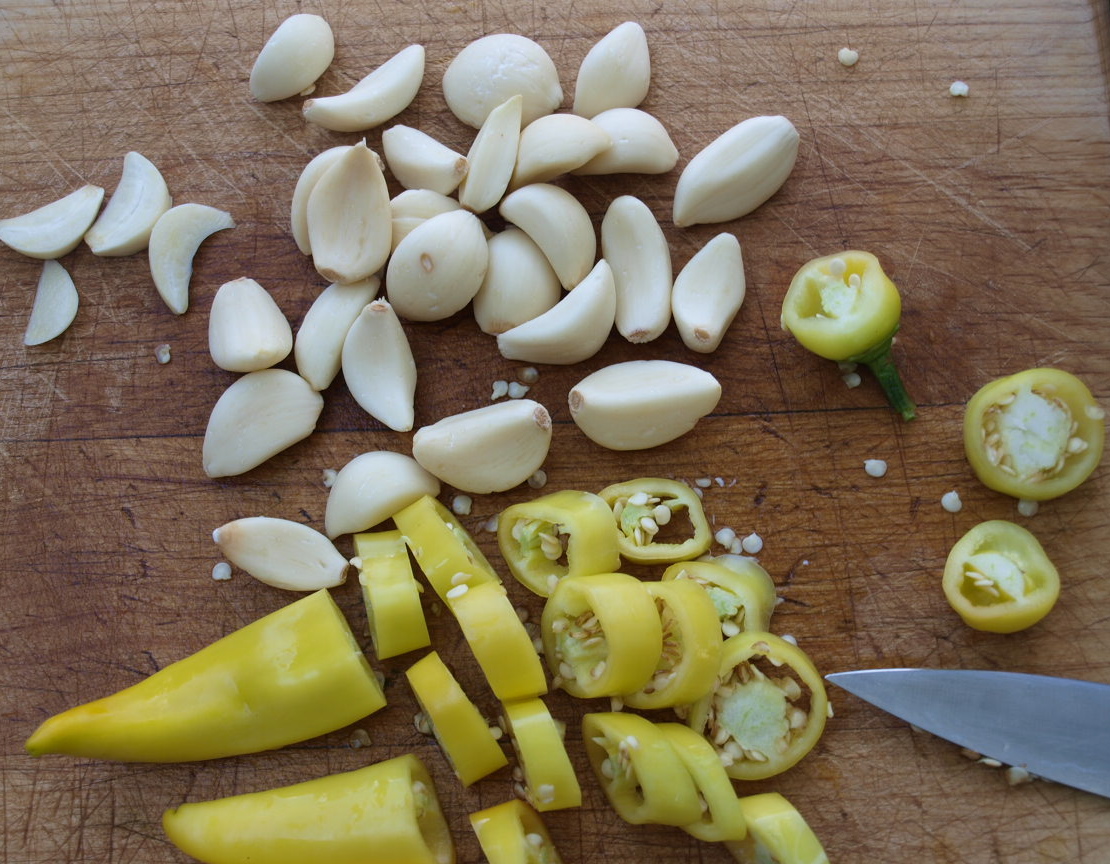
Pick a peck (or two) of peppers… or buy/barter some from a local farmer. Wash peppers well to remove dirt and debris. Shake off excess water. Chop peppers into circles, about ¼” wide.  (You may want to line up peppers into rows of two or three to expedite the chopping process. Chopping with friends is also helpful.) Discard tops, bottoms too small to worry over, and any portions of the pepper that appear to be mushy or compromised by bugs.  Keep chopping until you amass a mountain of sliced peppers.

Next, slice a head of garlic into thin slivers.  (Buying pre-peeled garlic is much easier and far less sticky than peeling each clove individually.)  Garlic adds an aromatic quality to the peppers and develops a savory, toothsome texture as it ages in the jar.  If you like garlic, don’t be shy – go for two or three heads per bucket.  If you don’t like garlic, err on one head per.

This is roughly the chop you want.

This is roughly the chop you want.

Transfer peppers and garlic to the brining solution until the vessel reaches critical mass – the point at which it becomes difficult to stir.  Common sense will dictate if you’ve put too many peppers into the mix. Don’t panic if you suspect you’ve put in too many.  You can always fish out the overflow with a large bowl and transfer it to an additional brining vessel.

Allow brining mixture to rest for three or four days.

OLYMPUS DIGITAL CAMERA

The bottling process:

Purchase one or two cases of quart-size bottling jars, and a good amount – a few gallons? – of corn oil.  (We bought more than we needed and saved the receipts in case we had unused items that we could return.)  Working with one case at a time, remove the lids from each jar and set the lids aside in a dry, clean place.

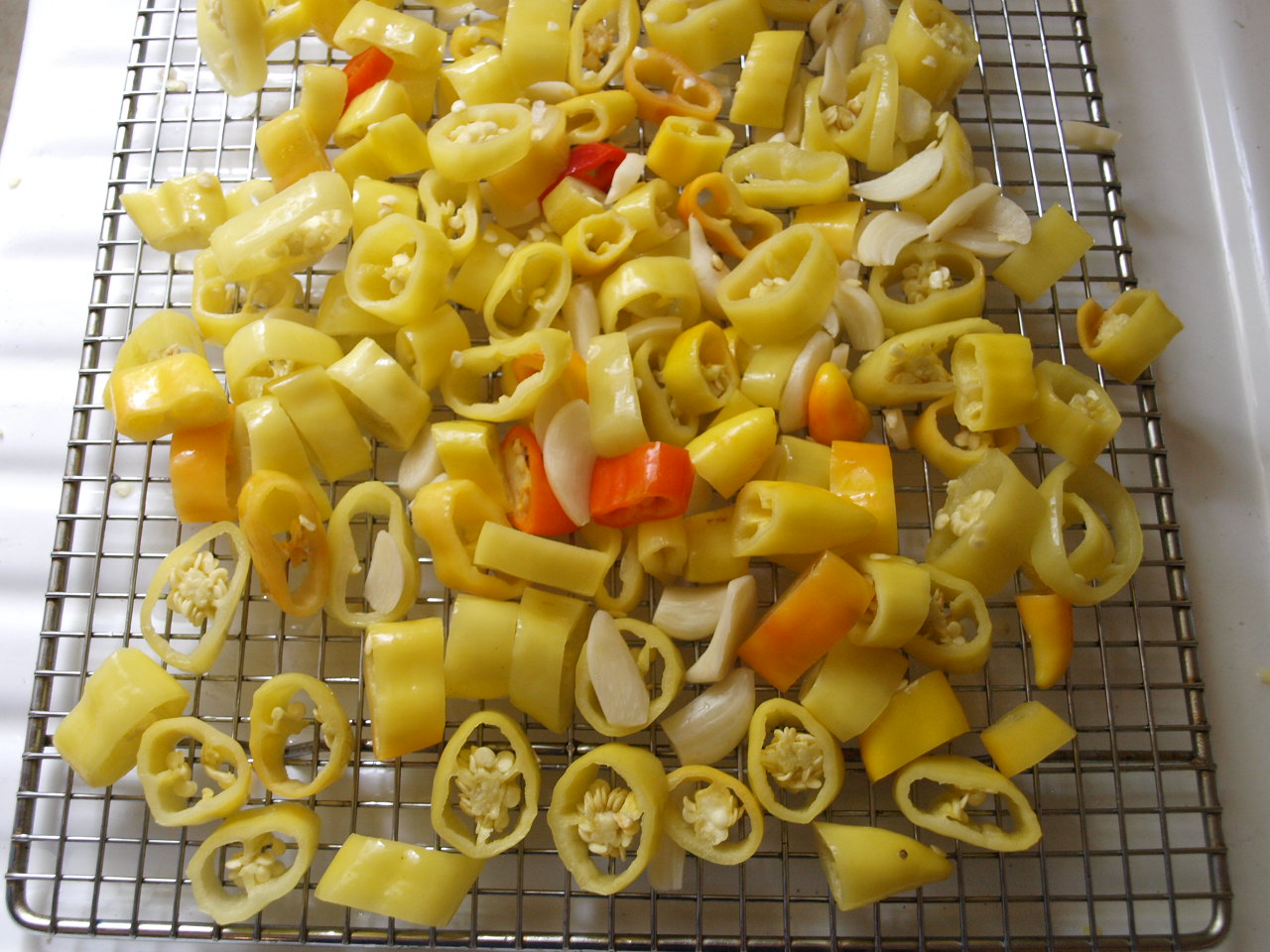
Set up a draining station by the sink.  You will need a large, lightweight mixing bowl or spoon (for scooping peppers from the brine), a large colander or straining bowl (for draining the initial brine), and a couple of cooling racks, placed where any excess brine can drain (we placed ours adjacent to the sink).  I highly recommend opening your windows or otherwise ventilating your workspace.  My friends and I worked in teams to save time.

Draining station.

Draining station.

Scoop some peppers from the brining solution.  Drain them over the sink, then transfer them to a cooling rack.  Arrange the peppers so that they rest flatly on the cooling rack to remove as much of the brine as possible.  Grab a jar.  Gather several garlic slices to put at the bottom of the jar (they tend to naturally rest at the bottom).  Start adding pepper slices.  Shake the jar a few times as you fill it – this allows gravity to help the peppers settle, reducing air bubbles and maximizing the amount of peppers per jar.  Fill to the top of the jar – about where the lid stops when it is tightly screwed on.  Do not overfill.  Set the jar aside and repeat.

If you have company, ask them to start filling the jars with corn oil – it speeds the process up.  If you’re working solo, jar all the garlicky peppers and begin adding corn oil to each jar, allowing enough oil to cover the mixture.  Then, take a fork and carefully tamp the peppers against the glass in an effort to remove air bubbles.  Screw the lid tightly on the jar and repeat.

Later in the night or the next day,  jostle the peppers in a gentle sideways swishing motion to suss any remaining air bubbles out.  Allow peppers to cure for about two weeks.

We devoted about eight hours over two weeks, jarring upwards of 30 quarts of peppers – a full year’s supply for two households.  Pickled peppers rock in martinis, salads, and pizzas.  They are also delicious when served as an appetizer with cream cheese, sweet jelly, and crackers.

It's going to be a good year for martinis!

It’s going to be a good year for martinis!

© 2013 Julia Moris-Hartley

Leave a comment

Filed under food, literature, travel

Secret Squirrels

OLYMPUS DIGITAL CAMERA

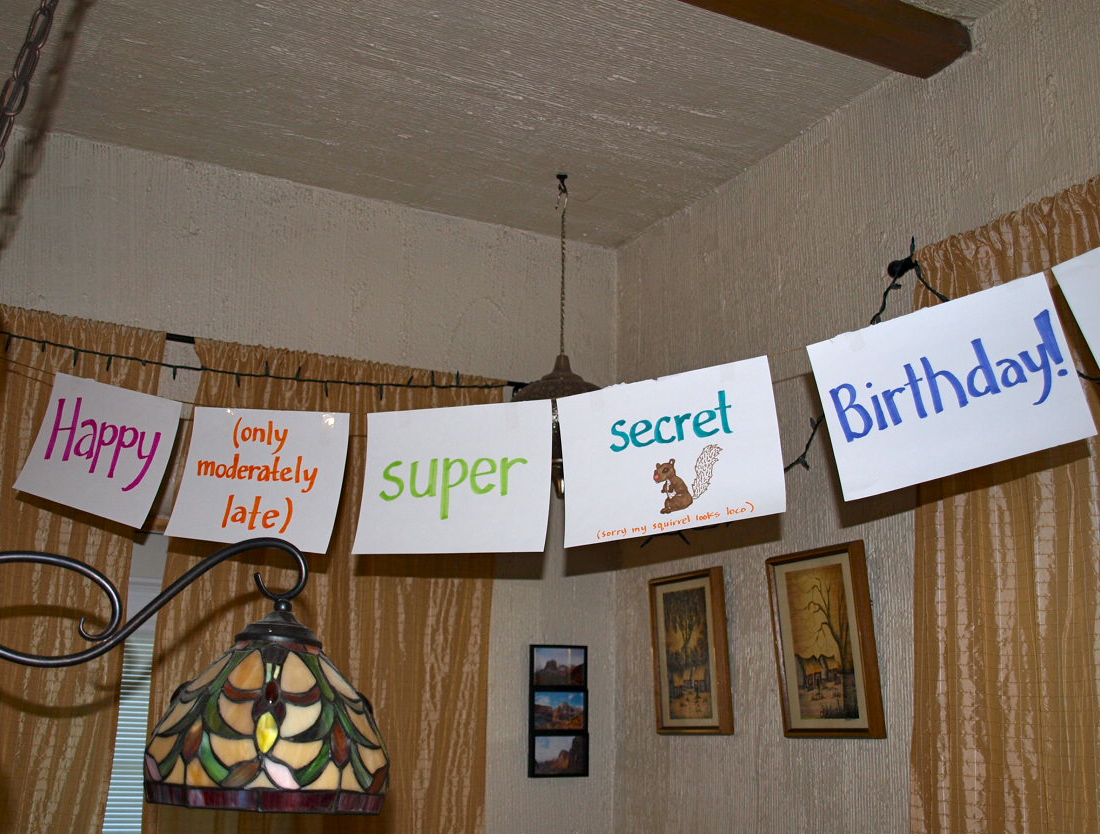
Recently, I orchestrated my greatest culinary coup yet.  I pulled off the ultimate surprise party – a belated birthday brunch for one of my dearest friends, Lori.  Lori and I started working together six years ago, both of us relocating from the South.  We quickly realized that living and working at a boarding school carry complicated dynamics, which are difficult to explain to those who live outside of the boarding arena and which sometimes impose tricky, uncomfortable situations within the boarding community.  Simply put, living at a boarding school is like being on reality television, 365 days of the year… Which is why it was a little amazing that the party secret didn’t leak two minutes after I distributed the invitations.

Part spitfire, part sage, Lori has helped me overcome countless emotional hurdles.  She mourned with me when I lost my mom, and she has coached me through struggles with my children and with some choice haters.  Her bright blue eyes positively twinkle with mischievous sass, but make no mistake: she is all heart. I knew that whatever I planned would have to be big.

Coordinating an in-house party for upwards of 30 adults and children requires planning and endurance. Logistics come into play, because summer vacations comprise a variable element in boarding school life.  When will the maximum number of potential guests return home from their vacations?  How many seats do I have available?  What if some guests RSVP and others don’t – what is an acceptable median for invitations extended?  And, most importantly, who should I invite?

The answer changes with each party and harbors an implicit caveat: everyone can’t be invited to everything, especially in a boarding school community, where faculty are united by chance, tamped into a fish bowl, and expected to accord in peace while living on-call, 24/7.  There are too many members in the community and too few venues in which to host events of such magnitude.  Ultimately, the decision falls on depth of experience – the friends with whom one has laughed the most.

When the day came, we hovered in a darkened corner of my living room, smirking when we heard Lori ask her husband, my co-conspirator, where everyone was.  He came in, nodded at us, and gave us the verbal cue: “I don’t know, honey… Maybe they’re all outside.”  She entered the room.  We yelled, “Happy birthday!” She twirled in a double take.  And we laughed all morning.

OLYMPUS DIGITAL CAMERA

© 2013 Julia Moris-Hartley

Leave a comment

Filed under food, literature, travel

Hummingbird Juice

Photo courtesy of Rory Hartley.

Photo courtesy of Rory Hartley.

In 1969, my grandfather built a log cabin in Featherville, a small town in central Idaho.  The cabin overlooks the south fork of the Boise River and its porch is, in my opinion, one of the pleasantest places in which to squander entire summer afternoons.  I sit on the cabin’s dusty wooden porch and try to read, though I am often distracted by the swooped flight of the osprey that’s built its nest on the opposite river bank or the low hum of a hummingbird hovering just over my head, suckling from a freshly filled feeder.

Each year, I look forward to hanging the feeder.  The hummingbirds arrive minutes after I’ve hung it, usually in rotating quantities of four or five: copper and shimmering; pale, silken beige; emerald and ruby-throated. I admire their slender necks, their Lilliputian black feet.  They chatter on high pine branches, dive-bombing each other with their tails flared.  Evolution has granted them more personality per centimeter than any animal I can think of.  I watch them with wonder, and try to memorize the buzzing rumble of their wings to recollect on a snowy winter’s day.  They speak to me of joy.

I was particularly glad to see the hummingbirds again this summer, because last year the cabin came uncomfortably close to burning down.  Someone flipped their four-wheeler on the dry tinderbox of Idaho’s mountains, and the heat from the exhaust pipe inadvertently sparked a forest fire that threatened thousands of acres and hundreds of multi-generational family homes and businesses. For weeks, fed by fiery sparks of grief and dread, I awaited the inevitable news: Sorry, ma’am, the fire claimed your family’s cabin. We tried our best, but in the end there was nothing we could do to save it.  September was a long, hopeless month.

I’ve been coming to the cabin since I was a baby.  As a child, I didn’t realize that a manmade structure could assume a living, breathing identity, though in my experience it has. I can’t fathom my family’s history – or myself – without the cabin: its pale pastel walls, like an osmotic tonic; the scratchy moss green couch; the brown checkered linoleum and mismatched rugs; the remnants, relics, and artwork collected during my grandfather’s medical career in China and Africa.  These details are enfolded into innumerable Moris stories and memories.  I can’t imagine a summer without this particular porch or hummingbird feeder.

Ultimately, the awful news never came.  Firefighters wrested control of the flame as it hovered on the edge of evacuated towns, leaving residents their homes and livelihoods in tact… for now.  The relief, however real, hasn’t eradicated my dread over the cabin’s impermanence or the irrational rage that flares each time a four-wheeler rides past the front porch.  This temporary reprieve tastes of tarred ash.

My riverside musings are a little heavier this year, sagging under the weight of erosion and lost tree limbs, but I take solace in admiring my spritely hummingbird friends.  Now more than ever, I hold tight to the sight of them to help sustain me through the next long year. I pray this won’t be my last batch of hummingbird juice.

Hummingbird Juice

4 cups water
1 cup sugar
Red food coloring to preference

Bring water to boil in a medium saucepot.  Remove from heat when water starts to boil and stir in the sugar. Mix well to dissolve the sugar.  Add red food coloring – a few drops should suffice. (This is an aesthetic choice. My aunt doesn’t color her hummingbird juice and she experiences a moderate turnout.  I attribute my heavy traffic to the red food coloring.)  Let cool, then transfer to a glass feeder.  Hang feeder in a conspicuous outdoor spot.  Enjoy.

© Julia Moris-Hartley, 2013

Leave a comment

Filed under food, literature, travel

Happy Cows

Chillin' with the girls.

Chillin’ with the girls.

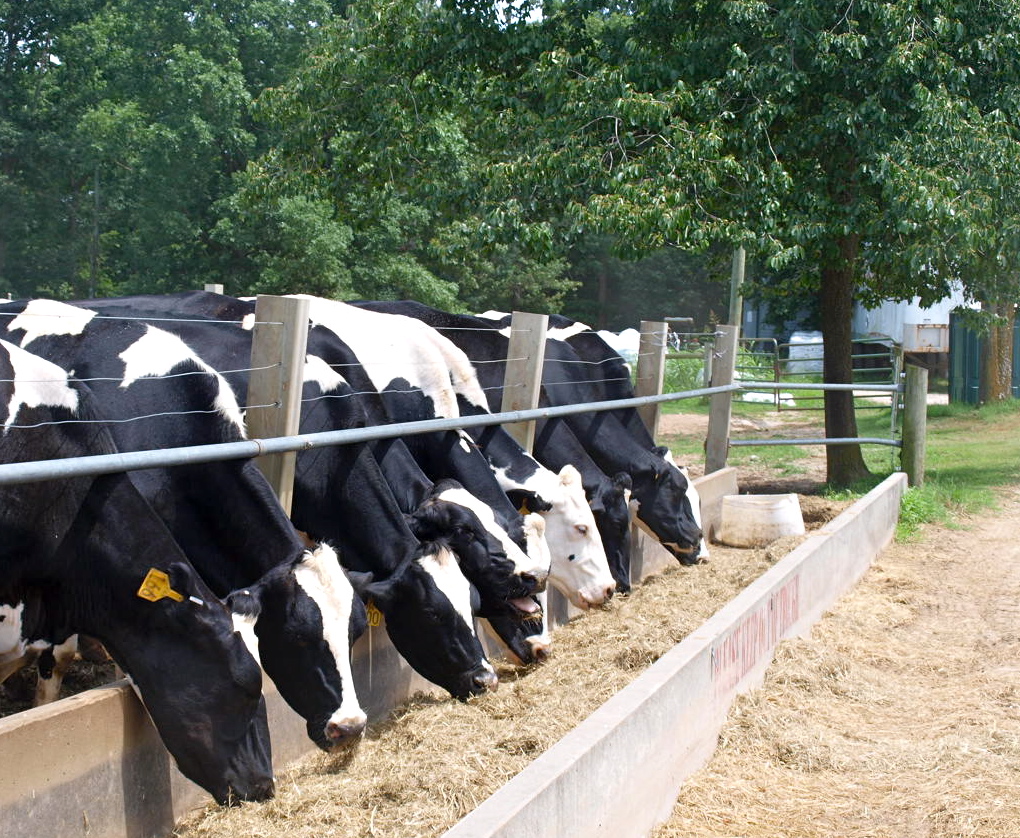
The cows outside the Happy Cow Creamery of Pelzer, South Carolina, aren’t smiling, talking to each other in conspiratorial tones, or comically misspelling words in large billboard print.  They aren’t doing much of anything, in fact, except snacking on grasses rich with alfalfa and clover under a grove of tall, shady trees.  The air is balmy warm and smells of grass.  Birds twitter from high branches.  I can’t say if the cows are happy, know that they are happy, or are capable of feeling happiness, but “the girls,” as they are affectionately called, seem relaxed and content to graze on this sunny June afternoon.

It took me a while, but I finally persuaded my mother-in-law to tour the farm and adjacent creamery with me.  Our tour group met under the shaded picnic area, where we boarded a wooden wagon pulled by a green John Deere.  As we gently jostled around the farm, three tour guides – Ashley, Suzanne, and Sonya – taught us about the farm’s history and the practices that have sustained its success, powering down the tractor at intervals to point out varieties in the grass and the beehives for honey production.  The farm prides itself on environmentally sound operation, and follows a method of herd rotation called 12 Aprils.  The herd of approximately 90 cows rotates through the farm’s 29 paddocks.  When the day is done and the herd has trimmed the grass of its nutritious uppermost tips, they are moved to another paddock to graze the following day. By the time they have rotated through all 29 paddocks, they return to the fresh regrowth of the first and begin the cycle of eating once again.  The grass regrows naturally, eliminating the need for fertilizers, and the cows benefit from the nutrients available at the tips of each grass blade.  The girls are milked twice daily, producing the vitamin- and enzyme-rich milk – full of fat and nutrients – that has contributed to the farm’s continued success and consumer appreciation.

Suzanne’s voice wavered as she recounted growing up by the farm and watching the cows move from paddock to paddock, expressing gratitude for having a local resource for healthy milk for herself and her family.  Ashley, a trim, no-nonsense blond, explained the process and effects of homogenization with such clarity that I understood it completely.  (Happy Cow does not homogenize their milk.)  Their smiles and easy, confident demeanors broadcasted their pride and sense of purpose.  As impressed as I was with the cows, it was quite something to witness how earnestly everyone we met at the farm wanted the business to succeed… and believed in what they did.

At the end of the tour, our guides handed out unlimited samples of the creamery’s milk.  The small children in our tour group scrambled for additional helpings of the chocolate and strawberry milk.  Judging by the giddy grins of the adults who sat around me, I suspected some of the “big children” considered asking for seconds as well.  Ashley handed me a paper cup of the creamery’s strawberry milk, winking and advising me that the small fatty chunks were the source of the milk’s “goodness.”  The milk tasted like heaven in a cup.

*

The Happy Cow Creamery operates an on-site store and distributes dairy products for sale in stores like Earth Fare, Whole Foods, and the Greenville State Farmers Market.  The farm and creamery offer tours to groups of twenty (reserved in advance), and receives visitors in the hundreds when schools tour the 100+ acre farm during the academic year.  You can find additional information on their website: http://www.happycowcreamery.com/

If you’re in the area, stop by and take a tour, and don’t forget to pick up a hunk of green olive cheddar cheese from the store.  It pairs excellently with Granny Smith apples.

OLYMPUS DIGITAL CAMERA

© Julia Moris-Hartley, 2013

4 Comments

Filed under food, literature, travel

Fortune Cookies

A scholar's writing lasts longer than a martyr's blood.

A scholar’s writing lasts longer than a martyr’s blood.

You have an excellent sense of humor. Lucky number: 13

I have a moderate book problem.  I inherited my addiction from my father, who suffers from a severe, raging book problem.  He spends hundreds of dollars on books each month, scouring book-buying clubs for the newest titles, the latest, greatest publications to acquire.  He views his acquisitions in terms of collections, and is continually searching for ways in which to improve his collections. His Africa collection is exhaustive, as are his Peoples of the World and Peoples of the American Southwest. He taught these subjects at Utah State University throughout my youth.

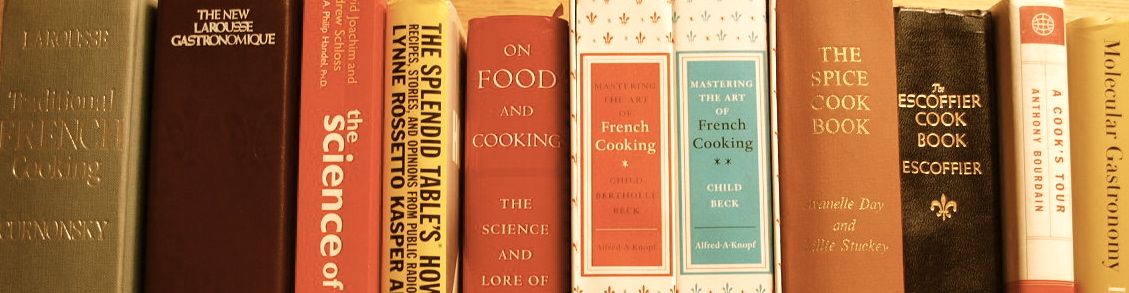
I go on book binges, but have not yet reached a point in my life where I can afford or find room to house hundreds of dollars worth of book purchases.  My only prized “collection” – of food writing and cookbooks – falls far short of comprehensive. Sometimes I make second-hand purchases, a practice my father finds reprehensible.  I can’t help myself.  Books comfort me.  I love their distinct printed smell, the silken heft of their pages.  I do not feel settled unless I can see their colorful spines, lined up in rows on my bookshelves and arranged alphabetically by author’s last name or, in the case of anthologies, alphabetically by book title.

Can a love of words really be transmitted through a genetic line?  My dad and I both love to read in general.  We’ll read anything we can get ahold of, and spend all day doing it if time and circumstance permit.  Though I didn’t grow up in my father’s house, we cultivated our relationship over summer breaks.  My mother showed little interest in books and she sometimes teased me – not maliciously – about my reading habit, which causes me to wonder if I picked it up casually through observation of my father (whose houses over the years were technically libraries with beds, measured in linear shelf space rather than square footage) or whether there’s something to the theory of genetic transmission.

Your smile lights up a room. Lucky number: 2005

Another thing I inherited from my dad: a button nose.  I got my mother’s hazel eyes, and my father’s round chipmunk cheeks and pert nose.  My sister and brother are also blessed with the nose.  I used to like my nose passively; it was something that made my face seem less plain in photographs, though I gave little regard to it otherwise.

A large black Chow subdivided my nose in 2005.  Thirty-seven stitches later, I retained a nose, with a board instead of a button.  It healed into something wholly unremarkable, except for the thin vein of white scar tissue that flashes like lightning over the bridge.  I actively appreciate my nose now.  Had I been standing an inch to the right or left, I might have been severely disfigured or blinded.

Recently, my daughter, who is six years old, contracted mono. (We live on the campus of a boarding school, and, as such, germs befriend one another quickly.)  I have never before been so acutely aware of her spleen.  The weight and worth of my daughter’s existence catapulted to the forefront of my mind.  Simple tasks like riding her bicycle to school or competing in team sports are out of the question for the time being.  Nothing is worth risking the rupture of this small internal organ.

The body is such a miracle.  My daughter will recover.  My nose remains in tact.   Sometimes it’s the misfortunes that make us feel fortunate.

You have lovely eyes. Lucky number: 2

As a writer, I rely on my eyes to gather the visual details I tuck away for later: the tufted dandelion sprout, floating in the air; the crooked upturned arm of my spiny blue cactus; the silhouette of a horned owl, high up in a tree against the blush of sunset.  My eyes revel in my son’s playful smile; they drink in my daughter’s freckled cheeks.  They are vessels that carry the words I read onto the vast, curvaceous rivers of my mind.  If the day’s first blessing is waking up, the next true blessing must be opening one’s eyes to the possibilities of a new day. Thanks be.

You are an enigma. Lucky number: ?

Research for this essay returned me to a book I hadn’t read in years: Amy Tan’s The Joy Luck Club.  In a chapter titled “Double Face,” one of Tan’s characters, Lindo Jong, recounts sifting through potential fortunes at the fortune cookie-making factory where she once worked, in the hope of finding one that would elicit a marriage proposal from her beau.  She selected a fortune that read: “A house is not home when a spouse is not at home.”  Her clever plan succeeded.  The next day, her boyfriend asked, “Lindo, can you spouse me?”

My research also brought me to an article about the largest producer of fortune cookies, Wonton Food, Inc., which distributed over four million cookies a day in 2005.  That amounts to nearly a billion and a half cookies annually!  Who eats them all?  My theory is that most people – excluding children, who would eat cardboard if it tasted moderately sweet – are more interested in the fortunes than the golden cookies themselves.  Sometimes the messages resonate; sometimes it’s the lucky numbers. In 2005, lucky numbers won 110 people sums of approximately $100,000 each in a single day’s Powerball drawing.  The accompanying fortune?  “All the preparation you’ve done will finally be paying off.”

I don’t harbor strong feelings about fortune cookies, but I love the intrigue they hold within.  Maybe if I had taken the time to read a fortune on the day of my new nose, it would have read: “Beware of inauspicious strangers.  The admiration of their beauty wields a deleterious cost.”

All the preparation you’ve done will finally be paying off. Lucky number: 2013

My dad once advised me to prepare to hold at least three professions in life.  The changing world, he said, required adaptability.  To date, I’ve worked in about twelve positions – with vastly different titles and responsibilities – without interruption (and sometimes simultaneously).   My love of words has threaded through each of my professional incarnations.  I am very grateful to possess a skill that benefits myself as well as others, and buoys me, despite sharp changes in the economy and employment rates.

Right now, I teach Humanities to a gregarious group of middle school students.  I have no idea how I got so lucky in this latest gig: not only do I get to read and write, I get to geek out about reading and writing with young, enthusiastic minds!  Together, we explore worlds that are so different from our own with characters who are so similar to us.  I love when my students ask questions about the text and I can literally see their imaginations flare.

I do not know what the new school year will look like for me, but I hope that the long weekends of lesson planning and grading will pay off.  I hope that this year of channeling my own creativity into the creativity of others will not have been in vain.  In truth, I have missed the freedom to write and read on my own schedule.  I have missed marching into the grocery store; sweeping ingredients into my arms, like long lost lovers; and coming home to a joyous orgy of cooking and photography.  But I have also cultivated positive relationships with seventeen great students.  I’ve learned a lot about what it means to be a teacher… and learned that the process of learning never really ends. Nor does the adaptability of my spirit.

I face the fortune ahead of me with gratitude and optimism.  My love of words has yet to let me down.

© Julia Moris-Hartley 2013

1 Comment

Filed under food, literature, travel

The Ort Report

OLYMPUS DIGITAL CAMERA

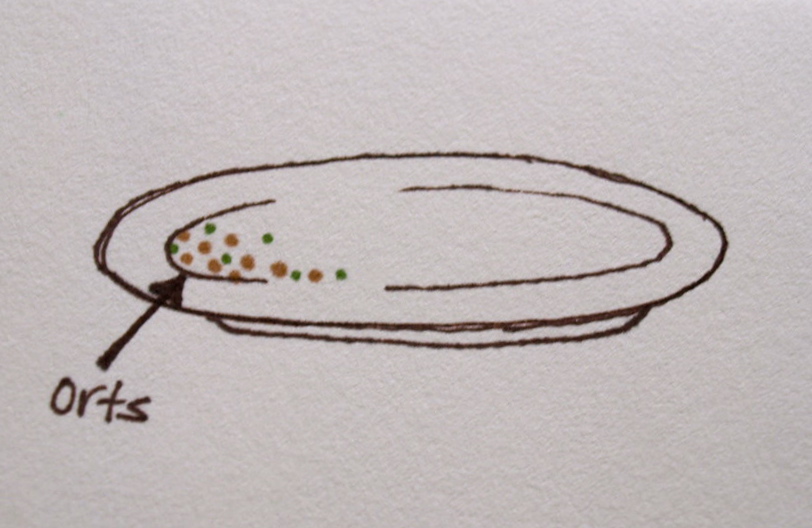
Ort: Noun. A scrap or morsel of food left at a meal.

Recently, I accompanied two other faculty members and our entire class of 17 middle school students to a 255-acre outdoor learning center called IslandWood on Bainbridge Island, Washington.  We spent three activity-driven days, exploring the island’s lush forests and challenging ourselves to learn from the natural world.  We hiked a lot and sampled native plants, such as stinging nettle leaves and salmonberry blossoms.  We spotted wrinkly, orange-bellied newts and thumb-sized green tree frogs.  We listened for the chipper call of the bright yellow American goldfinch, the state bird of Washington, and picked up a few songs to carry home with us, among them “The Ort Report”– arguably the most memorable tune we learned in our time at IslandWood.

I had never heard of an ort.  I certainly had not given much thought to tiny scraps and morsels prior to learning “The Ort Report,” which we sang after every meal served in IslandWood’s spacious dining hall.   Here are the words to the song:

Ooh, ahh, the Ort Report,
I said a-ooh, ahh, Ort Report,
Jiggy jiggy jiggy.
(Repeat twice, and don’t forget to swish your hands in the air during the jiggy part.)

The song’s mission is simple.  It introduces visitors to the concept of eating “just enough” – not so little that one is left hungry, nor so much as to prompt the loosening of any belts – and leaving fewer orts on our plates.  Though most of the students visiting IslandWood with us were fourth and fifth graders, who, because of their age, might be more prone to giggling, even our middle schoolers couldn’t camouflage their goofiest, lopsided smiles when we sang the song. That is brilliant marketing.

Not that the IslandWood dining hall markets anything except reduced food waste.  We ate family-style, each table served by a “captain,” who fetched heaping bowls of food from the kitchen and brought them to the table for us to share.  Once everyone received the first round of platters, Deborah, a tall strawberry blond who facilitates dining room affairs, encouraged anyone still hungry to claim second helpings.  IslandWood welcomed us to eat as much as we pleased, but issued gentle reminders – through Deborah – to eat “just enough,” so that we weren’t sluggish and inobservant in the field.  After meals, we sorted our plates according to food and liquid waste, compostable matter, and dirty dishes.  Deborah and a rotating group of student helpers then weighed the food and liquid waste, and revealed the findings to the diners, prefacing their announcement with “The Ort Report” song.  We (in all, roughly 200 visiting students and teachers from four schools) wasted about ten pounds of food and liquids after our first meal.  By the end of our short visit, we’d lowered our waste to two pounds.  Brilliant.

Deborah also taught us a lesson in fractions, whittling down an apple to a sliver of 1/32nds.  The apple represented the earth.  The sliver: the portion of the earth available to grow the overwhelming majority of foods we enjoy today.  Deborah prompted us to consider how much food gets tossed into the trash, un- or half-eaten, each day… at schools, restaurants, hotels, hospitals, airports, and in our own homes.  I can’t speak for others, but seeing that tiny apple sliver in Deborah’s slim fingers profoundly reinforced the notion of leaving behind far fewer orts.

Several of the middle school students returned from the trip with an interest in changing food practices in our own dining hall. They serenade me with “The Ort Report” in class.  Their smiles and laughter remind me that it’s not too late to decimate the ort population and stop eating at “just enough,” even if it’s just a few of us making that personal choice.  I’d do almost anything to make their world a bigger, better, longer lasting place.  The journey begins at breakfast.

1 Comment

Filed under food, literature, travel