Singing Kettles

Ten years ago, I wrote an essay about Featherville, Idaho.  In the essay, I mused whether Featherville, an old mining town small enough to be omitted from most maps, teetered on the verge of death like Rocky Bar, the nearby ghost of a gold-mining hotspot, or whether it would thrive like its eastern neighbors, Ketchum and Sun Valley. 
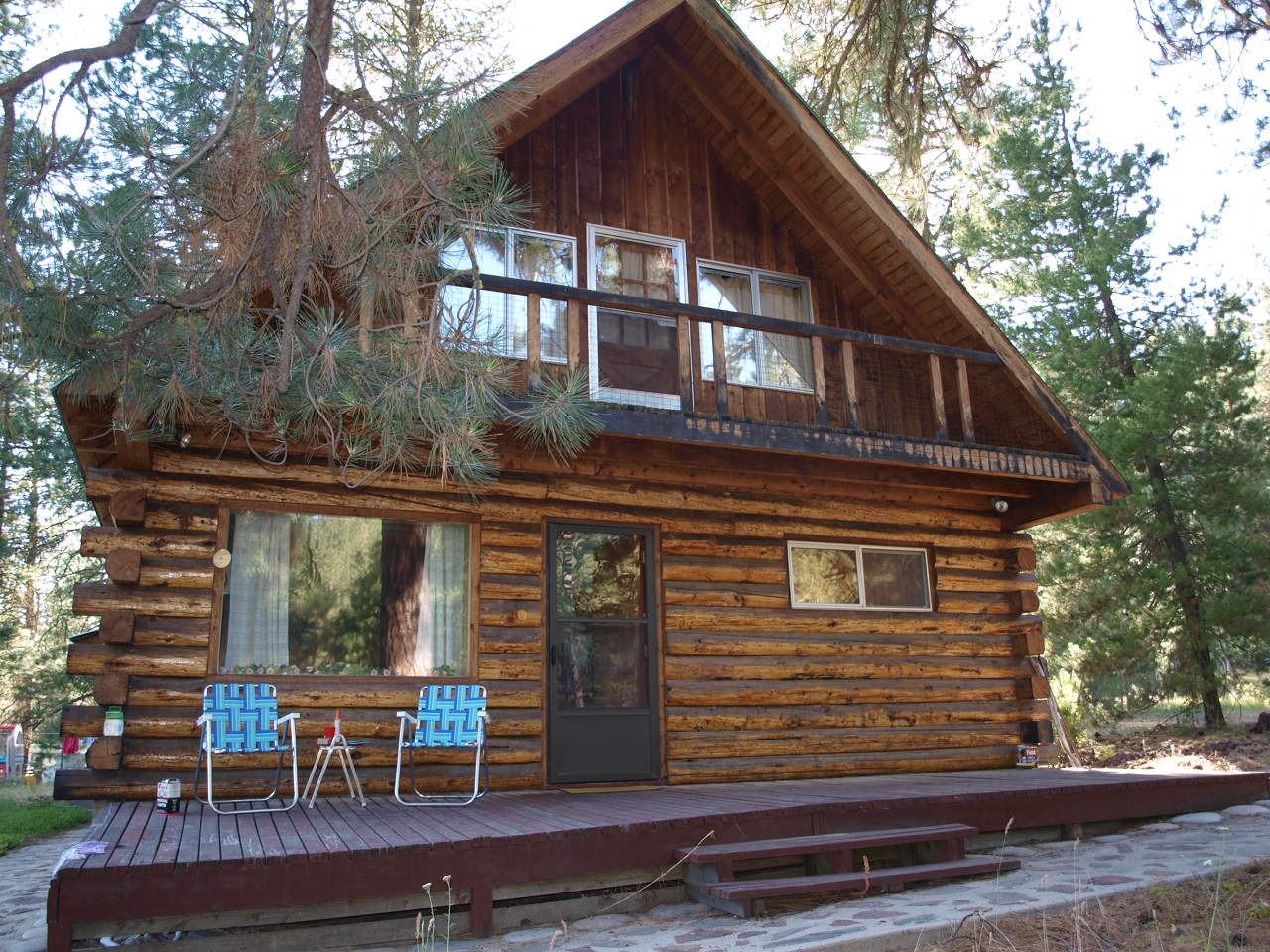
As it turned out, Featherville thrives.  Its population has proliferated in direct relation to the shrinkage of its wild spaces.   There is money again in its economy; there are fewer foxes, elk, wolves, mountain lions, and bears.  The cabin that my grandfather built in 1969 consumed a small portion of this same wild space whose loss renders me a bit tetchy; it is among the long list of Things For Which I Was Not Responsible But Still Feel Guilty About. But I can’t imagine the cabin not being there. Featherville is in my blood. 
Charlie Baker, grandfather to many of my Idaho friends, opened the area’s real estate in the late sixties with properties known as Baker’s Acres.  My grandfather, who worked as a physician at the Gooding Hospital in Gooding, Idaho, met Mr. Baker through shared friends.  Grandpa visited Featherville at Baker’s urging and was immediately enthralled with the area. He quickly purchased the cabin’s current plot at the edge of the wild from Baker.  My grandfather and Mr. Baker were close allies in the development of Featherville, as were grandpa’s descendants and Mr. Baker’s: the McCoys, the Browers, and the Lancasters.  
Grandpa built the log cabin with his second wife, Edith, at the outermost boundary of Featherville, on a plot of land that adjoins the National Forest Service.  There is a Forest Service turn-around point for vehicles just beyond the dividing line, and many campers have tried – some successfully, some unsuccessfully – to make the space an unofficial camping spot.  When I am at the cabin, I become almost pathologically vigilant about preserving the sanctity and serenity of the cabin, staring coldly towards the drivers of vehicles that stop at the pullout in front of the house. 
I feel proprietary of Featherville and of the cabin.  Featherville has been my family’s special place for over forty years.  I have seen the town’s general store move from one side of the road to the opposite side, then back and over again, and have seen several incarnations of it open and close. The problem with seeing all the changing hands of businesses as they begin and consequently end is that I know and remember all of the owners and all their spaces, but the new owners and spaces don’t remember me, because I am only at liberty to visit Featherville occasionally.  To them, I’m not an insider; I am an outsider.  The dichotomy is discomforting, compounded by the gradual loss of the older generations of families with whom my family shares a long history.  What right do I have to bulldog the open space in front of the cabin when I’m only visiting for a week?  And yet, feelings bubble to the surface: Get out of here!  Don’t you know you can’t camp there?  Do I want to see your face when I go out for my run first thing tomorrow morning?  I can’t seem to correct my attitude, though I know it is unfriendly, uncharitable, and ultimately beyond both my control and my right.
The cabin is a fixture in the Moris family – a place for retreat and meditation, for reunions and large communal meals.  Its history is important to me.  Edith frequently preached from the small wooden pulpit of the town’s Little Church in the Wildwood; every Sunday, I sat on one of its chilly wooden pews and admired the colorful decals of stained glass affixed to its windows.  I learned to fish down in the river with my aunt Pat.  As children, my siblings and I played countless games of Scrabble with the grown-ups at the large dining table, late into the night with moths and mosquitoes illuminated against the darkness through screened in windows.  Grandpa had an uncanny talent for scoring triple word points and deftly dispatching all of his letters at once with words that we dared not challenge.  (We would have been wrong.)  So many photos have been taken on the front porch – small children becoming, in each advancing shot and in various stages of dress and preference, the next generation of adults, bringing with them their small children. The porch is, incidentally, the perfect place to drink kettle-boiled coffee while looking for chipmunks, foxes, and deer in the crisp morning air as the sun rises over tall pine trees.
Sharing the traditions of the cabin with my children helps to settle my inner grizzly.  We sit on the planked steps of the front porch: our shoulders awash in sunlight, watermelon juice dribbling down chins and arms.  We scout for chipmunks.  We stand on an overhang above the river, which rushes fast, full, and freezing cold in green pools below us; we toss rocks into the deepest parts, hoping to scatter a bright red prism of kokanee salmon.  We read together.  At dinnertime, we gather at the big table and eat simple food: spaghetti with oniony tomato sauce; thickly sliced white bread with salty butter; chicken breasts marinated in balsalmic vinegar, oil, garlic, and fresh rosemary; whole cobs of sweet summer corn.  My daughter serenades us throughout meals with “DJ Got Us Fallin’ In Love Again” (she is four and only knows the chorus, but she sings it with gusto). My son invents new jokes – primarily variations on the theme of ‘banana, banana, orange.’  We all vie to sit closest to the window so that we can watch the river as it rushes below.  The sound of water is a salve.
In a moment of insanity that struck just after my son was born, I thought I could forsake Featherville and the cabin.  Grandpa bequeathed his children and grandchildren equal stakes in the cabin, and we are all, more or less, collectively responsible for its maintenance and taxes.  My family – and fellow shareholders – urged me to wait a while before I relinquished my share. Thank God that they did. 
The cabin has no television.  The record player plays limited LPs crisply (my favorites are Swan Lake and The Sound of Music); it also receives limited radio transmission, but only during sunlight hours.  The phone receives incoming calls but dials out only locally. There is no such thing as Internet or cell phone reception.  Furnished as it is with items from the early 70s – lots of loud oranges and avocado greens – the cabin is a place where we cook, read, and talk.  We scale the steep bank just beside the cabin and go to the river to fish or play in sand for our entertainment. We hike frequently and are, as a family four generations strong, characterized by an irrepressible enthusiasm for spotting wildlife.
The first thing we do upon arrival at the cabin – after the obligatory opening of curtains and turning on the water heater – is set a pot of water on the stove to make ‘hummingbird juice,’ a sweet concoction of four parts water brought to a boil into which one part sugar is dissolved.  Several drops of red food dye are stirred in.  Once the mixture cools, we transfer it to a hummingbird feeder and place it at the corner of the porch, hanging about eight feet up so that we can watch it throughout the day whether we are indoors or out.  The hummingbirds are reticent at first, hesitant to be near us, but they quickly overcome any concerns.  I delight in watching Lilliputian feet pressed against downy soft abdomens as they whiz around the feeder, taking small sips and chasing one another away.  I have a particular soft spot for the copper-colored Rufous with the Napoleon complex.
On a recent visit, I observed two long-eared, black-tailed squirrels engage in an extended “conversation” regarding the triangulation of the coordinates for the stack of peanuts I stealthily placed on the porch in order to attract these very same creatures.  I vacated my seat on the porch for 15 minutes and every single peanut (there were about 30 in the stack) had disappeared.  My brother used to attract the smaller, striped chipmunks in this manner, eventually coaxing them to eat the peanuts directly from his open palm. 
The garden, a small allotment of land adjacent to the cabin, once grew strawberries and wildflowers.  I think it was Edith who nurtured that garden in the woods; she spent a lot of time by herself at the cabin and her love for the place was evident in her care of it.  Now the garden area is overgrown and thick with fallen dried pine needles, but I remember peering under the white strawberry blossoms and dainty green leaves to find those small red berries growing in their shade.  I think of Edith as I watch my daughter kneel in the dirt on the garden path, gathering sticks and rocks for one of her many archaeological ‘collections.’ 
Though grandpa remarried after Edith’s death in 1982, Edith is, technically, my grandmother, and I have gathered from family recollections that she was instrumental in bringing my mother and I from Africa into the United States when I was a year old.  She constitutes my first real memory, except that I am not sure whether it is a memory or a dream, because I was very young and, according to my mother’s journals, she died quickly after.  I can still see Edith entering my childhood bedroom at night with the lights off – her body a slight outline against the light from the hall, her bare scalp swathed in a polyester turban – sitting down on my faded Holly Hobby blanket and stroking my hair.  Hair stroking was the only consistent means to put my son, who was colicky for his first six months, back to sleep as I tip-toed out the door each morning to work.  I can’t seem to resist stroking my daughter’s hair, though the act probably soothes me more than it soothes her. 

Maybe the element of comfort is what binds me to the cabin, the familiarity of these ghosts of remembrance.  Maybe it is the repetition, the little, compelling indulgences of tradition.  As an adult, I understand why Edith so often surrendered herself to the cabin’s silent allure.  Grandpa chopped and stacked the firewood in the back of the house for her; Edith used the wood to keep the cabin warm during her extended stays, when snow packed itself halfway up the roof and everything was quiet and still except for a hot kettle singing on the stove.  She sometimes returned to Grandpa weeks later, bringing with her the tranquility of solitude, the joy of reunion, and the certitude of her return to the place she loved so well.
Leave a comment

Filed under food, literature, travel

Untested Recipes

My mother and I shop for groceries at Key Foods every Saturday morning.  Mom lugs a wheeled portable navy blue plaid fabric handcart behind her.  The cart will be full in one hour, when we return home. I am eleven and taller than my mother by several inches, so my eyes skim above the billow of her short grey hair as it moves in the breeze on the way to the store.  Mom wears no make-up, but shapes her eyebrows into black arches that hang like severe punctuation marks over her almond-shaped hazel green eyes.  Her lips are pale oleander petals.  She dresses in demure polyester beige slacks and a white cotton jacket, but she categorically refuses – as she will throughout her life – to wear flat shoes or sneakers for the weekly chores.   Her gold-embellished platform sandals clack on the sidewalk ahead of me.  I love grocery shopping with my mother, except for every Saturday at Key Foods.
The middle-aged butcher materializes as we round the corner from the produce aisle.  No matter how quickly I rush past the butcher counter or if I evade the area by circling the opposite end of the aisles, there he is, calling out to my mother, who then calls out to me. The butcher wipes his hands on a stiff white apron, raises a sausage-like hand in greeting. His arms are plush and heavy with dark hair.  His olive skinned face is unlined and smooth, with two large black caterpillars hanging over bloodshot blue eyes.  
“How are you today, Valentina?” he asks.  “Fine, just fine,” says Mom with a smile that is simultaneously innocent and flirtatious.  I force myself to study the scuffmarks on the grey linoleum floor, but still I feel the butcher’s eyes rest for several long seconds on the tiny buds of my breasts underneath my shirt. They have just started to grow and, to my extreme mortification, my mother refuses to allow me to encase them in a training bra.  “You and your daughter are looking lovely as usual,” he says. Mom’s appreciative laughter twinkles like radiant spring sunshine. I look up and see that the butcher’s eyes have settled on the zipper of my black acid-washed jeans: just where they do every week; just as if I am a piece of tender pink lamb. “Your daughter,” he says.  “She is growing so quickly…”
Mom talks to the butcher for a few minutes more, asking me questions to include me in the conversation.  “Yula,” she says. “Tell him what you’re studying in school these days.” I want to please her, to oblige, but something that feels close to fear and not far from revulsion crystalizes inside me.  Mom tries again a few moments later: “Yulichka, dear, the nice man just asked you a question…” Her eyes implore mine. I have no words for her… or for him.  As we walk away, Mom’s breath scalds my ears, hissing and spitting. “Ju-li-a,” she scream-whispers. “You!  Are!  So!  Rude!” 
*          *          *
I am standing outside my daughter’s bedroom, peering at her through the open door.  Rory is four.  She is very thin and very tall.  She sleeps on her back – her arms spread widely on either side – and snores quietly atop her flowered sheets.  Her golden green eyes flit underneath closed lids; long, honey-colored eyelashes rest on her fair, finely-freckled cheeks.  She has pushed her amethyst curtains open so that the afternoon sun streams into her room, and she has lined every inch of her bed’s perimeter with stuffed animals: her “audience.”  Her small, bedraggled hand puppet, Eeyore, rests on the Dora pillow by her tousled head.  I can hear my neighbors mowing their lawns as Rory naps, smell the freshly cut green grass wafting through an open window.  Sunlight, spring grass, my beautiful, irrepressible daughter lounging in peaceful repose: these are all wonderful things, but I am wrenched by fear.  One day, sooner than I would ever wish, Rory will encounter all of the contradictions involved with becoming a young woman and there is nothing, absolutely nothing, I can do to protect her.
*          *          *
Mom takes me to Italy when I turn fourteen. Shortly after our arrival, Mom meets an Italian man named Sandro at a train station in Rome.  Sandro is in his late-twenties. He wears a button-down shirt with rolled-up sleeves, khaki shorts, and supple brown leather sandals. Thick, black hair frames his face.  Whistles blow all around us.  Steam hisses from the tracks; the air is heavy and hot.  I admire the metal beams and windows overhead. Italians hustle, jostle, and press: hoisting luggage, gesticulating with their hands, speaking a language I don’t understand.  I smell espresso and sweat.  Mom somehow engages Sandro as an impromptu tour-guide while I try to reorient myself in the strange, thrumming world around me. 
After roaming the streets for some time – Sandro casting his arms one way and another as he explains the sights – we seat ourselves at an outdoor café with dark blue tablecloths that flap crisply in the wind.  Sandro sits directly across from me at the undersized four-person table, engaging my mother in conversation.  “I am so proud of my country,” he says with a thick Italian accent, lips curling up in a sultry half-smile.  He presses one of his legs against mine.  I feel the scratch of his hair, his hot, moist skin. “We have such traditions,” says Sandro.  “We love the family life, we love to eat and to drink!”  Before I think to react, his other leg traps my legs in between his.  My mother’s laughter flutters through the air; I know she is happy for the company and for the respite from the punishing obligations of real life. 
“We love the beauty,” says Sandro. “We love the great amore!” Under the table, Sandro’s fingers traverse the tendons and muscles of my left leg.  The birdsong in my mind grows silent.  I glance at my mother, who sits to my right; she sips water from her glass and leans back in her chair, smiling at Sandro.  Later in life, I learn that fourteen marks the threshold for Italy’s age of consent, but I do not know this as I eat an early dinner with my mother and a stranger in this foreign country.
I straighten my back.  My body betrays me: I’d have green lights down to my toes if only he was my age; but he isn’t and I don’t.  In fact, I have never felt such a strong urge to backhand someone.  Sandro’s hand retreats with caution after taking in my warning glance, but his legs remain with confidence.  He lights another cigarette – flicking his gaze toward my mom but resting it evenly with mine – and says: “You know, Valentina.  I have this beautiful cottage on a lake in the north.” He exhales a plume of smoke.  “You and your daughter should come see me there!  What a nice time we would have!”
*          *          *
My current strategy is this: teach Rory to fight dirty when (and only if) the situation truly warrants it.  Teach her how to execute a respectable one-to-four; teach her to go for the groin in self-defense; teach her the vocabulary of being brave and strong in the face of fear and bullying, whether she is the target or not.  But also: teach her how to use her words to drop kick, and teach her to thwart danger with unspoken threats from the daggers of her eyes.  My strategy forgives Rory for responding petulantly to perverts and letches; it gives Rory the big OK to resist any comments, leers, and jibes she finds untoward or humiliating to herself or to others.  Basically, my strategy so far is to create a young Black Ops superspy with crazy ninja skills, a keen mind for social nuance, and a rock-hard body empowered with self-sufficiency, discipline, and strength.  And I thought my mother had high expectations for me.
*          *          *
I am standing on the elevated platform of the A train at Rockaway Beach.  It is a cold November afternoon, the sun hard and white in the pale grey sky.  Wind whips my ruby-red hair around my face, blows wrappers and trash along the tracks below.  I am seventeen.  Tommy stands too close to me, yelling.  Tommy is brown through and through: brown moppish hair that falls into his eyes when he tilts his head just so; large brown eyes; golden brown skin that stretches on long, taut limbs.  His thin, beautiful fingers are bones and nails bitten down to nubs.  Tommy is the jokester in our circle of friends, and, when he tells a funny story, his skeletal arms flail around him and his full, mulberry-colored lips waggle dramatically.  Tommy introduces me to Star Wars and Baskin Robbins gumball ice cream.  I don’t like Tommy at first… until I find that I like him too much. 
Tommy stands at least a head taller than me.  He holds the white plastic shopping bag that I have given him in his right hand, waving it frenetically around as he yells.  It crackles and flaps in the cold wind.  He keeps asking me: “Why?”  The bag contains one silky pair of women’s underwear, a timeworn pair of purple fishnet stockings, every gift Tommy has ever bought for me, and every love letter between us.  He knows why.  I peer wondrously into the deep maple pools of his eyes.  I mash my hands to my eyes to break the compulsion.  Tommy yells: “Tell me why!”  People shuffle reluctantly down the platform, eyes averted.  He knows.  I want to tuck myself into his arms to hear his madly fluttering heart, feel his great heat; I want to rip out his eyes, thrust them onto the dirty tracks.  I want to say: Was she worth it?  When the train comes, I board it and Tommy doesn’t follow.  I sit in a corner seat so that I face as few people as possible and sob hysterically for the duration of the long, long train ride home.   When the train arrives at my station, I stand up, sit back down, stand up again.  A cop standing by the worn metal subway doors leans towards me, pats my shoulder, and says, “Don’t worry, hon. It’ll get better.”
*          *          *
If Rory asks, I will tell her: Sometimes it gets better and sometimes it doesn’t.  Sometimes you grapple with the choices you have made, even if you made all of them correctly.  Sometimes you feel inexplicably sad when, by all accounts, you should be happy; and sometimes you feel happy, though others believe that you should be sad.  Sometimes, you forget the sweetness of a first kiss and relive only the firm pressure of the door as it closes behind you.  Nothing is ever as tidy and straightforward as you would like it to be.
I will pray that I can be strong for Rory when she needs me to be strong, and soft with her when she needs a little extra cushion of surety and safety.  I will pray that she makes smart decisions and forms lasting friendships; that her sense of empathy, humor, creativity, and intelligence grow in oversize proportions as she grows into the woman she is to become.  I will savor my daughter’s sweet embrace and her irrepressible warmth.  I will rejoice every time she etches an indelible love note on the landscape of my heart. 


4 Comments

Filed under food, literature, travel

Alphabet Soup

A = Asafoetida
Harold McGee writes that asafoetida is “the strangest and strongest of all spices,” bearing a “strong, sulfurous aroma reminiscent of human sweat and washed-rind cheese.”  Asafoetida is also referred to as stinking gum or devil’s dung, which gives an approximate idea of its odor prior to cooking, though I’m told it’s actually very nice when cooked.  In college, I worked in a market that sold herbs and spices by the ounce.  We kept the spices in Kerr jars with gleaming golden lids.  The market is no longer there, and, even though I really didn’t enjoy the aroma of refilling the asafoetida jar, I mourn its demise.
B = Blood
My son, Kai, is learning to read, and, as part of the process, I am relearning to read.  Kai reads the word blood as ‘blewd.’  This makes sense: ‘oo’ means ‘ooh.’  It fascinates me to watch him as his brain picks through the intricate web of the English language, which has so many different, conflicting rules governing simple combinations of letters.
C = Ciabatta and Chop Suey
The word ciabatta makes me want to kiss someone.  I admire the sound of the word as much as the bread itself; not many words produce a similar effect.  Ciabatta also awakens my irrepressible affinity for word play: Ciabatta incites in me a cacophony from the cockles of my heart to the core of my coccyx.  Never dangle enticing words in front of a word lover: terrible consonance results. 
Chop Suey is my favorite food to slander when my self-esteem draws low.  I say, “What am I, chicken chop suey?” and everyone laughs.  Except maybe me.
D = Decrashuns
Kai wrote his first story in kindergarten this year.  I was proud to the point of bursting.  Here is his story: “It was my dad’s birthday but my mom was sick so I went to the stor to by partey decrashuns and a cake.  My dad was so happy he gave me a big hug.”  This story is gloriously original and bears only two falsehoods: I am rarely sick and Kai cannot drive.
E = Effervescent
I am ebulliently and effusively effervescent. 
F = Fava Beans
Quick!  What’s the first thing you think of when you hear ‘fava beans’?  For me, it will forever be chianti.
G = Ginger 
Great rhizome, great dried spice, great color, great adverb.  Also, my favorite character on Gilligan’s Island. 
H = Hasenpfeffer
According to my dictionary, hasenpfeffer is “a stew of marinated rabbit meat garnished usually with sour cream.”  It comes from the German words: hare’s pepper.  I have never eaten hasenpfeffer, but I like to say the word.  It reminds me of that Loony Tunes episode where a heavily abused Yosemite Sam fails to procure hasenpfeffer for the angry king and Bugs Bunny uses his wiles to trick the king into thinking that carrots are hasenpfeffer.  The episode was called “Shishkabugs.”
I = Ibis
An ibis is a bird that has long, stick-like legs and a long curved beak; is indigenous to waterways; and was at one time revered as sacred.  The Ibis is also the name of the shop I worked in throughout college.  I started there as a barista, but found that I preferred working on the market side.  In addition to the herbs and spices we sold, the market offered fresh feta cheese and olives by the pound, bulk dried beans and rice, and various gourmet items with pretty French labels, which at the time I considered very exotic.  I didn’t appreciate those beautiful raw ingredients enough during my years working there.  Sulfurous asafoetida powder, dried juniper berries, lovely stars of anise, red lentils, adzuki beans, basmati rice… The market no longer exists; it has since been remodeled into a more profitable café venue.  Sometimes I feel like a jerk for not fully appreciating all the market had to offer.  See also Idiot.
J = Juniper
Juniper berries make me think of my ex-boyfriend Jeff – all the hard, spicy ways we fell apart.  He was a chef.  He looked at me like a starved wolf.  I should have known better. 
K = Kodachrome
I don’t care what anyone says about Paul Simon.  I am physically unable to prevent myself from singing the “Kodachrome” song when I hear it.  I hear this song and dance through grocery store aisles; I hear this song and have never felt happier to see English muffins and small white tubs of Greek yogurt.  What is wrong with expressing appreciation for nice, bright colors and the greens of summer, for thinking that all the world’s a sunny day?  What do I care if a musician writes a song that is actually – heaven forbid – financially profitable?  Why do people have to be such haters?
L = Libation
A shot glass delivers a Lilliputian libation.
M = Mother
At the Ibis, we kept olives brined in large gallon jars, which we stored in refrigerated cases, shielded from the sun.  The brines sometimes harbored strange substances on their surfaces.  When I brought these particulates to the attention of my boss, she shrugged and said, “Oh, that’s just the mother.”  I thought I misheard her.  I have sifted through many dictionaries and encyclopedias, learning nothing about mother except this possible connection: “noun: a stringy, mucilaginous substance consisting of various bacteria which forms on the surface of a fermenting liquid and causes fermentation when added to other liquids, as in changing wine or cider to vinegar.” Harold McGee says nothing about mother, but notes that olives are often fermented, requiring a “slow alcoholic fermentation that takes as long as a year.”  Since my former boss was – and is – a very knowledgeable person with epicurean savvy well ahead of her time, I readily accepted her diagnosis of the state of the store’s olives.  Now you know.  That weird-looking scum floating on top of the olive brine?  That’s mother.  “Mother” is also a kickass Danzig song.
N = Nicotine
The Science of Good Food reports: “Eggplant, one of the more benign members of the notorious nightshade family, is neither addictive nor poisonous like its relatives tobacco leaf and deadly nightshade…  Eggplant contains more nicotine than any other vegetable, about 0.01%, which is negligible compared to the amount inhaled through passive smoking.”  Now I understand my fondness for eggplant – it’s magically addictive.
O = Olives
Not to harp on olives, but did you know that olive trees can live for a thousand years?  The University of Arizona campus in Tucson, Arizona, is thick with well-established olive trees.  In the spring, small bright yellow flowers blossom on green branches. The exposed roots of the tree’s trunks are gnarled, welcoming seats for those in need of shade. 
P = Poppies
Morphine is derived from the opiates contained in poppies.  My husband, who recently experienced the intense pain of kidney stones, says that morphine is the greatest substance on earth; ergo, poppies are medicine’s greatest flower.  According to him, the morphine administered to him in the Emergency Room took his pain away in 30 seconds. 
We have a poppy patch in our backyard.  As summer approaches, the patch shoots out pale green, alien-like egg-shaped sacs on long spindly stems.  Everything is covered in dense fuzz.  On one special day in early summer, the luscious red flowers ‘pop’ open, revealing their black pollen in a glorious, fleeting display.  I imagine the effects of morphine on my husband were much like that ‘pop’: so lovely, so ephemeral.
Q = Qua
Here are five words you can play in Scrabble when you have a ‘q’ but you don’t have a ‘u’: qaid, qindar, qintar, qiviut, and qoph.  Qua is also a good word to play, but only if you have a ‘u.’
R = Rhubarb
Harold McGee writes that rhubarb is “a vegetable that often masquerades as a fruit.”  Olives, avocadoes, corn, okra, plantains, and tomatoes are fruits that masquerade as vegetables.  Mushrooms fall into neither category because technically they are fungi.
S = Salt
One adds salt to a sweet recipe because it intensifies the qualities of sweetness.  I add salt because it reminds me of living in St. Augustine, which has very nice beaches.  When my children were little, Kai chased sandpipers down the shore, and Rory and I knelt in shallow tidal pools, admiring minnows and hoping to see little crabs.  The sun warmed our backs.  Salt caked our skin. 
T = Teetotaler
I admire the temerity of anyone who tries to titillate a teetotaler.
U = Umami
Umami, the quality of savory deliciousness, was discovered in 1908 by a Japanese chemist named Kikunae Ikeda.  Ikeda used brown algae kombu to create the flavorful white powder, MSG, now commonly accepted as a source of the umami sensation.  Umami is also experienced through consumption of meats, mushrooms, certain cheeses, and broths. 
V = Vespers
Sometimes I pray out loud.  To what and to whom, I don’t really know; despite having been raised a relaxed Lutheran, I have yet to sort out my full feelings of organized religion, let alone declare one to follow.  I do, however, believe in prayer.  I believe it is important to take the time to say: “I am thankful for my family.  I am thankful for my health.  I am thankful to have so many memories.  I am thankful to be alive.” 
W = Won ton
There used to be a Chinese restaurant called Sam’s on the corner of Third Avenue and 29th Street in Manhattan.  It was a bright, open place with several large windows overlooking the street.  A line of chefs flanked the southern wall, separated from the seating area by tall silver counters and cooktops. Ducks hung upside down in the kitchen; underneath them sat a wizened woman molding fresh dumplings in her small, smooth hands.  Sam’s made the greatest vegetable dumplings I have ever eaten.  They also made excellent won tons, which I consumed wantonly. 
Sam’s isn’t operating anymore; now it’s a bar/nightclub.  The windows are blackened, and the doorway is lettered in crimson on black.   Sam’s is a memory of love to which I can only return in my mind.
X = Ox
Ax, ox, xi, xu.  Commit these to memory and you will always be able to play your ‘x’ piece in Scrabble.
Y = Yucca Brevifolia
The yuccas of the Mojave have evolved to nurture sister species of the female moth that share their name: the yucca moths, tegeticula synthetica and tegeticula antithetica.  The moths lay their eggs in the yucca’s fruit; the fruit nourishes their larvae, which grow into moths and thereby propagate the yucca by perpetuating the cycle of pollination of its flowers.  Yuccas and their moths have coevolved to mutually benefit one another.  Without this relationship, both would perish.
Z = Zinfandel
One day, I will sip zinfandel in Zurich and remember how my father used to wiggle his white mustache mischievously and say, “Zizzer zazzer zuzz.” 

4 Comments

Filed under food, literature, travel

Egg Wars

My mother and I were easy targets when we lived in Coney Island: we were *white* white, naïve outsiders relocating from the podunk state of Idaho to the only New York neighborhood my mom could afford.  Mom’s journals document the many police reports she filed: the mugging; the racial slurs that turned into unconcealed threats; the midnight banging on our doors; the prank caller(s) who whispered, “You’re dead”; the day a group of young men standing in the lobby of our apartment building threw a cherry bomb into the elevator my mom and I had just entered.  Assuming us Jewish, they yelled common terms of Jewish derision which need not be reprinted, seasoning their antagonism with the occasional interspersion of hateful terms for female genitalia and ‘Commie,’ ‘Rusky,’ and ‘Stupid White Bitch.’  Maybe it was merely adolescent trickery in a neighborhood where everyone had something to prove.  I was too young to remember much, but I remember the fear that pitted in my stomach.  I remember dodging the eggs and shaving cream bombs as they were hurled out of bus windows on Halloween; the following day, the sidewalks were caked in yellow goo, cracked shells, splotches of hardened white cream and razor blades, a sort of urban fossilization system.  Mom detested Halloween.
*
My mother was a child in the Ukraine in WWII.  The war rendered her father a casualty, killing him when mom was two.  This loss defined my mother in significant ways, as did the war itself.  It explained her habit of saving and reusing the most commonplace household items: string, wrapping paper, tin foil, buttons; her emphasis on squirrelling money into savings accounts at the expense of improving daily living conditions; and her manner of proclaiming everything in her life – clothes, food, furniture – as ‘the best,’ though she could have been easily contradicted, and occasionally was, by someone lacking a broader sense of empathy.  Losing her father meant she held tightly and fiercely to those she loved in life.  She certainly held fiercely to me. 
She also held tightly to defining all that she was not.  She was not a Communist (she believed more in Socialism).  She was not Jewish, and she bristled when people assumed she was, as they had assumed her father was and killed him for it.  I was never fully certain whether she was anti-Semitic at heart or whether her fervent denial of being Jewish was an act of self-preservation spurred by loss.
Mom’s journals testify to her abiding belief in a God who shows benevolence to those who are lost; everyday, she wore a necklace with a golden medallion of St. Christopher carrying a young child on his back.  We attended various churches throughout my youth: the Greek Orthodox church where I first tasted Jordan almonds and an ambrosial mixture of nuts, spices, and apples, diced together in individually portioned sandwich bags; the Catholic church where I fumbled with the correct liturgical responses.  I followed my father’s side of the family, Pastor Krey confirming me as a Lutheran at fourteen, though I have since lapsed into murkier spiritual water.
My mother and I held egg wars on Easter Sunday, abstaining from eggs during the week prior.  On Easter, mom hard-boiled a dozen eggs in a large pot, allowing them to dry and cool before placing them on the table, a blank tableau.  She set out crayons and markers between us.  We decorated six eggs each, naming them with our wittiest egg names. Facing each other, decorated eggs in hand, we smashed their narrow ends in battle to see whose eggs proved stronger.  Percy Bysshe Sheggley parried with Lord Alfred Teggnnyson; the Archangel Geggbriel defeated the Deggvil.  We ate all the spoils with generous sprinklings of salt and tall glasses of milk.  I see now the irreverence, but as a child I savored the tradition of egg wars on Easter.
*
When your right ear rings, someone speaks well of you – hold your head high.   Ringing in your left ear means trash talk, so be careful.  Pay attention not to get into a fight when your nose itches, a sure sign that someone wants to hit it.  Never leave an orphan in the egg box: better to eat the last egg with its last remaining partner.  These are the peculiar notions I use to sort through life.
Last week, my car was egged while parked at a friend’s house.  Three staunch yellow rivulets, caked with shattered shell, ran down the front passenger window, freezing against the glass through the long, cold night.  It took a great deal of scrubbing to remove the dried egg.  I usually love eggs.  I love how beautiful and orange a soft-set yolk appears in a nest of smooth, barely set white.  I love how eggs rise and puff gracefully in the oven, how tenderly they are scrambled.  But this instance, menacing in its unspecific origin, set too hard with me, instantly returning me to that ostracized child, walking briskly to school with her eyes cast downward and her hands fluttering nervously in her pockets.  Fight or flight: the timeworn evolutionary response.  But, unlike the girl thirty years ago who trembled on bird-like legs, the egg on my car made this bird want to fight.

Leave a comment

Filed under food, literature, travel

Absinthe

Boulder hills of Navajo sandstone, home to small piñons, juniper, wiry grasses, and cacti, overlook the Muley Point rift and the San Juan River far below.  A cold wind blows; dust obscures Monument Valley in the distance.  My head swims, though I’m more than six feet away from the edge of the rift.  My pulse soars.  The familiar vertiginous bottoming-out sensation descends and my legs threaten to buckle.
“Dad, I’m gonna toss lunch if I don’t move back more,” I warn. My father chuckles, steps sideways, flourishing his arms as I pass, and continues to share his musings on macabre and sensational ways to die.  I scuttle awkwardly away from the edge, trying hard to control my movements, inch by inch, and don’t stop until I’ve gained about three more feet.  I inch further back each time I try to get a photograph, because the process of raising the camera and clicking shifts my sense of balance. 
The views are stunning, despite the dust: a striated red rock face, dropping to sharply incised gorges below.  I feel as if I’m standing at the edge of the world.
My father tells me that his mom suffered from an intense desire to throw herself from ledges, a compulsion she battled constantly throughout her adult life.  I experience the exact opposite: I suffer from an intense desire to throw myself onto the ground beneath my feet and, ideally, sprawl out bodily on a horizontal surface.  My most frequent recurring nightmare is that of plummeting.  But it wasn’t always this way.
*
I spent my summers in the West with my father and my grandparents; I lived in New York with my mom and sister for the long remainder of the year.  New York challenged me to revise my perception of place, tricking my mind to make canyons out of long stretches of skyscrapers, to cherish the small beams of sun that peeked through in-between spaces.  I took brisk walks along the piers of the East River, the smell of it cold, dirty.  I had Paddy Reilly’s around the corner, where I spent the nights, drinking and smoking and being jostled by inebriated, joyful, and sometimes vicious young Irish men, the sounds of Black ’47 deafening and thrilling in my ears.  The sand-colored walls of the Met buoyed me as I studied antiquities and the fine lines of art through the centuries: Rodin’s lovers, Picasso’s portraits of women with bodies like fingers clutching their organs. Outside the horse carriages clopped along, the air saturated with the smell of franks and hot pretzels from vendors, who rarely spoke English or spoke at all, just exchanged money for product and nodded.  Every year, the lights on the gigantic Christmas tree at Rockefeller Center overshadowed Prometheus’s golden perch above the ice skating rink, all bright lights and trumpeting white wire angels.  People with red noses, bundled in flimsy but fashionable coats, pressed along without making eye contact.
I loved New York but was not part of it.  I looked out my high-rise, barred windows at night, numbed by the brake lights of the traffic on Second Avenue, tamping down a rising sense of distress.  I loved the fact that a one-hour ride could deliver me to the Atlantic coast, where there were arcades, Italian sausages, grumbling Russian Mafioso.  But I dreaded the storms of winter, which stalled the trains for hours on end, and the men I met who made me feel pretty one day, worthless the next.  Fat rats sidled over the subway tracks, sidewinding with garbage trophies in their mouths.
I know I was not the only person to contemplate suicide in the black tunnels of the New York underworld, to imagine stepping off the tracks into the bright lights of an incoming train.  One day, having thought about making that quick fall one too many times, I shrank against the subway’s filthy columns, steadied my breath, and experienced the rare moment of perfect clarity that directed me to leave New York, rather than leave life itself.
Nothing changed the day I left.  New York City remained just as magnificent: the tall, wondrous skyscrapers hazy and ephemeral – a tall, opalescent fortress of distilled green poison, sweetened by a single, sickly, unrelenting cube of sugar.  
*
Memories shudder randomly into moments of realization. My father, who has brought me to Muley Point on this cold spring day, has always led me into the desert: together, we explored washes, rutted washboard dirt roads, back trails, and so many beautiful rocks, small to immense.  We picnicked amidst rounded orbs of sandstone, a warm heat emanating off the rocks, and with each summer I began to feel like a gecko, tiny and leopard-speckled, basking in the sun. 
As I stand on the sandstone with my father now – his wizened, bright blue eyes twinkling; white mustache twitching thoughtfully; outfitted in his standard attire of weatherworn wide-brimmed hat, plaid shirt, holes gaping in his faded pants, and dusty work shoes – I realize the force of place.  I felt powerful urges to leave New York, but every cell in my body sings to propel me into the desert.  My sense of displacement and distress dissolves in the desert’s fine dust; the sickly, nebulous green assumes the sharpness and clarity of sage and fragrant desert brush. 
In my teens, driving eastward from Mexican Hat into Bluff with my father on a leaden summer day, I caught sight of a lone sunbeam illuminating the warm, golden sandstone, the sky otherwise thickly and ominously gray.  The sight of it imprinted on me forever. 

Leave a comment

Filed under food, literature, travel

Skin

The sky quietly blankets the earth with soft, powdery snow.  Outside the window, under the glow of orange streetlights, the air seems tinted an otherworldly purple.  It’s early morning in late February: too early for people to drive to work, too early to rouse the kids for school, a perfect time for burrowing deeper under snug, warm bedcovers.  I can’t sleep.  Because my house sits on a relatively isolated stretch of this small town and because of the strange reflective quality that snow emits even at night, I’m stumbling around in the dark like a tipsy burglar, turning on as few lights as possible so as to not reflect light upstairs where my children sleep, and thinking about skin.
Skin is ubiquitous among all living creatures, barring flora.  This is a misnomer, though, because fruits and vegetables have skin too – in the form of outer membranes more commonly referred to as peels.  I would argue that plants and trees have a type of ‘skin’ too, protective, yet permeable outer layers visible to the eye and readily available to the touch, but I am not a botanist or a scientist. I am merely someone fascinated with the idea of skin: the vulnerable outer layer that is at once intensely delicate and undeniably powerful.
I do not think about skin in an “it rubs the lotion on its skin” way, though plenty of people do: cultures are built around skin, whether they realize it or not.  Being tan signifies youthfulness in one culture, while being pale and unblemished signifies status in another.  Opposing the mores of a dominant skin culture signifies another thing altogether. Traditions are built around skin: henna tattooing, traditional Japanese tattooing, the disc-wearers and neck-stretchers of Africa.  Without skin and its inherent vulnerability, vampires, witches, werewolves, zombies, and a swath of demons and potential possessors would lose their terrifying hold on the human imagination.
I celebrate skin in all of its various forms.  The irresistibly sweet-smelling heads of babies hold as much allure to me as the tender, fuzzy swells of late summer peaches.   I love the waxy, rutted skins of ripe avocadoes as I do the sheen of beach-goers, golden, slippery, and a little mussed with grit and sand.  
Growing up in Coney Island leaves an indelible imprint.  Though I never got accustomed to being ogled – a primary motivating factor in my decision to leave the city for good – I was nevertheless fascinated with Coney Island’s fixation on the bizarre and the strangely beautiful.  The neighborhood remade itself in the early part of the last century by capitalizing on the odd and grotesque. It also capitalized on the titillating aspects of exposed skin, touting itself as a place where everyday folks could shed their workweek concerns by joining a few thousand of their friends on the beach for shenanigans, mirth, and spontaneous intimacy.  I’m sure this was a comfort to those crawling out from under the cover of Victorian propriety.  Or maybe they just went there for the hot dogs.
Coney Island offered a broad variety of sensual delights, most memorably the beach and the food.  Along the boardwalk, long Italian sausages roasted on fire grills, skins glistening.  Cotton candy swirled in deep vats alongside racks of soft, hot, heavily salt-sprinkled pretzels, which were to be eaten with mustard, as de rigueur in the area.  The list ticks off with a response much like those exhibited by Pavlov’s lab dogs: Mrs. Stahl’s potato knishes, corn dogs, franks, hot roasted peanuts and winter chestnuts, buttery popcorn, gorgeous globes of caramel and candied apples…  Vendors offered beer in small, plastic cups; closer to Brighton, where the peninsula adjoins with mainland Brooklyn, they sold kvas, a heady, fermented dark elixir.  None of this food was intended to be healthful or nutritious, but it suited the neighborhood’s aura: it was sinfully delicious.
The food recollection is inseparable from the skin it evokes.  I call it ‘Beach-goers Nonchalance.’  When temperatures hit the high 90s with 100% humidity, the clothes come off, regardless of vanity or pragmatism.  Hirsute elderly fellows with questionable fondness for Speedos intermingle with lithe, bikini-clad beauties; children coated in a paling layer of titanium dioxide feverishly dash between the water and their towels.  Shrieks, laughter, and lustful stares abound; modesty retreats.  I will never forget riding home on the B36 bus and seeing a lady walking down Surf Avenue stark naked save for a white men’s button-down shirt, flapping wide open.  She was almost certainly high – oblivious, impervious, completely out of her head.  But she strutted. 
Skin: the great leveler. 
The freckles, sunspots, moles, scars, and dimples accumulate over time, but they are really only decorations on the astonishing cellular constructions that are contained and nourished by the skin.  All living things are held together in this way; skin is genetic common ground, but it is also something that makes us expressly unique among one another.  I have a small blue elephant tattooed on my hip, a gift I gave myself on my 18th birthday.  If I am lucky enough to make it to 40, I’m tricking my elephant out like Ganesha, so that I will never forget the humble and beautiful power of my skin.

2 Comments

Filed under food, literature, travel

A Valentine for Valentina

There’s a dull humming in my ears as the first anniversary of mom’s death approaches.  I’m restless with the sensation that there’s something I should be doing: something meaningful in her honor, something to fill the loss that, thankfully, only surfaces on occasion these days.   I’m troubled because I only recently realized I never wrote her obituary.  My sister and I were in such a state of shock after her death; it felt as if the bottom of our world dissolved beneath us, fully untethering us from reality.  But I’m a writer for God’s sake, and she never had an obituary.  I’m also feeling down because, as Valentine’s Day approaches, I can no longer remember her Russian word for the heart of things.  Little bits are falling away.
My mother was a certifiable vega-holic: if it grew in the ground, mom ate it, proclaiming it ‘the best.’  Her love of vegetables stemmed partly from growing up in the rural Ukraine during World War II; hunger begets necessity, and a relationship to food sources that one can cultivate and sustain is born.  But I think she also plainly enjoyed the taste of fresh food.  A meal was not a meal unless a salad accompanied it.  Mom made excellent salads, crunchy and fresh: the tender yellow hearts of romaine lettuce, hand washed just prior to serving and shredded by hand; wedges of sweet ripe tomatoes; thin strips of onion; and always a variety of briny Greek olives. She dressed her salads with a bit of oil and red wine vinegar, simple and delicious.  She was fond of pickled vegetables too, bringing back tall plastic take-out tubs of tomatoes and kirby cucumbers from her trips to Brighton Beach.
Because of her – the code of genetics – I also developed an undeniable predilection for vegetables.   See that picture of the girl at her sixth birthday party?  She’s wearing a white dress, seated with her friends at a table laden with sweets, and smiling and waving at the camera while holding a piece of raw cauliflower in her idle hand.  Cauliflower remains one of my favorite vegetables.  I sprinkle it with salt and munch happily away, and I strongly prefer eating it raw to eating it cooked.  The best part is its heart: the stalk.  Trim all the limbs, cutting just slightly off-center to keep the stalk in tact.  Peel the fibrous outer layer of the stalk away and one finds a little treasure, less than an inch thick and perhaps a few inches tall.  The heart.  Mom taught me to find the hearts of things: cauliflower and its cousin, the cabbage; lettuce; celery.  Though she enjoyed the heart as much as I did, she never failed to give it to me, her silver-white hair sprayed into a stiff peak over her bug-like eyeglasses, urging, “Eat, eat.”  She smiled broadly at the pleasure it gave me.
The code passed to my children, self-fashioned raw foodies whose diet would solely and happily consist of vegetables and fruits if it weren’t for chicken nuggets.  Family mealtimes with them are such a fine dance.  I delight when my daughter, who is almost four and a full-fledged pixie, leans across the table with a piece of food in her hand and offers me a taste – the sparkle in her luminous golden-green eyes, the delicate sprinkling of fine freckles across her nose, her warmth and sincerity as she asks, “Mommy, would you wike to twy some?  It’s weally good!”  Rory is the more adventurous of my two children.  Kai, age six and firmly on the path to professorship, has been learning how to politely refuse.  “No, thank you,” he says, bobbing his head like a spritely owl. Sometimes I marvel at his contentedness with a steady diet of fruit slices and peanut butter and nutella sandwiches.  My palate begs for variety.  I’ll try anything once, preferably more than once and with extra hot sauce.  How can he be mine?  My worries abate at the table when, out of nowhere, he perks up and asks, “Can I please have a pickle?”
It’s the meals I remember most vividly about my mother.  When I visited her as an adult, the first meal of each visit was dependably the same: a large pizza pie from the shop on Third Avenue, a salad, and cold Budweiser beer.  Nazdarovya, we exclaimed, popping open the cold iconic cans and guzzling in appreciation.  We sat around her coffee table, pushing aside the fresh flowers to make room for the pizza box.   She leaned forward, dressing the salad, then spooned it onto her plate and mine and, later, my husband’s.  We devoured the sizzling slices of pizza, employing the beer to cool the mozzarella as it scalded us.  We ate and drank more than we probably should have, and it felt good to see my mother laughing, to experience the radiant, twinkling warmth of her sincere joy.  I ate a lot of that pizza while mom lived out her last days in the Bellevue ICU, but its palliative effects were somewhat compromised. 
The heart is a burdensome thing: how strong it is and how simultaneously fragile, how its emotions swell and then wane, how it rests at one’s center but can just as easily be worn on one’s sleeve.  Hearts break, but how to assess anguish that can’t be seen?
Mom’s tastes were so simple.  She boiled a chicken and stretched it out to last the week.  Sometimes she ate boiled potatoes as well.  And a salad, always a salad.  She ate cottage cheese with fruit each morning for breakfast, savoring a cup of coffee – very hot, the way she liked it.  From her journals, I know that she didn’t enjoy cooking as much as I do, yet she tried her best to cook for Angela and me.   I suspect that she would have eaten out more often if she’d had any discretionary income.  She did her best and she shared the little she had with anyone she could.  Among the contents of her belongings when the hospital admitted her: half of a saved sandwich and a small bag of birdseed, proving that she gave of her heart to even the smallest of friends.

Leave a comment

Filed under food, literature, travel

Boiled Peanuts

“No, ma’am,” I said, shaking the peanuts into my bottle, where they caused a little reaction of foam, then floated on the brown liquid.  I drank and munched with the glory of salt and sweet in my mouth at the same time, all the while looking toward the window, at birds flying home to their nests and moonlight just starting to pour down on the midlands of South Carolina, this place where I was tucked away with three women whose faces shone with candle glow.”                  
– Sue Monk Kidd, The Secret Life of Bees
To become a better writer, read more.  To become a better food writer, travel more… and eat more while you’re at it.  Navigate the geography of tastes that the world offers.  Befriend grandmotherly and big-brotherly types, and use whatever wiles necessary to elicit an invitation to their homes for dinner. There are few things as edifying as experiencing a different culture firsthand: learning its beliefs and practices, adopting new forms of etiquette and interaction, and, of course, sampling its unique flavors and dishes.
At this point in my life, I don’t get to travel as much as I would like to.  I have two young children to attend to, and the household budget doesn’t allot much for international globe-trotting.  I rely on books as my primary means of transportation these days.  I’ve been all over Asia with Tony Bourdain; to Kansas City and Baton Rouge with Calvin Trillin.  I’ve bounced between Memphis, Orly, and Tunis with Jeff Steingarten, and lingered for extended periods of time in France with Colette, MFK Fisher, and Julia Child.  I got a real kick out of dressing in disguises with Ruth Reichl and sleuthing my way through the New York City restaurant circuit. These authors are unparalleled and highly treasured companions; their professional experiences, canny observations, and humorous anecdotes help me expand my own palate and open my mind to life in other places and cultures.  Their writing is unequivocally the next best thing to traveling itself.
I have had the good fortune of trying several delicious cuisines in my limited adult travels.  It’s no secret that the southwest places first in my heart, but, by dint of marriage and sheer deliciousness, southern cuisine takes a close second.  To my mind, the American South represents an example of the more troubled side of history, culture, and its geography of associated tastes: collard greens, boiled with a smoked ham hock until perilously soft (critics would say ‘mushy’); golden fried okra and spicy black-eyed peas; cracklin’ corn bread; homemade fried chicken and smoky pork barbeque; sweet tea; moon pies; salted peanuts dropped in coca cola bottles.  Southern food is, admittedly, not the healthiest long-term diet plan, but it tastes good.  Righteously good.  There’s a reason that people refer to it as soul food.
My only objection to eating southern food is that I have to be in the actual south to obtain it. Since I am as libertarian as a Yankee girl can be, being in the south usually involves keeping my opinions to myself, remembering my place, and trying very hard to consistently add “ma’am” to whatever I say.  There is also the unsettling undercurrent of residual social and racial tension.  I’m a sensitive person and I’m reasonably intelligent; the south exposes me to uncomfortable jolts of long-buried historical turbulence pulsing from deep underneath the façade of progress. When I’m in the south, I eat as much of its cuisine as I can.  But I get the hell out before the karmic weirdness becomes seriously upsetting. 
When I separate the history from the cuisine, southern food speaks to me about love and perseverance.  Grits are love – pat them with butter, sprinkle them with salt, and savor how something so simple can be so creamy and bone-satisfyingly delicious.  Fried foods have been known to awaken deep-seated passions in even the demurest of individuals.  Southern food is the opposite of pretentious and fussy; it is hearty, rustic, and slow-cooked, and it utilizes many of the ingredients indigenous to its geography.  It is the sort of food that ought to bring people together.  And perhaps the quintessence of southern cuisine is the boiled peanut.  Humble, inexpensive, and addictively good, the boiled peanut is best enjoyed while eaten outdoors with a glass of icy cold sweet tea and the company of good friends. 
The basic recipe for boiled peanuts is this: boil a whole mess of raw peanuts in a large quantity of heavily salted water for a good amount of time.  Unspecific, but that is as descriptive as I can be without venturing into the murky waters of “proprietary information.”  Recipes are widely available through the internet and in classic southern cookbooks, but it isn’t long before the variations appear: Use crab boil instead of salted water!  Add cloves!  Try jalapeno slices!  Substitute peanuts for unshelled edamame!  I do admire the great diversity of recipe variations on boiled peanuts, because they are at least slightly more forthcoming than the peanut purveyor whose recipe I lusted for: that guy at the US-1/SR 206 tackle and bait shop with the good ol’ boy drawl, who dismissed my recipe inquiry with a grunt and a faintly amused twinkle in his eye.  In that moment, I learned that boiled peanut recipes are as diverse as those of fried chicken, and they are held just as proprietarily among those who make the best ones. 
When my mother visited me in Florida, we habitually stopped at the Palatka fresh market to buy various produce and a few bags of boiled peanuts before returning home to St. Augustine.  We devoured the first bag of peanuts in the thirty-minute drive, setting aside the empty shells in the peanut shell receptacles I brought along.  The remaining bags we surreptitiously consumed in the evening and the following day.  Though boiled peanuts can last for several days when refrigerated, ours rarely lasted more than 24 hours.  My relationship with my mother was tenuous at times.  We both loved each other fiercely, but that also meant that if we disagreed, we did so with equal vigor.  Boiled peanuts were our Switzerland.
In a way, the time I spent in St. Augustine completed my transition from girl to woman.  I learned so much about culture and history, about making a home out of a house, and about becoming a mother in those three brief years.  I learned about understanding of place, individual and geographic.  I started writing again – about things I actually cared to write about.  Maybe southern cooking awakened something vital in me; maybe the change was strictly intellectually and physiological, but I think it was a synergy of several factors.  Whatever it was, when I think of boiled peanuts, my memories of them resonate with love.  

Leave a comment

Filed under food, literature, travel

Gator Tail

I was starting to feel really uncomfortable about tailless alligators.  Alligators are ubiquitous in Florida, and alligator farming is a rising industry.  But, as I reminisced about the fried alligator tail with ethereal citrus sauce that I used to get at Beachcombers Restaurant in St. Augustine, a nagging thought occurred to me.  What do they do with the rest of the alligator once the tails have been harvested for meat? 
It turns out that you can eat other parts of the alligator too.  Linton’s Seafood says that “Alligator has a mild flavor and a tender texture, similar to that of chicken or pork. Choice cuts of the alligator are the tail and the jaw, which work best in baked or cutlet recipes as well as in fried foods. If prepared properly (marinated or tenderized), body and leg meat can also be used in special recipes such as burgers, casseroles, ground meat, soups and stews.”  Gatorama advertises “the best Gator Tail in the World,” though it also sells gator ribs and a charmingly named Swamp Sampler, “a Gatorama signature since 1996!”  There is a chic market for alligator skin, and let’s not forget the heads, feet, and teeth, which are preserved through taxidermy and sold at virtually every roadside citrus and gasoline vendor along Florida’s I-95.  All of this made me feel much less guilty about my fondness for gator tail, leaving me with a profound (and profoundly unsatisfiable) craving for the gator tail at Beachcombers. 
Beachcombers is situated directly on the beach.  For most of the year, you can sit indoors or outdoors, surrounded by scantily clad beach bums and early drinkers, and feel the ocean breeze gently threaten to carry away your paper napkin. The dunes crackle, the sea beckons.  After dinner, you just exit to the restaurant’s deck, slip off your flip-flops, and saunter towards the tidal pools to search for hermit crabs and colorful shells.  After an ice cold beer and a serving of gator tail, it’s hard not to feel as if you’re in commune with the blueness of the sky on your skin. 
Unfortunately for me, Beachcombers is about 2300 miles and 6000 feet in elevation away from where I currently live.  There are no alligators in these here hills.  When I lived in St. Augustine, eating gator tail was an easy way to practice locavorism; in the heart of Utah’s high desert, not so much.  How far am I willing to go to recapture “the taste of Mahi-Mahi and catfish with a sweet hint of clams”? Does it make me a terrible person if I am seriously considering purchasing gator tail as a present to myself? 

The other thing I loved about Beachcombers was that on Tuesdays, they sold mammoth, deep-fried, gloriously crunchy, sinfully overstuffed chimichangas.  They served them on a bed of wispy iceberg lettuce, with salsa, sour cream, olives, jalapenos, and onions on the side.  (Any one of these accoutrements is ambrosial to me… Put them all together on one plate and I become a woman rapturously entranced.)  Their chimichangas were freakin’ awesome, so meaty and cheesy on the inside that they practically mandated drinking a Corona with lime, even though it was only nine in the morning.  I may be surrounded by deer and elk now, but I can do chimis.
Now if I could only do away with this lingering hunger for gator tail.  A trip to Florida is out of the financial question.  I have no insider pull in the gator industry.  Damn it, I’ve been a good girl this year.  Wouldn’t Santa want to give me the gift of a Swamp Sampler?  Christmas is right around the corner, right?

Leave a comment

Filed under food, literature, travel

Ashes

“Where does the history go between two people when one of them dies?  All that landscape is lost.  And for a long time after the person you loved is gone you want to tell their story, so the story you’ve had together isn’t lost.  If it’s an ordinary story, one by one the people you try to tell it to stop listening.”  – Sharon White, Field Notes
    Ash Wednesday was the hardest day.  In February, a snowplow struck my mother in the head as she crossed a busy Manhattan intersection.  She laid unconscious at the Bellevue SICU.  I’d flown to the city the Saturday before.  By Ash Wednesday, I was desperate to leave.  I navigated the city streets like a cipher, tapping an internal compass to reach my best friend, desperate to stop feeling what I felt.  I got lost on the walk to Grand Central, though I’d walked there countless times before.  The churches propped open their doors. I kept passing people with tell-tale smudges on their foreheads.  A man tried to speak with me, took a single look at my face, and turned on his heels, hurrying away, plainly discomfited by what he saw.  I eventually made my way to Grand Central, and rode the train to Ossining with the opiate of angry buzzing in my ears.  What should have been a happy reunion with my closest friend was instead marred by intervals of despondency, numbness, disorientation, and tears.
    Because of the suddenness of mom’s death, there were no minutes and hours of worry leading up to the event.  There were only the long hours after the fact in the hospital: before the staff removed her ventilator, when they dosed her with morphine to reduce the after-tremors, wondering when it was going to happen – when her body would heed her brain and finally cease to function.  It took six days.  Then three more until my sister and I could secure a funeral.  So much waiting for a body vacated by its soul.
    My mother wore a St. Christopher pendant nearly every day for as long as I can remember, a simple golden disk with a picture of a man carrying a child on his back.  The pendant reads: Saint Christopher – Protect Us.  She wasn’t wearing the pendant the day she died.
    I harbor this irrational fear that something will happen to me that will take me away as suddenly as my mother was taken from me.  My husband and I never told the kids what happened to mom, we just stopped mentioning her.  If something happened to me, what would become of my children? Would they remember?  In Refuge, Terry Tempest Williams writes, “But the feeling I could not purge from my soul was that without a mother, one no longer has the luxury of being a child.”  Now that I have been both a daughter and a mother, I see the terrible incongruity of loss.  A parent ought never to experience the grief of burying one’s own child.  But to imagine leaving a void in the lives of your children is pretty awful too.
    Who does silence benefit?  Certainly not the person who carries her secrets like large pebbles sewn into the hem of her dress.  Not the people who, by dint of circumstance, were present when the event occurred and who must knowingly, through fear or complicity, share the burden of another’s silence.  Mom never understood that I write to free myself of the burden of too many pebbles.  The irony is that mom wrote to cast away her pebbles too: she made monthly journal entries after she arrived in the States, testing out her English and unburdening her soul.  She just never shared her writing with anyone.
    From her journal: “I only want to ask: Dear God, where am I?  And where are you?”
    After she died, I started walking away from things, casting off parts of me as if shedding: a sliver of soul here, steady streams of tears there, raw whispers into the darkness.  I realized how much of myself I’d been cloistering away, afraid to reveal who I really am for the sake of protecting mom.  What about protecting what I valued in myself?  What about remembering what I needed to keep living?
    A friend sent me a copy of Field Notes after mom died.  The first half – the wrenching recollection of a young writer’s grief upon losing her husband to cancer – I liked.  The latter half I interpreted as a quasi-happy ending, and, though I consider myself a hopeless happy ending person, I ultimately realized that I no longer believe such things exist.
    When I was in high school, I elected to move in with my dad for the fall semester of sophomore year.  It was a rash decision based on my unrelenting desire to flee Coney Island.  I was tired of being taunted and afraid; I was tired of being leered at by the men who owned the local supermarket, Key Foods, and by random strangers on the subway. The counselor at my new school suggested that a school-sponsored trip to Escalante with a group of my peers might be helpful in helping ease the transition from New York to Utah.
    The group spent several days hiking through Escalante on a ‘survival’ trip.  I recall jolly rancher candies, nuts and seeds, and Tang, punctuated by the unspeakable beauty of rocks and the desert and, for an inept city girl, grueling hikes.  I did not yet understand the school counselor’s goal: take a youth at risk (of what, I don’t know, but my life was not on an even keel), put her in one of Utah’s national treasures, and hope something important ignites.
    The biggest challenge of the trip was the solo night.  Our guides deposited us along stretches of a river bed, placing us a significant distance from and on opposite sides of the river from one another.  We were to spend the night alone, using common sense and newly learned skills to set up camp, start a fire, and feed ourselves.  They placed me in a cave under an immense rock face.  I wasn’t prepared, couldn’t start a fire.  I was terrified as night fell.  I remember sitting up in my sleeping bag, shaking.  And suddenly, I felt a hand on my shoulder.  There had been no footsteps, and I didn’t hear sloshing in the river either before the sensation or a few moments later when the sensation went away.  But the calmness that washed over me was unmistakable, as palpable as the river and the sand I sat upon.  Something ignited.
    In the morning, we ate pancakes cooked on the ashes of a fire.  Ashcakes.  They were delicious.
    I returned to my mother in New York in January the next year, bringing with me a newfound belief in angels – of a sort – or at least energies, both positive and negative.  After mom died, I kept waiting for a sign to point me back to that girl who believed in angels.  There were no signs, only ashes.

Leave a comment

Filed under food, literature, travel