Category Archives: food, literature, travel

Party Days

Let's party!

In my family, spring is more or less a continual opportunity to celebrate a string of birthdays that begin on March 4th and end on April 18th.  So, between consulting gigs and birthdays and instead of testing out recipes for single meals, I’ve been cooking on a mass scale and hosting a lot of parties.

I seldom need an excuse to throw a party.  It’s Thursday?  You like purple?  Let’s party!  When I watched Daniel Holzman and Michael Chernow – the chefs from The Meatball Shop – on Chelsea Lately in January, I knew that it would only be a matter of time before I hosted a meatball party.  My daughter, Rory, who shares my suggestibility, eagerly co-opted the meatball party idea for her fifth birthday.  Though Laurie Colwin, who writes of the birthday tea party tradition she shares with her daughter, had already sold me on a tea party for Rory’s birthday, Rory was so sunny in her hope for meatballs that I couldn’t refuse her.  And then I thought, Why not do both?

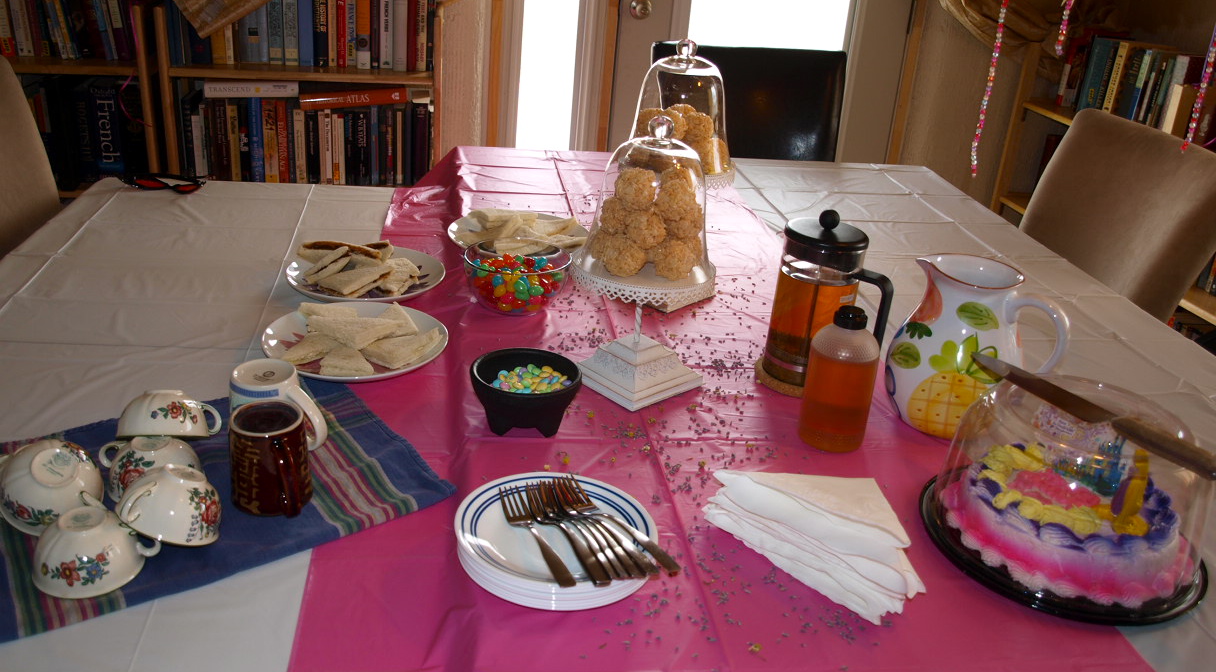
By the time Rory turned five, I could barely contain my excitement.  We celebrated last week.  Rory invited four friends (and her big brother) to a princess tea party that was so civilized I almost laughed.  I prepared three types of tea sandwiches: coconut and lime curd, peanut butter and Nutella, and honey with banana slices.  I molded rice crispy treats into small spheres, and served them with chamomile tea and raspberry lemonade.  I learned several interesting things from the giggling guests, including the merits of having a younger brother, the versatility of bird poop, and the hilarity that underlies British accents.  Rory opened her presents, my husband extracted quarters from behind the ears of the guests, and the tea party concluded with a rousing jump on the trampoline in the backyard.  Laurie Colwin, you are a genius.

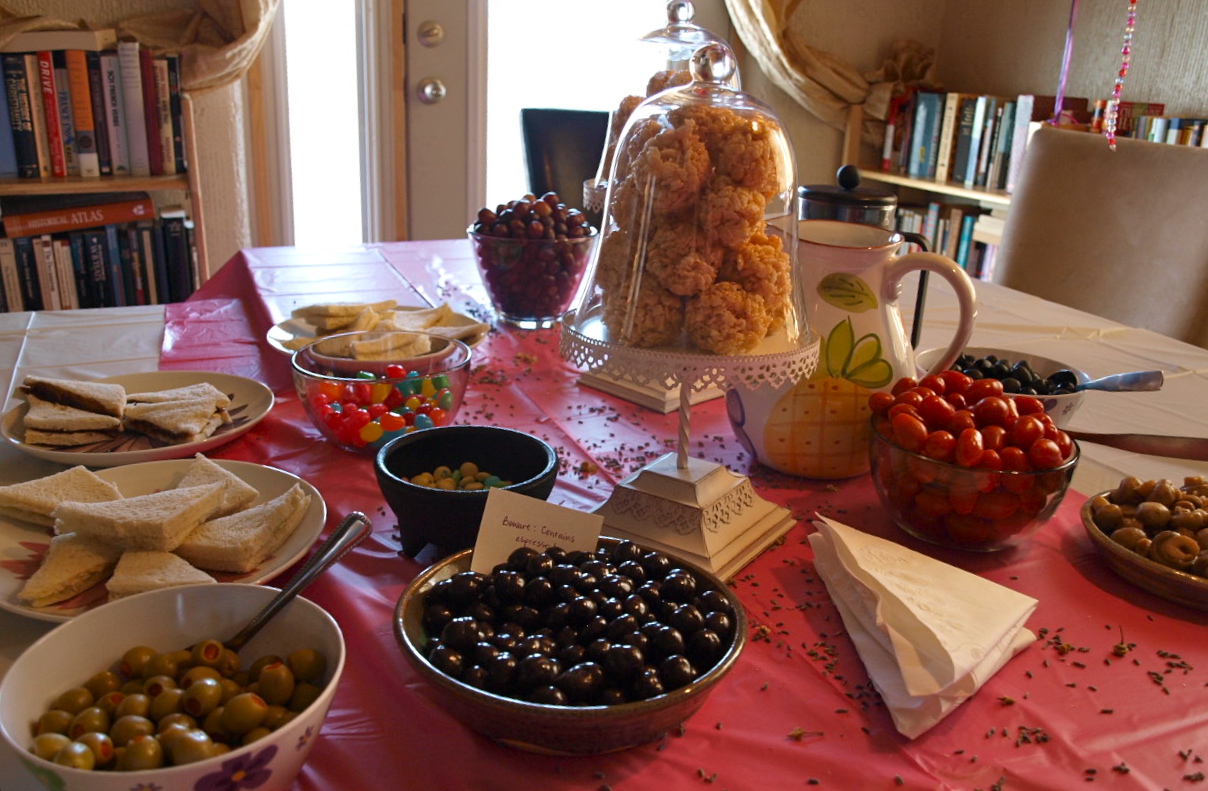
The meatball party commenced half an hour later, giving me just the right cushion of time to clear dishes and prepare for round two.  The Meatball Shop Cookbook provides numerous options, but ultimately I settled on their pork recipe.  I prepared the spicy pork meatballs the night before (ground pork shoulder, minced white bread, and hot cherry peppers ensure their spicy tenderness), and put them to heat in the oven mid-tea party.   I prepared TMS’s spicy tomato sauce to serve as an accompaniment.  I made a quick sauce of ginger ale, ketchup, barbeque sauce, and grape jelly for frozen meatballs, which I cooked in the crockpot all afternoon for the children of those we invited. (Rory declared the meatballs “dewicious!”) Because sometimes meatball ideas can be daunting, I extended the party theme to “Meatballs and Other Edible Items of a Spherical Nature,” which opened up potluck possibilities for all the guests.  Collectively, we ate the spicy meatballs and sauce on round rolls; African meatballs with green olives and an additional spicy tomato sauce; hominy in cheese sauce; a salad of miniature mozzarella balls and cherry tomatoes; marinated mushrooms; grape tomatoes; green and black olives; red and green grapes; blueberries; rice crispy spheres; energy bite balls; donut holes; chocolate-covered espresso beans; and jelly beans and M&Ms. (Other suggestions: oranges, radishes, melon balls, macadamia nuts, caviar, red hots, cheese balls, and any number of round, dough-based creations…)  Similarly inspired by TMS, my friend, Casey, served ice cream floats: root beer and vanilla ice cream for the kids; cream soda and cappuccino ice cream (and rum) for the adults.

We sat at the table well into the night, picking at our plates and laughing, while upstairs the children watched Cloudy With a Chance of Meatballs.  It was a great night… and the start of an annual tradition that I will enthusiastically repeat.  As  The Meatball Shop folks say: “You had me at balls.”

Your friend in meatball love,
Jules

Leave a comment

Filed under food, literature, travel

Cheese Love

Cheese love is real.

My partner in cooking crime, Casey, and I flew to New York City last weekend for Foodfest 2012, a four-day, whirlwind celebration of my 35th birthday that centered around our shared passion: food.

We dined at Kin Shop, Veselka, and Les Halles.  We bought food books at St. Mark’s Bookshop.  We visited the magical kingdom known as Kalustyan’s Fine Specialty Foods, which is packed with floor-to-ceiling shelving and a real estate-defying inventory, and Murray’s Cheese Shop, where the staff has a collective mischievous humor and the warmth of spirit characteristic to lovers of cheese.  My daughter, Rory, has requested a meatball party for her 5th birthday, so Casey and I diligently conducted field research at the Meatball Shop, where the vibe is fresh, fun, and informal, and the servers and kitchen staff operate under the ethos: “You had me at balls.”  (We liked the spicy pork balls with spicy sauce the best, and the cream soda float with espresso ice cream was divine.)

We also met our friends, Misael and Donella, for drinks and dancing at a Bulgarian bar called Mehanata, where we ate fries smothered in grated, melted feta (a revelation!) and were hit on relentlessly by a young man who looked barely old enough to sprout facial hair.  It was hard not to enjoy his tenacity, despite having to show him my wedding ring and repeat the phrase, “Sorry, I’m married.”  (Later that night, Misael said, “Man, Jules, dudes were hitting on you like crazy!”  I corrected him: “Dude.  Singular.  Just that one desperate homeboy, over and over, ricocheting between me and Casey like a clueless chihuahua.”  Misael laughed.)

I even enlisted a talented and imminently likeable artist named Logan Aguilar to tattoo me with the image of a fat-bellied elephant wielding a whisk.  (Thank you, Logan!  Big hugs to you and Lunchbox!)

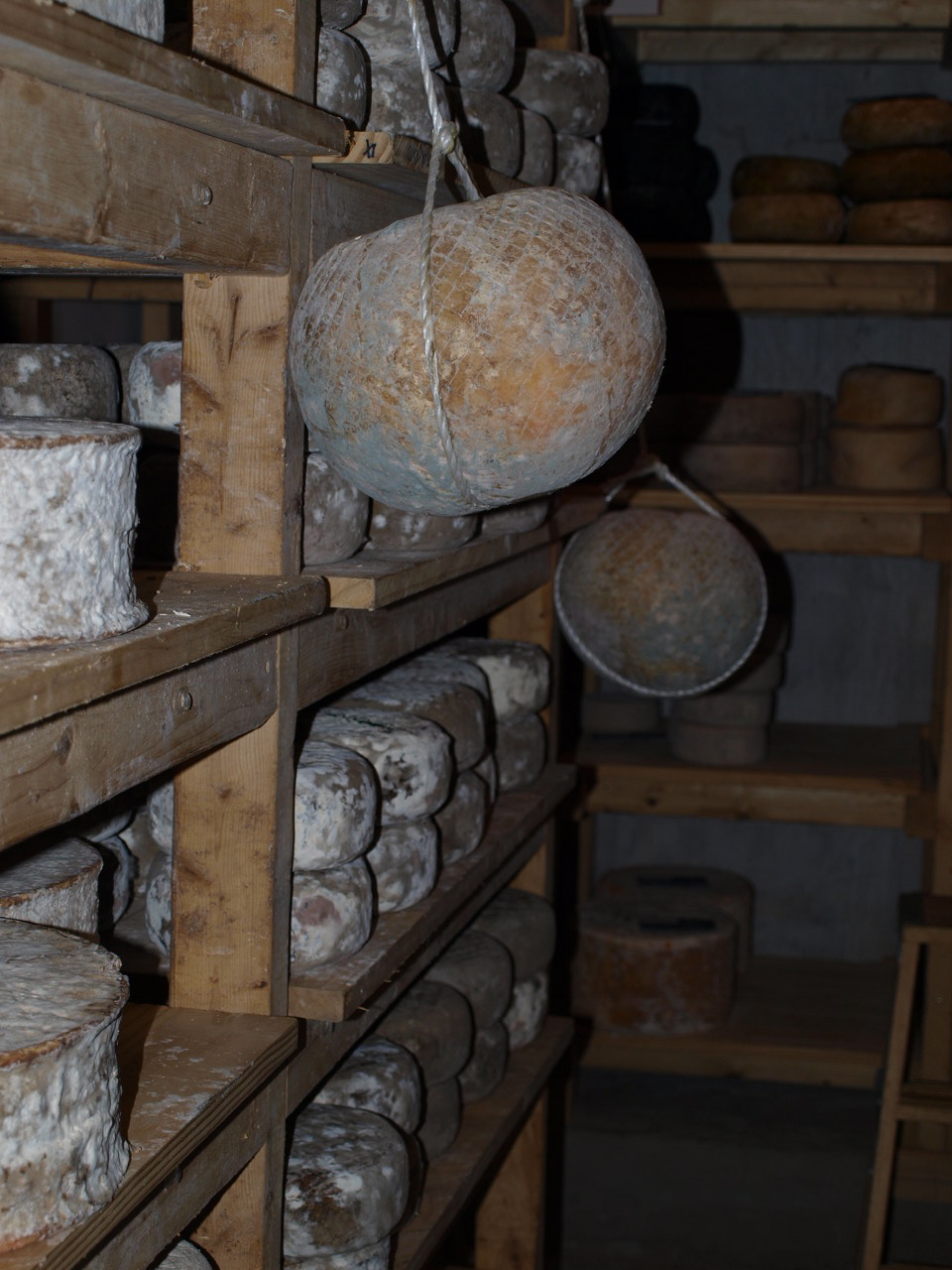
These experiences left Casey and I with a shared lexicon of playful words and one-liners that will last us a lifetime, but the pinnacle of the trip was our education in cheese: in the classroom at Artisanal Premium Cheese and in the cool, temperature- and moisture-controlled cheese caves at Murray’s Cheese Shop.  We participated in one class at each location. Our instructors differed in personality and teaching approach, creating distinct classroom experiences for their diverse group of students.  Despite those differences, we all united to commune in cheese love.

Fromager’s Favorites, at Artisanal, taught the basics of pairing wines with cheeses.  We sampled seven cheeses in a rising succession of intensities and flavor profiles, tasting each with sips from four wines (two whites, two reds).  Erin, our instructor, provided us with a framework for “grading” the pairings:

+2 – Heaven in the mouth
+1 – Pretty good
0 – Neutral
-1 and -2 – Not worth pairing and/or terrible

(Casey promptly adapted this grading scale to the following: We’d make adorable babies; Smooth and sassy, just like Jules; I might call you for a second date; and Let’s not see each other again.)

Erin led the classroom in exploration, urging us to focus on the texture and aromas of the cheeses as they mingled with the wine we drank.  We learned that some combinations enhance the flavor of the wine or the cheese or, in ideal pairings, both. I found the occasional bad pairing fascinating.  I never would have imagined that two of my favorite food groups had such potential to sabotage one another.  It was truly an illuminating experience.

At Murray’s, our instructor, Jason, who once worked the cheese cart at Picholine, led us into the basement to tour us through the cheese caves, which were constructed in painstaking replication of the caves that one might find in Europe.  Afterwards, we sampled five cheeses and were offered bottomless glasses of red table wine or sparkling white wine.  The Murray’s classroom had U-shaped seating and a wide glass wall overlooking the bustling storefront below; this contributed to a slightly less formal environment that encouraged direct interaction between students. By the end of the class, our inner sass revealed itself, prompting us to coo over our slate plates and loosen the notches of our belts.  (This shouldn’t imply that Fromager’s Favorites was void of sighing and moaning.  There were plenty of inappropriate noises at Artisanal, too.  Cheese love is real.)

I highly recommend visiting these institutions to experience their cheese classes firsthand, but, in case you can’t, here is the comprehensive list of the cheeses we sampled, along with place of origin, milk type, the notes Casey and I took, and our pairing responses:

Wines at Artisanal:
Chenin Blanc Fynbos, XF, South Africa 2010 (white)
Melon de Bourgogne Muscadet, Domaine de la Louvetrie, France 2010 (fruity white)
Tempranillo/Garnacha, Cortijo, Spain 2010 (red, my top pick)
Primitivo, Li Veli Orion, Italy 2009 (zinfandel-like, bold red, Casey’s pick)

The Artisanal Cheeses:
Piper’s Pyramid, USA, Goat: Dusted with paprika, mild but slightly pungent.  Good introductory cheese.  Casey and I both liked it paired with Tempranillo.  I thought it had a similar effect to that of beets, a natural complement that improves the flavor of both the wine and the cheese.

Lillé, USA, Cow: Salty, gooey, creamy like Brie*… but better!  I gave it three hearts, while Casey drew a smiley face with stars for eyes.  I loved it so much I shipped a wedge of it home.  As with Piper’s Pyramid, we both liked this paired with Tempranillo. Ditto for the beets comment above.  (*American Brie, which is different – some might say “lesser” – than the Brie available in France.)

Ossau Iraty, France, Sheep: Union of France and Spain; contains more protein, vitamins, and minerals than cow’s or goat’s milk.  I thought resting at room temperature improved its taste and gave it two hearts.  Casey gave it three stars and an enthusiastic “I like it!”  We both thought it paired well with the Muscadet, and it improved my perception of the Primitivo.

Epoisses, France, Cow: Erin and her husband courted over this cheese, which provides an opioid chemical effect that encourages bonding, similar to what occurs between nursing mothers and their babies.  The aftertaste was a bit bold for me, but it lessened when I breathed out through only my nose (mouth shut).  It reminded Casey of her dad.  We enjoyed this paired with the Chenin Blanc.  Casey thought it married well with the Tempranillo.

Brazos Cheddar, USA, Cow: Mild, less salty than other cheddars, smoother in texture, not as “twangy.”  Our collective wine comments can be summarized: “Meh.”

Beaufort Chalet d’Alpage, France, Cow: Grass-fed cows with a diet rich in Alpine flora, very flavorful.  Wheels typically weigh between 90-130 pounds, requiring two milkings of 45 cows to make one wheel.  Though delicious on its own, Beaufort scored neutral to low in all four wine comparisons.

Valdeon, Spain, Cow and Goat Mix: Milder blue, salty profile, creamier rather than crumblier, wheels are wrapped in sycamore leaves that contribute to their flavor.  Our appreciation of the Valdeon improved with all of the wine pairings.

The Murray’s Cheeses:
Selles-sur-Cher, Aged on site, Goat:  We sampled this at two ages.  I liked the creamy, lemony young version.  Casey preferred the aged variety, which was drier in texture, tasted “goatier,” and had a salty, umami-rich rind.

Ardrahan, Ireland, Cow: Rind washed with saltwater, lends nutty saltiness to cheese, gooey center, evocative of Brie* only with more “punch.”  I gave this cheese two hearts, and it earned a whopping five stars from Casey.  Murray’s recommends pairing it with brown ale. (*American Brie.)

Berkswell, England, Sheep:  Granular with sugar deposits from amino acids in the milk, smells like pineapple, with a rind reminiscent of the skin on a ginger rhizome.  Recommended with a smoky Pinot Noir.

Cabot Clothbound Cheddar, United States, Cow: Our top pick of the evening – nine stars from Casey.  Breaks into pieces with jagged texture (like a quartz stone) but never gets waxy, not like a typical cheddar in flavor, but wonderful… perhaps because it is rubbed with lard and elicits comments like this from Casey – “Rub me down with lard! Yummy!” – or this from our instructor, Jason: “You had me at lard.”

Fourme d’Ambert, France, Cow:  Creamy, “tame” blue cheese with a salty finish.  A lady sitting across from us declared it “smooth and sassy.”  It is purported to “convert even the staunchest blue cheese hater,” and is excellent paired with tawny Port.

Happy experimenting!


1 Comment

Filed under food, literature, travel

The Notorious Nightshades

So happy together.

I love hanging out in the produce aisle of a grocery store.  Baskets of smooth-skinned, waxy yellow potatoes lure me; piles of Anaheim and jalapeno peppers interspersed among papery white domes of garlic inspire an entire week of meals.  I like the cool feel of the misters on my hands as I select nubby carrots and bright radish jewels.  My children, Kai and Rory, enjoy plunging their hands in the tall barrels of shell-on peanuts, cupping the peanuts and letting them drop back into the barrel one by one: Plink! Plink! Plink!

Occasionally, we run into someone we know, which happened last week with a local acquaintance and gifted potter named Joe.  Joe and his wife, Lee, operate a pottery shop in the neighboring town of Spring City.  I have purchased several of their creations since I moved to the area, among them a brown, high sheen pitcher patterned with little bird wings. I use it for serving things that elevate, such as gravy, wine, or sometimes gravy seasoned with wine.  I think that one of the nicest things about where we live is that I know a little about Joe and Lee; I know and admire their daughters too.  They know that I like to write and take pictures of my food to post on Eater Provocateur.  Friendliness is a small town perk.

On this day, Joe and the produce manager, Randy, were engaged in discussion, so Rory and I wandered in their periphery while they talked.  Rory is quickly ascending the kitchen ranks from assistant to right-hand sous chef.  Her duties include offering suggestions about what produce I might like to buy and the supervision of a small, wheeled shopping cart.

“Do you need some tomatoes, mom?” she asked, pointing to clusters of the vine-ripened variety.  I have a weakness for fragrant tomato leaves, so I did need some of those pretty red orbs.  I deposited a cluster in her cart.

“Ooh, mom, how about eggpwant!”  Rory’s suggestion instantly awakened a craving for eggplant parmigiana.

“Look at them,” I said, striding in their direction.  Their skins shone – lovely, deep aubergine, with a top hat of delicate green stalk – but the flesh felt too soft to my touch.  Eggplants should be used quickly (they don’t respond well to extended time in the fridge); these were so close to going bad that they didn’t offer any turnaround time, so I didn’t buy one.  The depth of my disappointment surprised me.

Joe stood on the opposite side of the aisle by the lemons and limes.  He smiled, his eyes crinkling.  “Looking to make something provocative?” he asked, with a friendly wink.  I told him I was definitely scheming.

*

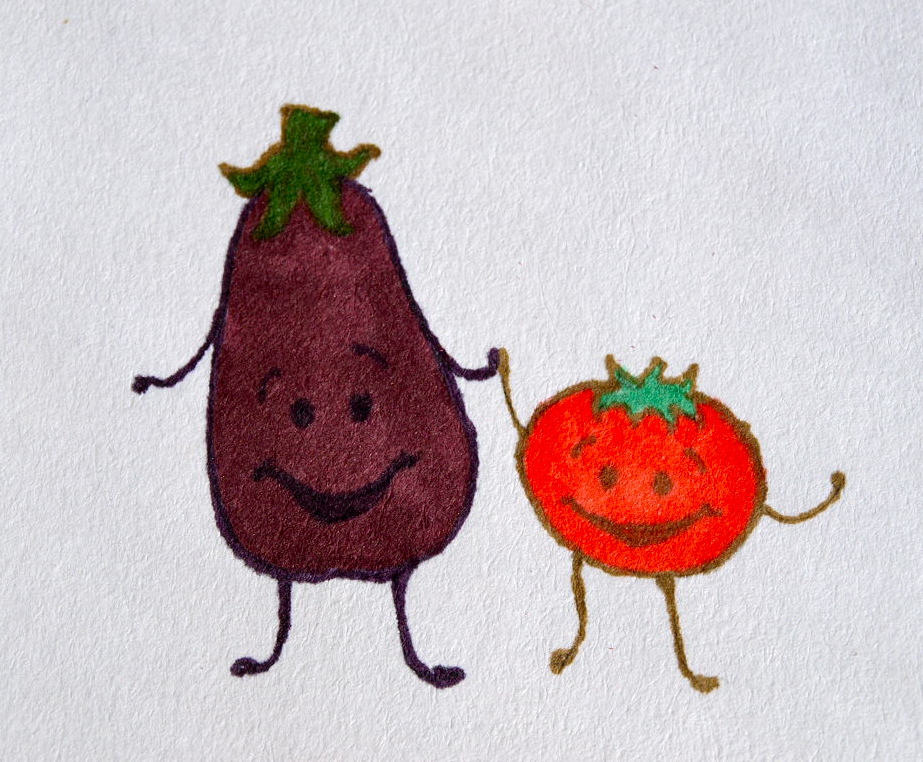
Botanically speaking, eggplants are tropical fruits that originated in Southeast Asia. The Science of Good Food reports that eggplant is “one of the more benign members of the notorious nightshade family” that is “neither addictive nor poisonous like its relatives tobacco leaf and deadly nightshade,” though it does contain “more nicotine than any other vegetable” (or fruit, as the case may be).  Other delicious members of the nightshade family include some of my favorite foods: potatoes, tomatoes, capsicums and chilli peppers (such as jalapeno, serrano, poblano, habanero, and Scotch bonnet), and tomatillos, all of which happen to be fruits (with the exception of potatoes, which are tubers).

Eggplant etymology is equally alluring.  Elsewhere in the world, the luscious meaty fruit is known as an aubergine, which is also the name for the purple color of its skin.  Though it is a fruit, the eggplant is frequently treated as a vegetable, much like its relatives.  In 2008, the New York Times featured an article called “The Misunderstood Eggplant,” which gives detailed instructions for roasting an eggplant, an excellent way to counteract the “heaviness” commonly associated with dishes like eggplant parmigiana or the delightfully named Imam bayaldi, which translates to “the priest fainted.”

Ever scheming, I found a suitable eggplant at a different store the next day.  Using a roasting method adapted from Molly Wizenberg’s ratatouille recipe, I cooked the eggplant that afternoon with halved tomatoes and shallots from a friend’s garden.  It was delicious.

Roasted Nightshades
Serves 2 as a side dish, or 1 for a main course

1 medium eggplant, sliced in ½” rounds
4 medium tomatoes, halved
Shallots to taste, sliced in ½” rounds
Olive oil for brushing
Salt and pepper to taste

Preheat oven to 400 degrees F.  Spread a thin layer of oil on a baking sheet to minimize sticking.  Arrange eggplant, tomatoes, and shallots in a single layer on the sheet.  Use a brush to apply a light coating of olive oil on all the veggies (or fruits).  Flip veggies and apply olive oil to the opposite sides.  Apply a heavier layer of oil on the shallots to prevent them from burning as they caramelize.  Season the veggies with salt and pepper to your preference.

Roast for 40 minutes, flipping everything once at the halfway point.  Transfer to a serving dish and arrange alternating slices of eggplant and tomatoes for a pretty presentation.  Garnish with shallots and torn, fresh basil leaves.

This dish is wonderful topped with fresh mozzarella and broiled for a few minutes – a healthy, satisfying alternative to eggplant parmigiana.

1 Comment

Filed under food, literature, travel

Love Song

Isn't she lovely?

“There!” says Rory, pushing flaxen strands of hair away from her face and waving a sheet of paper in the air. “My birthday wist is done!” I have been watching Rory work on this list for half an hour, divining birthday inspiration from the air with a wandering pointer finger, her tongue poking out sideways from between her lips.  She turns five in April. Her wish list includes happy face balloons, a “Barbie Girl cake from Target,” bowling, Angry Birds (the pig is worth 105 points, she adds; the bird, 109), a scavenger hunt, pizza and Cheetos, Wuggle Pets, and a 6-volt battery-operated princess convertible. “And that’s all I want on my birthday!”

Rory was born sweet, almost preternaturally so: communicating her pleasure with the wiggles and flexes of her toes, pressing herself into the tucks of our arms, asking to sit in our “waps” and begging to be tickled.  She surrenders herself to mischief and joy; she laughs with her entire body.  Her latest infatuation is tricking my husband into looking away – usually by distraction – and then punching him in the face. (I warned him not to encourage her, but he finds it endlessly amusing and so, apparently, does Rory.) Her sweetness makes it difficult to deny her of the objects that captivate her, which typically involve bright colors, princesses, Hello Kitty, or sparkles – sometimes all at once.  Financial necessity demands that I be strict, though I don’t want to be: I love to revel in the radiant glow of her smile.  When I turn her down, her eyes brim with enormous tears.  Her shoulders slump forward as she walks away, slowly dragging her feet along the floor, the picture of defeat.  But even then she remains sweet to the core. “I wuv you, mom,” she says, curling into my lap at the end of the day.  “I wuv you even though you didn’t get me the Wuggle Pets at Target.”

*

My mom used to tell me that I was a sweet little girl.  I wish I had pressed her for specific details.  Did I sing the way Rory does: a soft birdsong that warbles and flaps like a little finch in the spring?  Did expressions light my face, eliciting enchantment from anyone lucky enough to witness the flutter of bright golden green eyes or the freckles I adore so much in Rory?  Did I cup my thin fingers over my mouth while giggling, or waggle my elbows while doing the chicken dance around the dinner table?  Did I smile to wake up each morning?  Perhaps, as with many things, the overriding impression supplanted the precise details and mom wouldn’t have remembered.  But I should have asked, because now there isn’t anyone to answer these questions the way my mother would have.

*

Being able to stay home with Rory is a treasure for which I am immeasurably grateful.  I missed an important chapter of my son’s youth while I worked full-time, precious years of Kai’s toddlerhood I can’t ever recapture.  I remind myself of this whenever I start to feel guilty or anxious about my decision to be, first and foremost, a mom.  Staying home allows me to celebrate Rory’s lovely, tender beauty.  I get to witness her kindness: how she tucks in her stuffed animals each night; how she treats her favorite toy – a tattered grey-blue Eeyore hand puppet that she’s had since she was born – like her child, eagerly ascending the stairs to see it and calling out, “Oh, Puppet Eeyore!  I’m hoooome!” I see Rory as an emissary for good: delivering hugs, high fives, and muppet-like cheer (in her inexplicable New York accent) to the students who attend the school where my husband works.  I live in a blessing.

I’ve kept a journal for Rory, committing myself to actively remembering the details I know I will forget.  (I also keep one for my son, Kai.)  I’d forgotten how, as a baby, Rory smelled like French bread.  She gave me such powerful cravings in utero that I referred to her as the Barracuda.  I forgot that she was born on Good Friday and slept through the night at two months.  She flapped her arms like a bird for the first time at seven months and hasn’t stopped since.  I forgot that Kai used to refer to her as “Beddy Woody” (Baby Rory), and that Rory used to call her Eeyore “Yeye.”  I don’t want to forget that this morning, Rory lifted the edge of the living room rug, found a penny, and exclaimed, “Hey, mom!  Wook!  I’m a wucky ducky!” I don’t want to forget that these ordinary, seemingly uneventful days will become the deeply rooted memories that shape their growing lives. The journals help me remember.

*

Rory has been picking out her clothes and dressing herself since she was three.  I usually do not intervene because I respect how she chooses to express herself.  She coordinates her clothes by color and theme, and she is quick to compliment others on their fashion choices.  Rory knows how to rock a look.  Last week, her preschool hosted pajama day.  Rory opted to wear her two-piece, neon pink, button-down Dora pajamas, though she has several other pairs of pajamas that are much easier to put on and are more comfortable.  She accessorized her pajamas with blue and white snow boots and a pair of purple Hello Kitty sunglasses.  On that day, her clothes did not match, but it didn’t matter because she didn’t care… and neither did I.  Rory strutted.

We went to the grocery store after I picked her up from preschool. I handed Rory one of the store’s wheeled baskets.  She pulled it behind her as we shopped, backing it up (“Beep, beep, beep!”) and maneuvering it from side to side.  At checkout, she almost toppled over as she lifted a gallon of milk from the cart, insisting: “I can do it, mom.  I can do it!”  She placed the pork loin, basil leaf, blueberries, and sliced provolone on the conveyer belt.  The cashier smirked at me over the register.  As we left, Rory said, “You carry the milk, and I’ll take the bags.”  I dutifully carried the gallon of milk.  She hoisted a bag in each of her hands with a Schwarzenegger-worthy grunt, and carried the bags out to the car.  When we arrived home, she brought in the bags, set them down on the beige kitchen floor, smiled up at me, and said, “I’m a good shoppa, right mom?”

“Yes, dear, you’re wonderful,” I said, reaching out to smooth her hair, which wisps in a perpetual shroud of static electricity.

“I’m a good cooka, too, right mom?”

“The best,” I said, smiling.  “You keep cooking with me and you might become the next Julia Child!”

Rory nodded.  “Okay!”  Retrieving her apron from where we’ve tied it to the pantry, she put the apron on and said, “Okay, so first we put our hair back and wash our hands, right?”  Then she went to the bathroom to get her step-stool.

We assembled the necessary ingredients and made small cheesecake-inspired fruit tarts to hand out to students and faculty at the school.  The tarts were a hit, but it was Rory’s response that pleased me the most.  She licked the cupcake liner clean and gathered the crust crumbs that had fallen on the table.  “Mommy,” she raved, “this is the most dewicious cheesecake you’ve ever made!  I can’t bewieve how good this is!”

*

My mom didn’t have the luxury of staying home with my sister or me; as a single mom, she did everything she could do to survive.   Now that I have had the opportunity to work from home and be present in the lives of my children as they grow, I understand what a luxury it truly is to view life as a celebration of emotional and spiritual well-being, a repository for memories that I would never dare erase. Rory reminds me everyday.

2 Comments

Filed under food, literature, travel

Resolutions

A space of my own. Mostly.

Patience
Virginia Woolf espoused the notion that a woman needs a private space of her own in which to write.  Natalia Ginzburg writes that “the birth and development of a vocation needs space, space and silence.”  One of the biggest challenges that I face is finding the silence in which to concentrate and develop ideas for writing.  I don’t have an office or studio.  I live and work in the same location.   There are few private spaces in a house with an open, circular floor plan, which necessitates writing in unusual places, such as the bathroom or the garage.  I completed this essay in my son’s closet, as he and my daughter played on the Xbox downstairs.

My first task for the new year was to set up a writing station in the kitchen.  I hope its presence will act as a visual declaration to my family so that I do not have to once again reiterate: “I am at work.  Please do not disturb or distract me.  Every distraction you make detracts from my productivity and hinders my creative verve.”  I am aware that I sound like a jerk, particularly to my husband, who grew up accustomed to the stimulation of computers, gaming, and the steady ambient noise of two younger brothers and a garrulous dad.

For me, writing is like running: a compulsion that can only be satisfied when completed.  I get antsy when I can’t write.  Even a quick writing session is enough to soothe me.  I need to write.  It is not something I can do if you are sitting two feet away from me, fingers tapping furiously on your keyboard as you Google chat while listening to Rihanna on the fancy pancake-sized earphones you got for Christmas.  Je. Suis. Désolé.

*
Industry
I am blessed with friends who support my food habit.  My friend, Casey, is one such friend.  Casey is tall and statuesque, with long blond hair that she styles impeccably and a bright, encouraging smile.  She is the type of person who photographs well.  (I am not.)  She loves life and is usually the person laughing the loudest at a party.  Casey is the greatest personal ambassador I could hope for.

Last fall, Casey sponsored me on Mightybell so that I could develop a clearer strategy for achieving my writing goals.  After months of inactivity and a litany of daily emails urging me to “step up,” I finally logged on to answer various prompts about what I want from my career.  One of the prompts required me to write down my resolutions – all of them, no matter how absurd or unattainable. Though I generally eschew making resolutions because I get depressed when my resolve inevitably wanes, I made my list.  I did not hold back.  Here it is:

*Make myself indispensible to Jean Louis.
*Start the Park City chapter of Les Dames d’Escoffier International. (Though I don’t live in Park City, the location offers me a larger, more knowledgeable group of potential members, with the added perk of getting to spend a lot more time there.)
*Get a working manuscript in order.
*Submit to the MFK Fisher essay competition.
*Eat more cheese.
*Cook more, preferably in the company of other people who like to cook.
*Write more, preferably in the sunlit silence of a newly created kitchen nook.
*Beg Jenni Ferrari-Adler to be my agent.

*
Abandon
My family spent the holidays in South Carolina.  We are all enthusiastic eaters, so most of our time together involved food and sampling new restaurants.  We even ventured to Atlanta, where we ate an unforgettable meal at the Six Feet Under Pub and Fish House on Memorial Drive, situated directly across the street from Atlanta’s historic Oakland Cemetery.

You know that warm feeling you get when you first realize you’re falling in love?  Or maybe that slight giddy high you feel after you complete a deadline that’s been stealing your sleep for weeks? This electrifying establishment reaffirmed my belief that culinary magic exists.

How else can I explain two generous appetizers – spicy ‘rat’ toes (bacon-wrapped jalapenos encasing a shrimp goodie) with a side of ranch dressing, and a combo of three soft tacos topped with fried calamari, blackened shrimp, and catfish, served with a garnish of a thick salsa verde – shared among four adults; a couple of Shock Top Heffs, an enormous mound of bite-sized fried alligator tail pieces, and a side of Killer Cole Slaw?  I’m a little gal, and that was just my dinner portion.  We also partook in generous samplings from each other: a spoonful (or eight) of shrimp and grits, and a taste (or several) of the fish stew, a medley of tomatoes, fennel, mussels, scallops, shrimp, and cod.  We all whined about how full we were.  We all did not stop shoveling it in, sighing and saying things like: “This is the most amazing thing I’ve eaten in a long time,” and “Why can’t I get food like this where I live?” and “Do you think they would hire me to just stand outside and stare in the windows longingly?”

*
Passion
I love cheese.  I just finished reading Gordon Edgar’s Cheesemonger, an informative book that I’d recommend to any fellow turophile.  The cheese area at Whole Foods is one of my happy places.  I like to sweep the display cases once, then double back to devote deeper attention to the arrangements of patterns and colors on display.  I love the variations in the colors of rinds: the deep eggplant against the milky white of the drunken goat; the buttery yellow gouda sealed in red wax; the grass green lettering on the white seal of slim wedges of nutty fontina val d’aosta.  My cells sing as I caress the wedges, relishing their smooth heft in my palm.  I hold them close to my face, studying their texture and unique bubbling.  I breathe them in.  Edgar’s book confirms that this sort of rapturous, proto-sexual behavior often occurs among his customers and acquaintances. “Any cheese worker will tell you that the cheese counter is often a place of flirtation,” writes Edgar.  “The smells and lusciousness of cheese bring out lust in people.  Cheese lends itself to hedonism and excess.” Cheese love is real.

*
Cardinal Virtues
Unfortunately, my family also had an unforgettable meal of another sort on our trip: at Cracker Barrel, of all places.  We arrived there at 11 o’clock on a sunny Monday.  Our waiter, Al, promptly took our table’s order, serving four biscuits and three little packages of jam to our table of six.  We were all very hungry, so we shared the four biscuits, thinking more would come soon.  We waited.  They did not come.  Ice popped in my water glass.  Country music piped from the speakers.  A crowd of customers stood in the foyer waiting to be seated; wafts of air tickled my cheeks as the hostesses seated people around us: talking, laughing, looking forward to biscuits. Al, a tall man of bear-like comportment, had somehow magically camouflaged his broad white shirt amidst the restaurant’s old-time tchotchkes, so we asked other servers to please bring us more biscuits and jam.  The biscuits didn’t arrive, but our food did.

Al reappeared, chucking three small packages of jam – but no biscuits – in my direction, strewing them across the table.  Did we need anything else?  Syrup, please, we said in unison, and a few more biscuits.  No syrup came.  No biscuits.  We asked Al again and the server who followed him: Please, could we have syrup and a few more biscuits?  When my soda ran low, Al refilled it – unbidden – from a juice glass, reaching directly over my head and spilling it onto my plate and the table.  Caramel brown fluid pooled under my perfectly runny yolks, forming a small carbonated swamp next to the cheesy hash browns.  We were still eating when Al began removing our plates.  He didn’t ask if we were finished.  He absconded with my son’s fork, my daughter’s water, and my brother’s grits.

Prudence: Since most of Al’s hostility seemed to be directed at me, perhaps he mistook me for a customer who had stiffed him recently.  People often mistake me for someone else.  Maybe the restaurant had received a smaller delivery of biscuits than they anticipated and management decreed a moratorium on biscuits that day.  There are any number of random, converging forces that might have caused the weirdness of that particular meal on that particular day.

Temperance: I asked a cashier for a comment card.  She informed me that the establishment didn’t have any.  Would I like to talk to a manager or leave a note?  The cashier adjacent to her suggested that I could post my comments online.  I smiled, thanking him, but informing him that the restaurant probably would not appreciate the comments I was poised to make at that moment.

Justice: I learned later that my mother-in-law had spoken with the manager as I wrote a note of complaint.

Fortitude: I respect servers – they are vehicles for deliciousness.  I tip well.  I refrain from making unnecessary food enemies.  It was right to complain about Al’s poor, unprofessional service.  None of this lessened the tremor in my hand as I enumerated the specific examples that comprised my complaint.

*
Aspirations
It’s important to have aspirations: small, easily achievable goals, like painting a wall in the kitchen or cleaning the litter box; and loftier, oversized dreams, such as collaborating on a cookbook with (and ultimately making myself indispensible to) a certain French restaurateur in Park City whose name rhymes with Pick Me!  Chances are Mr. Adorable doesn’t need my help, but what if he does?  What if, in stating my dream out loud, this chef is suddenly struck with an overwhelming desire to put out a cookbook?  Perhaps he’s always wanted to create one, but was hindered by time or linguistic constraints.  Perhaps he has stories he’s hoped to share with the world. He just might find it pleasing to see his face on the cover of a whimsical, yet well-written collection of recipes from his youth.  Aspirations hide in the unconscious until something (or someone) triggers them, and then suddenly they spring forth with trumpets and fanfare: Of course I want to do this!  Why haven’t I thought of doing this before?  I’m just saying, it doesn’t hurt anyone to dream big dreams.  Dreams are free.

*
Vision
“My vocation is to write and I have known this for a long time,” writes Ginzburg.  “When I sit down to write I feel extraordinarily at ease, and I move in an element which, it seems to me, I know extraordinarily well; I use tools that are familiar to me and they fit snugly in my hands.” I considered her sentiments as I made my list of resolutions.

Casey contributed a desk to my new space.  I painted the walls in purple, beige, and ivory stripes, and bought a celebratory rubber plant with fiery patterns of yellow and red to admire as I work.  An iron bell hangs over my head.  I’m going to ring it each time I complete an essay in a blissful sunlit spot of my very own.

2 Comments

Filed under food, literature, travel

A Tale of Two Barks

It was the best of times, it was the worst of times...

There are times when being a creative free spirit does not necessarily reap culinary rewards.  I love reading recipes, and I often do research before embarking on a kitchen adventure.  Recently, I decided to give my friends homemade peppermint bark for Christmas.  I researched a few recipes and found that many of the recipes were similar: melt chocolate in a makeshift double-boiler, pour and spread onto lined cookie sheet, refrigerate until it sets, repeat as needed, and top with crushed candy canes.  Simple, right?

Looking back on things now, I realize that I should have picked a single recipe and stuck to it.  But, no.  Heady with confidence in documented recipe research and resolved not to pay Crate and Barrel the $20 they charge for their patented peppermint bark, I decided to wing it.  I’m not a rookie, I thought, as I pulled my baking sheets out from under the oven, placing them on the counter with a clatter.  I can do this, I thought, lining two sheets with parchment paper and one with foil in the interest of “scientific analysis.”  I filled a six-quart pot with an inch of water and set it on the stove to boil.  I topped the pot with my largest metal mixing bowl.

I wanted to make two-tone bark for aesthetic appeal, so I started with the brown chips to form my base layer.  Once the water came to a boil, I added two bags of the chips to the mixing bowl, using a toweled hand to steady the bowl as I slowly folded the chocolate into molten goo.  When the chocolate was uniformly smooth, I lifted the bowl off the pot and poured the goo onto one of the sheets (one and a half, actually). 24 ounces of melted chocolate is kind of heavy.

I tilted the sheet at various angles to help distribute the chocolate more evenly. I got the bright idea to press a separate baking sheet, coated with non-stick spray, onto the chocolate to create a perfectly flat surface.  The result was not as successful as hoped.  A thick layer of chocolate clung to the press as I pried it away from the base layer. I scraped it off with a spatula, salvaging what I could, and forged on to heat and pour the second batch of dark chips.  When finished, I placed the finished baking sheets in the fridge to allow the first layers to chill and set.

For step two, I unwrapped candy canes and set them on my cutting board, singing an adaptation of the Bob the Builder theme song: Jules the Crusher, can she crush this? Jules the Crusher, yes she can!

“Honey,” I called out to my husband, who was reading his Economist in the living room.   “Where’s the hammer? I need to smash my candy canes for the peppermint bark.”

“In the basement,” he said.  The hammer was not in the basement.

“Is there any other place where it might be?” I asked.

“In the garage, on the right side.”  It was not in the garage on the right side… or the left for that matter.

Perhaps judging from my extended absence, my husband came out to the back steps by the garage and suggested: “Maybe you should use a wrench… What’s that in your hand?”  A wrench.  It was the heaviest tool I could find.  You can’t fake inanity like this.

Back inside the house, I washed the wrench in soapy water and outfitted it in a condom made from tin foil.  I started smashing the candy canes with the sanitized wrench.  Sticky little bits of candy cane dust bounced off the board with each whack.  None of the recipes I read warned me about this.  I tried to find the exact pressure needed to smash the candy canes without creating further loss of product, hoping to raise my candy-to-effort ratio.  Then I discovered that the handle of my knife did a better job at crushing, so I abandoned the wrench, wrapped my knife in a towel, and carefully – oh, so carefully – started bashing the remaining candy canes, all the while praying to the kitchen muses to protect me from unwanted loss of small limbs.

A more reasonable person might have approached this task by considering other solutions, such as using a rubber mallet or a rolling pin, or putting the candy canes into a sealable plastic bag to contain the sugar splatter.  But, as I said before, I am a highly creative individual, occasionally prone to lapses in good judgment, particularly when it comes to my ego as a cook.  I also have an aversion to using unnecessary plastic in the kitchen – this aversion has prompted me to stop watching Rachael Ray and Sandra Lee on the Food Network, because I can’t get past their predilection for disposable, non-degradable storage bags.  Four messy candy canes later – sticky bits strewn across the counter, into the sink, and on the floor; sugar caking my cheeks – I relented, with far more successful results.  I pounded the remaining candy canes in bliss.

Once the first chocolate layer sufficiently set, I turned up the heat on the double boiler and melted the second layer, this time with white chocolate.  As I heaped mounds of hot white chocolate over the cold brown, I realized why so many peppermint bark recipes use only white chocolate.  Molten white chocolate began melting my dark chocolate, creating gooey mocha smears in my “snow.”  Being a multi-tasker did not benefit me in this scenario.  Again, I scrambled to fix my hot mess.

I realized I needed more white chocolate.  Initially, I’d only bought two bags, thinking I wanted a thinner layer of white atop the dark base.  But when I spread the white layer too thin, it melded with the brown, forcing me to halt production for an emergency trip to the grocery store.

This experience also taught me that my indomitable politeness probably causes me more distress on a day-to-day basis than I am aware of.  I ricocheted around people in the grocery store like a bullet in a rubber box.  I paid in a rush, annoyed with myself.  I charged towards the exit, fiddling with things in my purse, but a man stood in my way.  He moved slower than molten chocolate, but walked a path that made passing him seem awkward and rude.  I wanted nothing more than to scurry around him and rush out of the store, but I just couldn’t do it.  Why? Because I respect my elders, damn it.

I didn’t buy enough of the ingredients I needed.  The peppermint bark required only about half of the candy canes that I laboriously pulverized.  But, on the up side, I was a pro by the third batch, smoothing on the white layer in quadrants and replacing the mixing bowl on the simmering water to keep it from clumping.  I learned valuable lessons about my personality and how I respond to stress.  I learned that some recipes seem deceptively simple, but it helps to try to make them by the book, at least for the first time.  My peppermint bark turned out great.

Crazy Creative Peppermint Bark

Yields three large cookie trays worth of bark

3          12-ounce bags semisweet chocolate chips
1          12-ounce bag dark chocolate chips
4          12-ounce bags white chocolate chips
Few drops peppermint extract
8-10 candy canes, pulverized to desired consistency

Buy chocolate chips and candy canes.  The peppermint extract is optional.

Identify the biggest baking sheets that will fit in your refrigerator. Line the sheets with a barrier material, such as parchment paper or aluminum foil.  (In theory, I prefer parchment because it is more readily degradable; in practice, I prefer foil because it sleekly molds to sharp edges.  Either works fine for the purpose of easily releasing the finished bark.)

Fill a pot with some water.  Top the pot with a heat-safe mixing bowl.  It doesn’t matter how much water you put in the pot – just make sure the water doesn’t touch the bottom of the mixing bowl, or you will have to dry off the bottom of your bowl every time you move it to portion out the melted chocolate.

Bring water to a boil, then reduce it to a simmer.  Add chocolate to the mixing bowl and melt it in batches, folding and stirring as needed.  I recommend smaller batches (one bag at a time?).  Fold and mix chocolate until chips are melted and texture is smooth.  Once smooth, remove mixture from heat and spread onto lined baking sheets.  Texturize to your preference.  (P.S. – If you come up with a solid flattening method that doesn’t require product loss, please share it with me, ok?  Love you.  Thanks!)

Place the filled sheets in fridge to set and cool for at least 30 minutes.  (The wonderful thing about peppermint bark is that you can prepare it all in one sitting, or you can spread completion out over hours or days.)

In the meantime, smash candy canes until you reach your happy place.  Go ahead and waste a plastic zip bag.  Channel the Bob the Builder theme song if that helps.

When the first layer of chocolate sets, begin your second layer.  Melt and mold the second layer of chocolate the same way you did for the first layer, adding peppermint extract if you would like to.  But this time, when you spread out your delicious molten goo, work in smaller sections, because the hot layer will quickly melt the cold first layer below.  Keep the unused chocolate warm on the simmering double boiler as you work.  You’ve gotten all your aggression out on the candy canes, after all, and this is Christmas.  Put on some Foghat and take it easy.

Act briskly with the candy cane crust, though, because the white chocolate hardens sooner than you’d think.  Generously sprinkle on your “bark,” patting it into the chocolate to really get it crusted well.  Your hands will look like you just did something wildly inappropriate with one of Santa’s elves, but no matter.  The mess comes off in warm water.

Chill everything again in the fridge. Break the bark into pretty, rustic hunks before delivery, and smile, because tomorrow your friends are going to be very, very happy.

1 Comment

Filed under food, literature, travel

Flurries

Unlikely lessons from a vagabond cat.

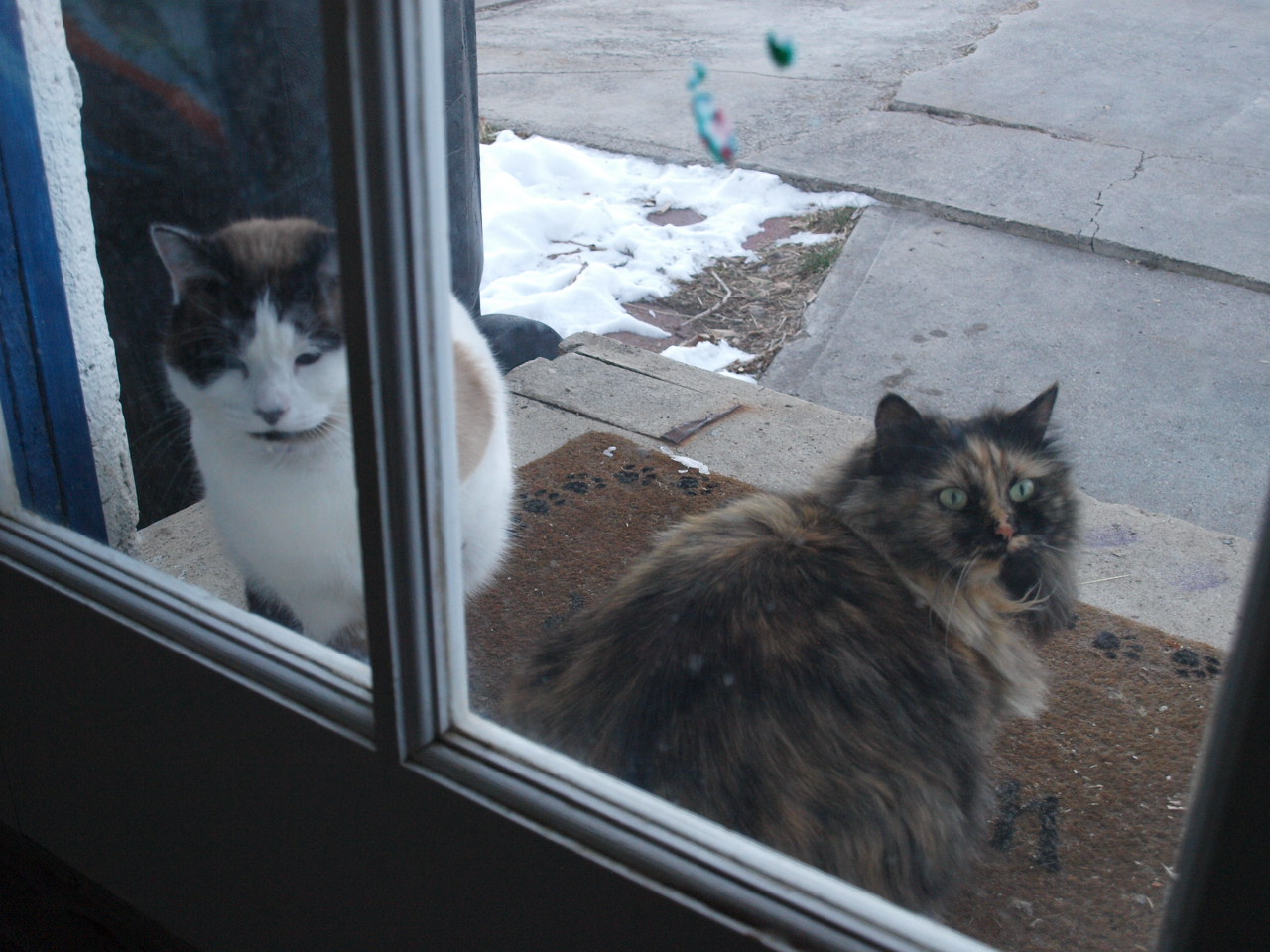
The morning is grey.  Clouds and a haze of snow obscure the mountains that flank the valley, incising them from the landscape.  Snow has settled in the ridges of the giant oak tree on the west side of the house.  Frost crusts the windows on the deck.  Across the street, Mr. Speakman and his family have just pulled their blue minivan into the icy road on their way to church; the roof of their small saltbox house, a doll’s dream in mint green and white, is tufted with fresh snow.  This sort of morning doesn’t announce itself.  Usually, sunlight pours through the east-facing windows in the bedroom.  Today, the bedroom is dark, all blackout thermal curtains and muffled silence.  Lily rests by my husband’s feet at the corner of the bed, a warm, purring mass of white fur.  My children are still asleep, judging from the silence of the floorboards upstairs. I shuffle into the kitchen. Ethel, a mottled longhair tortoiseshell with sharp green eyes, waits on the back steps for food.

Ethel chose us.  She appeared last May, her fine coat thickly entangled, fur falling out in handfuls.  At first, she annoyed us with her low, aggressive mew. Lily eyed her, twitching.  Our town has a problem with feral cats.  We live near a feral colony hangout, but somehow Ethel didn’t come across as wild: she was too eager to be petted, too comfortable in our company.  We assumed she was probably dumped.  My children, Kai and Rory, imitated her bawdy mew as she weaved through their thin legs.  I distracted her with treats as I cut the mats from her fur. We mused about a good name for her, settling on Ethel, because I enjoyed hearing Kai and Rory say her name.

*

Effel!” calls Rory.  Ethel materializes from somewhere in the garage, flopping over at Rory’s feet and rubbing her whiskers against the driveway.  Whatever her name was before, she’s Ethel now. “Who’s a good girl,” asks Rory, puffing out her lips and petting Ethel on her matted belly.  “Who’s a good girl?”  The house shades the driveway from the morning sun as Rory and I play with Ethel.  The weekend’s snowstorm has moved on; the sky is a rich, promising blue above the western hills.  Rory’s face pinkens in the cold air.  She smiles at me, revealing an appealing line of rounded teeth and her singular dimple.  When I look at Rory – tiny hand patting Ethel, blond hair falling over her face, the flit of mischief in her golden-green eyes – my focus sharpens, makes a clear, precise picture, and sets right an unbalanced frame.

Two years ago, I decided to leave my full-time job in order to stay home with my children.  I’d lost my mom, and her loss dramatically restructured my priorities. My husband and I also lost our children’s caregiver (not to death, only fate).  The small town in which we live has no daycare providers and the elementary preschool, officials informed me, was only an option for special needs children over 4 years of age.  The logistics grew too difficult.  I quit.

Switching gears between career and family presents challenges that I grapple with nearly every day.  For the first few months, I felt a steady nagging sense of guilt about not reporting to work, to some physical place where I had a documented set of responsibilities, an order, a reachable goal.  For me, the hardest part about not working in a ‘proper’ workplace is its attendant sense of isolation.  Entire days pass when I don’t see anyone other than my family; on a cumulative level, this lack of social contact suffocates.  I find ways to deal, even if it means going to the grocery store to buy a single kaiser roll from the bakery.  I have not regretted my decision to be with my children, to be present in every moment of their lives… and every moment in mine.

*

The differences between my children astound me.  Rory is a telegrapher.  Her feet have communicated her state of mind since she was two months old.  If she is not singing, she is mid-conversation.  My son, Kai, who is two years older than Rory, is a heavy kettle that releases only an occasional cloud of emotional vapor before returning to a steady, quiet boil.   We call him the Professor.  Perhaps we should call him the Situation, since he finds it important to continually define what “the situation” is.

Kai loves first grade; he can’t wait to tell me about his day when he comes home from school.  Sometimes, he flails his legs and skips, a young Gene Kelly.  Once, when Rory and I painted our toenails, Kai asked to me paint his as well.  I said, “Boys don’t usually paint their toenails…” He persisted, so I painted his nails; it seemed like a harmless way to make him happy.  He wiggled his powder blue toenails with pride at his winter gymnastics performance.  Rory loves preschool like Kai loves first grade.  She adores her teachers, and their goofy, indulgent smiles confirm that they love her too.  Rory occupies herself for long stretches with drawing, painting, and bedazzling, usually while singing or telling jokes.  She has a perplexing habit of suddenly losing touch with gravity, though, tumbling sideways at random moments.

When Rory eats something that pleases her, her body dances a small, unconscious rumba of appreciation at the table.  She might have learned this by watching me, or perhaps it’s a basic human trait: good food = happy.  Kai is a beanpole who wears clothes intended to fit children half his age.  When he finds a food he enjoys, predominantly sweets, he inhales it, just like his dad does.  His eyes hone in on me if I so much as crinkle a wrapper.  “What’re you eating?” he asks, the tiny synapses in his mind firing in anticipation of something sweet.

“It’s cheese,” I say, perhaps a little too perversely.  “Would you like to try some some?”  He doesn’t want to try my cheese.  It isn’t made from sugar.

*

At breakfast, Rory says, “Hey, mommy! Why did the refrigerator talk to the other refrigerator?”

“I don’t know,” I say, staring blearily at my water glass and wishing it was a triple espresso.  “Why?”

“Because the refrigerators wanted to get refrigerator married!”  She cracks herself up with this joke; tiny blueberry muffin crumbs splatter across the table. Rory weaves a forked piece of cantaloupe through the air.  She builds towers of muffin and scrambled eggs on her plate.  Daily chores start to tick off in my head: laundry, sheets from suspended student, dishes from earlier this morning, dishes from last night, four students coming over for tutoring today, mop the floors, edit the essay I wrote a month ago, find Zen place for once.

Though I cherish the time I spend with Rory while Kai is at school, I can’t wait to drop her off at preschool so I can go for a run. I embrace the solitude; solitude embraces me. Running helps me enlarge my world on days when it feels too small: it lifts the ceiling of small town insularity and demolishes the self-imposed walls that I have built around what it means to be a good wife and a good mother.  My legs sing with pride when I get home.  I shower in silence.  I get dressed in silence.  I am ready once again to un-pause my world.

*

After I read the children their bedtime stories and tuck them in, I turn on their lamps and nightlights.  I say, “Goodnight!  Sweet dreams!  I love you!” as I descend the stairs.  Kai and Rory chirp back: “Goooood ni-ight!  I love you, cupcake face!  Sweet dreeeeeeams, dear mother of zucchini!  Farewell until tomorrow!”

Though people frequently tell me how sweet and funny my children are, I berate my parenting skills.  Every other word from Kai’s mouth is an apology.  “Sorry, mom,” he says, sighing into his shoulders, when I ask him to zip his winter coat because it is freezing outside.  “Sorry,” says the bony hunched figure playing his Xbox in the wicker chair upon my suggestion that he move to more comfortable seating.  Loving observations turn into reproaches that prompt the inevitable: “Sor-ry.”

Rory’s catchphrase is: “K, mom.”  I can’t deny the charge I get from her agreeability.  She has independently dressed herself for over a year now.  If I compliment her outfit, which is as likely to match as it is to mismatch, she beams: “Thanks, mom!”  The other day, she played with a garbage bag, pretending it was her cape.  As she twisted the bag over her shoulders, she inadvertently knocked over a picture of my mother and me.  I gasped when the frame clattered against the wood floor.  Rory’s eyes brimmed with tears.  “It’s okay, honey,” I stammered, rushing to hug my terrified child, whose face clearly telegraphed her fear of my rage.  “It’s okay,” I said, hugging her, massaging her back.  “It was an accident…  Accidents happen all the time…  It’s just a picture.”  But insecurity flooded me: How did she think I was going to react instead?

It is my responsibility as a mother to encourage the individuality of my children and bolster their confidence as much as possible in preparation for the grueling adolescent years. I want to build them up, because I know that there will be plenty of people trying hard to tear them down as they grow.  It’s a shame, but that is the reality of life.  I can’t control what other people do or act or think or say, so I build and build and build, controlling what I can.  But I can’t shake the fear that, no matter what I do, it won’t be enough.  It breaks my heart to hear Kai say “sorry,” to see the look of terror in Rory’s eyes.

*

Cats exhibit a total responsiveness to touch.  They don’t know the meaning of subterfuge; you know without doubt when a cat likes you.  This may be why I identify more with them than I do their domesticated canine counterparts.  I know all of Lily’s pulse points: she likes to have her chin scratched, and she presses her head into my hand when I flatten her ears and pet the sparsely covered patches above her eyes.  She finds me irresistible in my smelly, panting, post-run state.  She does not like it when I tickle the muscles of her hind legs.  Ethel, on the other hand, likes to be petted simultaneously on both sides of her rib cage.  She skooches just beyond reasonable petting distance and is prone to flopping sideways when spoken to.  Ethel responds well to manhandling.

I worked full-time when Kai was a baby.  My husband worked towards his PhD at the time, which allowed him freedom to stay home with Kai while I worked.  I got myself ready for work, and then I woke Kai for his morning feeding; that is, if Kai didn’t wake me first.  I fed him in the dark, burped him, changed him, and returned him to the car seat in which he slept when he was very little. (He didn’t sleep in his crib, so my husband and I made do.)  If Kai didn’t fall back to sleep right away, I rubbed his forehead with my thumb in soft, soothing motions: my beautiful, little owl-eyed worry stone.  The more I rubbed, the glassier his eyes became and the heavier his eyelids drooped until, finally, he went back to sleep.  I placed him, car seat and all, next to my husband still sleeping in bed, and crept out the front door to work, making as little noise as possible and praying for Kai to return to sleep.

*

Ethel was still here, encamped under the giant shrub in front of the house, when we returned from last summer’s three-week vacation.  Though we had arranged for someone to provide care for Lily in our absence, no one knew what to make of the furry vagabond: should they feed and encourage her, or should they ignore her and hope she wandered back into itinerancy?  They ignored her.  She remained.  We found clumps of her fur discarded randomly around the lawn. She was thin, the sides of her body freed of hair, a bodyhawk in feline form.  I grew fond of Ethel’s multi-colored whiskers and delicate paws.  I smiled when I sometimes caught her creeping around the neighbors’ yards.  She became dear to me.

I tried to lure Ethel indoors throughout the summer and fall, despite my husband’s protests and a wicked adult-onset allergy to cats. I left trails of treats leading inside the house and left doors open for longer than necessary.  I even physically placed Ethel on the living room floor.  Her rear end twitched; she sniffed furniture.  But she found the nearest exit and sat by it, looking outward, until I relented and let her back out.  Ethel settled in the hay-filled cranny underneath the unused chicken coop adjacent to the garage.  We’ve seen her slinking out of it on cold mornings.  Now that the snow’s arrived, she’s a little more eager for her morning bowl of food and she’s bolder about coming into the house for small stretches, but she seems to have found her true home somewhere in between the chicken coop and the crannies of our lives.

Ethel leaves us love letters in the form of dead farm mice.  The ragamuffin persists.  Her winter coat has come in thickly, and her belly has rounded.  I am not sure what she sees in us, but I see her in vivid detail: an announcement, a warning, a challenge to memory, an enigma.  Sometimes you have to add members to your family who aren’t related by genes or blood, but feel entirely right to you on a metaphysical level.

Every day is a lesson.  When I open the back door and see Ethel, I place my hands on the small bowling ball of her body, lift her front paws off the ground, and kiss the top of her raggedy little head.  She chose us, but I want her to understand that we choose her right back.

8 Comments

Filed under food, literature, travel

My Favorite Things

How do you catch a cloud and pin it down?

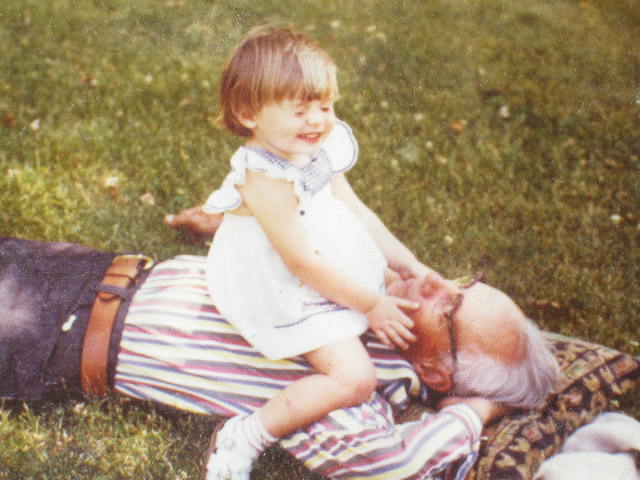
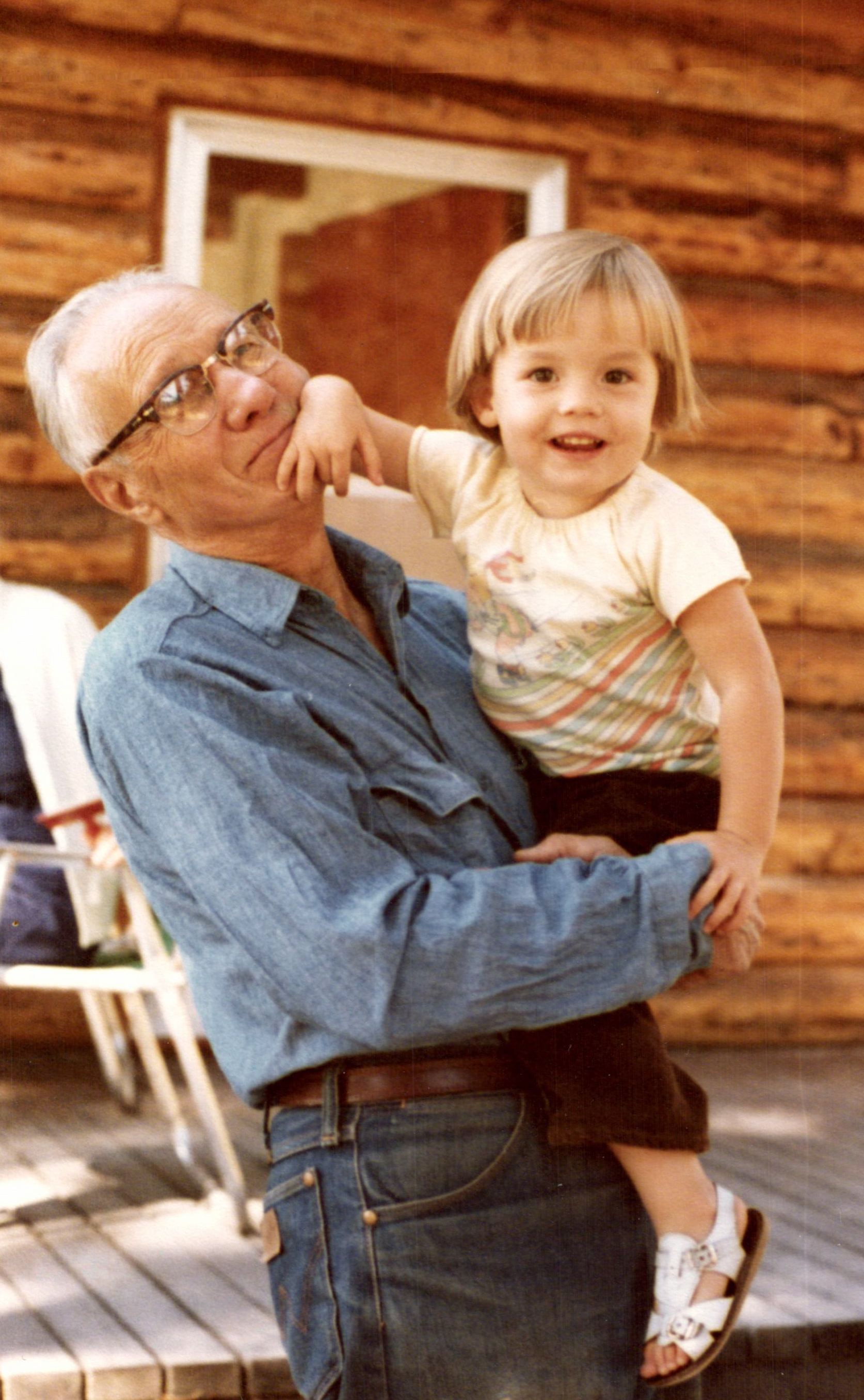
Some of my happiest childhood memories involve The Sound of Music.  My grandparents had the soundtrack on LP at the family cabin in Featherville, Idaho.  Since the cabin didn’t have televisions, its primary entertainment source was the record player, on which my sister, Lisa, and I played records in heavy rotation.  Grandpa had amassed an eclectic collection in the years before LPs grew to near extinction, but our favorites were The Nutcracker and The Sound of Music.  Late at night, with the curtains flung open and moths fluttering against the lighted windows, Lisa and I leapt from avocado green sofa to sofa: hair flying and limbs flailing, like sugarplum fairies gone wild.  We waltzed on tiptoes through the kitchen, humming “Edelweiss.”  We pirouetted around the dining table, wire whisks raised in our hands, our voices warbling: “How do you solve a problem like Mariiiaaaaaaaa? How do you hold a moon beam… in your… haaaaaannnndd?”

When I was sixteen (going on seventeen), Lisa flew to Boise during a break from medical school in Geneva to join me on a tour of colleges in the Pacific Northwest.  We drove the silver Tercel that Grandpa had “sold” to me.  It was an old, no-frills hatchback, but it was mine and I named it Orby, after one of Grandpa’s mischievous brothers.  As Lisa and I left Boise, heading west toward the highway, we stopped at a red light at the intersection of Milwaukee and Emerald.  The engine hummed quietly through the floorboards.  Summer wind blew through the car, the late afternoon sun warm on our legs. I couldn’t wait to start the trip and see the Oregon coast one more time, but as I stared down at my frayed denim shorts and freckled legs, I felt intense heat rise up my neck.  My forehead and cheeks burned.  Lisa looked at me with wide green eyes, the skin on her breastbone mottled with pink blossoms.  Ever responsible, Lisa ran through a shortlist of concerns:  Was the car overheating?  Did we have heatstroke?  Was this an allergic reaction?  What had we eaten for lunch?  Was there a bee in the car?  Did we need to turn around and go to a hospital?  We cranked the AC and started to roll up the windows.  Then we saw them: two good-lookin’ dudes perched high in a jeep in the next lane, peering down into our car with identical lopsided grins.  Lisa and I had been singing “The Lonely Goatherd.”

Goatherd incident withstanding, Lisa and I were accustomed to performing because we had a captive audience of family members staying at the cabin with us each summer, among them our enabler: Grandpa. Our cousins made excuses to go down to the river; uncle Don shuffled through the papers in his briefcase, squinting behind drugstore reading glasses; and Dad sequestered himself in the attic, illuminated by a single bare light bulb, tapping out manuscripts and textbooks on the manual typewriter he kept by his bed.  Aunt Sylvia sat on the flowery corduroy couch in the corner, knitting.  Grandpa had a talent for fixing his blue eyes on the pages of whatever he read, but every now and again, he lifted his gaze to smile at us.  Grandpa remained spry well into his 80s.  On really good nights, he sprung from his armchair and joined Lisa and me, bending at the knees and hooking his fingers into the imaginary suspenders on his chest, as we bobbed and sang, “Lay-oh-de-lay-oh-de-lay-hee-hoo!”

Grandpa was the first person to believe in my ability to write and he encouraged me to explore my talents, unprofitable though they might turn out to be.  He dreamed of writing fiction, and he bequeathed his unpublished stories to me when he died; the note affixed to the large manila folder read: “Keep writing!”  I also inherited my favorite of his belongings: a big, comfortable, tufted reading chair made out of I’m not sure what.  The chair is slippery and caramel brown, and it exhales a soothing pffft when occupied.  Its generous head- and armrests provide ample space for sleeping cats and reading material.  I like to sit in it sideways, my legs flung over the armrest, an avalanche of food books fallen around me, Lilycat coiled into a tight ball of white hair and purring on my lap.  I imagine Grandpa dozing in the chair, snoring softly, a book resting against his chest.  After his death, it felt less like losing him to keep something so big and enfolding near to me, something that felt almost as comforting as the soft scratch of his blue cardigan against my face when he pulled me into a bear hug.

Even as a young girl, before I became aware that it was possible for adults to be goofy, impetuous, mischievous, charmingly self-mocking, or wryly sardonic, I admired Maria’s little whimsies.  I admired the compulsion that drove her to rush to mountain peaks, singing at top volume with her skirt a-twirl.  I admired that she walked away from her faith for a reason that felt important to her.  (Not so much that she did it – at the prodding of the Mother Abbess, no less! – for a decorated military official with a cork up his butt, but at least she forsook her religion for a true passion.)  The von Trapp children adored her.  She was the kind of woman I aspired to be: tenacious, intelligent, resolute, and given to affection, deep emotion, and song.

I watch The Sound of Music every year at Thanksgiving because it is so entwined with the things I associate with love and showing appreciation.  Maria had her list of favorite things, and I have mine.  Thanksgiving gives me the outlet to freely and openly sing praise to everyone and everything I love, which makes it my favorite holiday.  I’m so thankful for my family, children, and incredible friends; for our collective good health, our jobs, our happiness, and our quirks and talents.  I’m thankful for all the things I have learned and will learn in my life.  But most of all, this year, I’m thankful for a life history that is woven together so tightly and completely that I can’t celebrate one memory without also giving thanks for so many others.

Thanks for believing in me, Grandpa.

2 Comments

Filed under food, literature, travel

The Humble Cauliflower

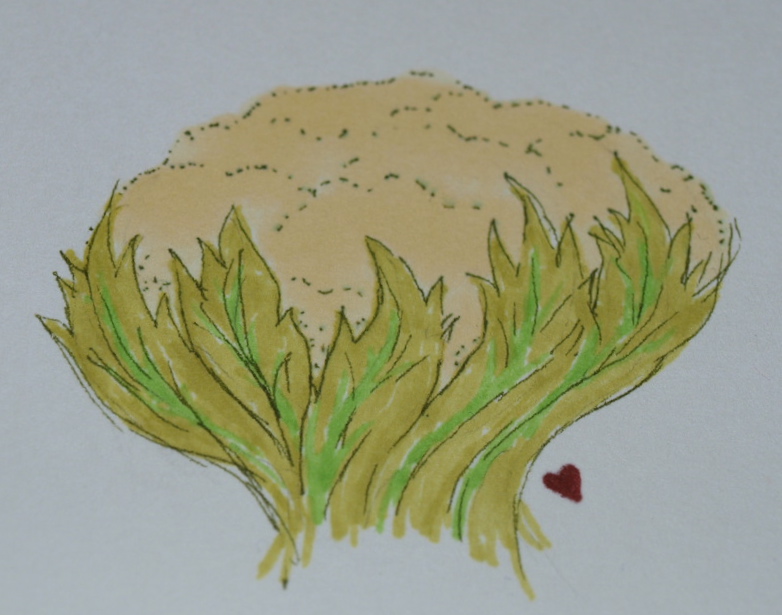
Cauliflower: "the garden's pale brain"

I recline on a beige vinyl examination table with needles dangling from my face.  They waggle in my peripheral vision when I twitch my lips.  Still more needles hang from the skin on my wrists, ankles, and knees. The air smells faintly medicinal, like bandages; a metronome clicks softly in the darkened room.  I am thinking about cauliflower.

“Write anything lately?” asks Dr. R, positioning a small needle gun against various points on my ear.

“No,” I say, frowning.  “It’s a terrible triangle.  If I’m cooking, I’m not reading or writing.  If I’m reading, I’m not writing or cooking.  If I’m writing…  Ugh! Do you know that I have about five essays in process right now, but none of them are going anywhere?”

He smiles, a lock of hair flopping over his eyes.  I wince when the needle gun applies pressure to an especially sensitive point on the ridge of my ear.  Dr. R dials back the needle’s intensity.  After a few more jabs, we move on to dinner plans.  “I’m going to make coq au vin with my girls,” he says.

I murmur in appreciation, trying not to move my head too much.  “As soon as I get out of here, I’m heading to buy a bottle of wine,” I say.  “Which I’m going to drink while I make a cheddar, ale, and cauliflower soup.  It’s a Bittman recipe I saw in the New York Times…”

“It’s funny that you bring up cauliflower,” he says.  “I was just thinking about a cauliflower gratin that I made once.  It’s one of Nick Stellino’s recipes.  So good!  Do you know him?”

I don’t know him, but Dr. R does a quick search for the recipe online as I recline in the dim coolness.  He prints it for me and sets it by my side as the needles do their work.  I try to relax, musing about the heroes of my kitchen; wondering how certain people rise to the level of fame that allows others to refer to them strictly by last name (Bittman, Bourdain, Pepin) or first (Julia, Mary Frances).  I’m thinking about the charge I get when I meet a fellow lover of good food, how honest and easy it is to ‘talk food’ with others.  My stomach rumbles at the prospect of a heaping mountain of hand-grated sharp cheddar (I always grate extra to compensate for the pinches I steal during preparation) and dark, nutty ale, frothing over boiled cauliflower florets.  Curiosity gets the better of me.  A needle falls from my right wrist as I reach for the recipe. Capers, garlic, rosemary, red pepper flakes, Pecorino Romano…  The recipe reads as deliciously as I imagine it will taste, though I make a mental note to double the cheese when I try to make it.

*

The cheddar and ale cauliflower soup marked the end of my yellow period, a bizarre month-long rash of yellow dishes.  What an incredible farewell!  My friend, Casey, and I devoured the soup in one sitting, mopping up its last vestiges from the pot with hunks of bread and leaving nothing behind but a thin film of cheese.  The hearty soup was a perfect send-off to yellow cuisine… and a warm welcome to the chill of autumn, which brings with it the opportunity to start roasting foods again.  Foods like cauliflower.

Cauliflower is a member of the diverse brassica family, which includes cabbage, Brussels sprouts, broccoli, kale, collards, rutabaga, and kohlrabi. Harold McGee writes that cauliflower is a “mass of undeveloped flower stalks,” whose development is “arrested” before they have the opportunity to flower.  (Other edible flowers include broccoli, artichokes, apples, pears, and citrus fruits, as well as numerous varieties of blossoms that are more commonly acknowledged as flowers, like roses, violets, jasmine, lilacs, and marigolds.)

I have often thought of cauliflower as an underappreciated vegetable.  My research – happily – indicates otherwise.  In 1891, Arthur Alger Crozier devoted over 200 pages to the humble head in a book called The cauliflower, just two years after James John Howard Gregory, a seed grower and distributor in Massachusetts, wrote the formidable Cabbages and Cauliflowers: How to Grow Them.  Samuel Johnson and Lorna Crozier (relation to A.A. Crozier uncertain, though potentially serendipitous) both rhapsodize the cauliflower.  Ms. Crozier writes: “The garden’s pale brain, it knows the secret lives of all the vegetables, holds their fantasies, their green libidos in its fleshy lobes.”  The ‘brain’ portion is called the curd.

Cauliflower withstands colder temperatures, making it an ideal winter vegetable.  It tastes delicious roasted or in soup.  (To prevent yellowing, try boiling it with a little bit of lemon juice or vinegar.) Cauliflower can be pureed or mashed, and served as an alternative to potatoes.  Escoffier writes of a puree that incorporates boiled, pureed cauliflower with mashed potatoes, cream, and butter.  The New Larousse Gastronomique offers several sauces, recipes, and preparations for cauliflower, as does Mastering the Art of French Cooking.  The Fannie Farmer Cookbook and The Joy of Cooking contain intriguing recipes for fried cauliflower, and Curnonsky, the ‘Prince of Gastronomes,’ cites a mouth-watering gratin called Cauliflower Cheese in his Traditional French Cooking.  Cheese is a popular accompaniment for the vegetable.

The leaves of the cauliflower are also edible, though according to the Food Lover’s Companion they “take longer to cook and have a stronger flavor than the curd.”  The Splendid Table’s How to Eat Supper offers a good leaf-inclusive recipe with helpful cooking suggestions.  My preparation of choice requires no heat at all: I wash my cauliflower and dry it well, chop it into bite-size florets, salt it, and eat it raw.  If I’m feeling particularly industrious, I might make a little dip with Greek yogurt and ranch dressing.

*

MFK Fisher wistfully recalled the time she spent in Dijon, where “the cauliflowers were small and very succulent, grown in that ancient soil.”  Back in the States, she found she could no longer make the creamy cauliflower casseroles she created during her magical time abroad.  “I could concoct a good dish, still … but it never was so innocent, so simple … and then where was the crisp bread, where the honest wine?”

The vegetable strikes similarly wistful notes with me.  In French, cauliflower is called a chou-fleur, which literally means cabbage flower.  It is one of those sweet translations that appeal to my love of words, inseparably connected with one of my mother’s own beloved translations.  Mom used to chop off the florets and trim down the stalk, cutting away the cauliflower’s fibrous layers to reveal the little nubbin of edible stalk at its core.  She called this piece the kachun, or heart.  I’ve written about the kachun before; it will forever be the tastiest part of the cauliflower for me.  Each time I prepare a cauliflower, I make sure to savor the kachun and say a prayer for my mom, who fed me well on a steady diet of hearts.

Cauliflower Salad
(Recipe credited to my friend Kari, who credits her aunt Vicki.)

1 head iceberg lettuce, chopped well
1 head cauliflower, cut into bite-sized pieces
1 medium red onion, diced
1 cup crispy crumbled bacon
1 cup grated Parmesan cheese
1 cup mayonnaise with 1 packet ranch dressing mix
Black pepper to taste

Mix all the ingredients together.  Tastes best when shared with friends.

1 Comment

Filed under food, literature, travel

Halloween Haiku

Something creepy this way crawls...

During the week, I work as a writing tutor for a rotating group of high school students.  This group also includes a slightly younger pair of siblings: Stella and Lucas, age 12 and 10 respectively.  Stella’s former teachers in the San Diego school system had encouraged her to explore creativity through writing; the writing program at her new Utah school simply wasn’t compelling enough to sustain her interest.  I think that Lucas, a redhead with a sprinkling of freckles and a shy smile, joined our tutoring sessions to see if his interest could be similarly sparked.  We sit together for hour-long sessions at my large dining table and work through free writing prompts and language-building activities.  I write with them, and we share our writing round-robin style.  Stella and Lucas laugh with each other, making faces.  They reference each other in their writing.  They are the highlight of my workweek.

Last week, we wrote Halloween haikus, illustrating them in the margins with spooky characters. Frankenstein appeared in all three of our lists of Top Ten Things Related to Halloween.  Stella and Lucas’ faces furrowed with intent as they sorted through the box of markers I gave them; they wanted to make sure that their Frankensteins were just the right shade of green, his scars in the exact right placement.

Here is one of our resulting haikus:

If Frankenstein ate
candy he might not have been
in such a bad mood.

Here is one of mine:

Shaving cream egg bombs
they tossed from the bus windows
and freaked my mom out.

“What’s a shaving cream egg bomb?” asked Stella, blond brows knit together, aqua blue fingernails tapping on the table.  These were actually two different ‘bombs’ fused together for dramatic effect, I explained.

A shaving cream bomb and an egg bomb comprised only a small portion of the Coney Island Halloween experience between the years of 1984 and 1992.  An egg bomb is a raw egg pitched at high velocity from moving buses, apartment windows, and random passersby on the street.  A shaving cream bomb is a rock loosely encased by a blob of shaving cream, thrown with similar speed and intent.  I never received a shaving cream egg bomb firsthand because my mother barricaded us inside the apartment for the entire day, but the evidence was plain to see on November 1st.  Egg artilleries imploded on the sidewalks, shaving cream napalm smeared against buildings, pebbles scattered like shrapnel.

Corn mazes, hayrides, bobbing for apples, and bonfires were not commonly practiced.  Trick or treating was not encouraged.

The act of donning a costume for public appearance is referred to as ‘guising’ after the verb ‘to disguise.’  My mother disapproved of dressing in costumes at Halloween; she thought it wrong to celebrate ghouls, ghosts, and creatures she associated with the occult.  I know that she let me dress up at least once because she documented it in her journal: I was a black cat.  In college, I guised as a piece of jail bait, a nun, a witch, and a demonic vixen, selections that accurately mirror my social experiences during those years.  This year I will guise as myself, which is perhaps the most illusory guise of all.

Tricks are essentially implied shenanigan threats, translating to “Give me candy or I’ll toilet paper your rhododendron.”  In some parts of the world, however, children are expected to earn their treats by performing “tricks” like singing or telling stories, a quaint practice that I wouldn’t mind seeing more of.  Wouldn’t it make the day more fun to see a pintsized skeleton dancing a jig on my doorstep?  Or to hear my daughter belting out spirited renditions of musical numbers for my neighbors as we made our rounds?  What does it say about a culture that submits to the threats of children with the reward of candy, and has even sanctioned a national holiday in celebration of this implied trickery?

Then again, few children seem to know the more mischievous nuances of the term ‘trick.’  Lucas didn’t, but he laughed when I told him about the singing and dancing alternative.  Many of the children who knock at my door omit the phrase altogether; they thrust out their buckets and bags, mute but with expectant eyes.  I wonder what they’d think if I asked them to sing me the SpongeBob theme song.

I’m not actually a Halloween crank.  The holiday endures because it’s fun to dress up and it’s even more fun to go on a raging sugar bender, as is evidenced by the extraordinary candy revenues reported in the days leading up to Halloween.  The Washington Post estimates that 90 percent of parents steal treats from their children’s sugary schwag.  (Lucas frowned when I shared this statistic.  Stella giggled.)  I admit to furtively savoring my ill begotten Skittles and Nerd Ropes. I try to remind myself that my history is not my children’s.  My kids will recall the chill of the night air, the anticipation, and the sweet rewards.

This year, Kai opted to be his hero, Spiderman, and my daughter, Rory, will be Ladybug Girl, resplendent with black fuzz ball antennae, shimmering red wings, and a gauzy tulle skirt that I handmade in one of my rare fits of crafting.

Our lights will shine through the windows on Halloween night.  I will gladly open the door.

9 Comments

Filed under food, literature, travel