Tiny Ninjas

The naked man standing in the hallway across from my Las Vegas hotel room covers his crotch with both hands and grins at me.  Though I need to leave the room, my momentum halts. I slam the door quickly, sealing myself inside.  My friend, Casey, a tall, bodacious blonde, stops short, looking confused. I’m not sure how I articulate the naked man’s situation, but Casey seizes the moment, pushing me out of the way and pressing her phone to the door’s peephole. She snaps multiple photos of his toned derriere as he furtively knocks on his locked room door.

I blush, breathing hard, my back pressed against the wall like I’m evading a zombie in pursuit.  Casey gives me the play-by-play peephole recap: the couple who encounters the man there in the hall, naked as the day he entered this world; their playful responses, goading him into reluctant laughter; the man’s gratitude when Casey tosses him a hand towel from our bathroom; the best wishes we offer him when we finally stop giggling, compose ourselves, and leave the room.

The elevator light dings at the end of the hall, smoke lingering in the stagnant air.  Casey turns to me, blue eyes sparkling, and says, “This is going to be the best day ever!”

*

Casey’s friendship comes with many perks, among them: travel, random naked men, and opportunities to try new foods.  Casey travels frequently for work. Usually my children and my teaching/tutoring schedule prevent me from accompanying her, though I would like to, but sometimes serendipity grants me its favor.  Casey’s most recent trip to Las Vegas occurs during my school’s spring break.  Would I like to join her for a few days of sunshine and fine dining in Vegas?  Yes.  Yes I would.

*

Casey convinces me to get a foot massage with her, despite my reservations. She is far more massage-friendly than I am, and she promises me that this experience will be “amaze-balls.”  (After the morning’s nude review, I’m not so sure.)  I reluctantly accompany her to the Foot Spa in Vegas’ Chinatown. I stress all morning in anticipation of the massage.

Golden curtains divide the spa into several intimate spaces.  A radio quietly plays classical music.  Water trickles from a waterfall in the corner.  I can’t see anything but tile flooring with my face pressed into the plush brown spa chair.  My massage therapist clearly struggles with her previous life as an angry ninja.  She karate chops my back with exaggerated gusto.  I begin to question the term “foot massage,” and how precisely it correlates to the face, scalp, arms, back, and butt.  My contemplations arrive belatedly in our hour-long session.  I beg the woman who “massages” me to be gentle.  I whimper.  At times, I clench every muscle possible in order to evade the pain.  I decide, resolutely, that I definitely do not like people to mess with my spine.

When the time comes to settle the bill, I realize why she’s been so rough on me.  She doesn’t understand a word I say.  I tip her $8 – about 25% – for the mercy of escaping alive.  My kidneys ache; patchy purple bruises begin to blossom under my skin.

Outside, Casey’s oversized grin confirms that she, too, has succumbed to ninja torture.  Sunlight assaults our dimmed Zen eyes.  Casey peers at me and asks, “We’re still friends, right?”  I assure her we are. But a teensy tiny part of me receives satisfaction in the mental image of the tiny ninja – all knees and elbows in full attack mode, perched on Casey’s back.

*

Casey is a gateway drug.  We first met at work five years ago.  Casey introduced me to important life skills, like smart, intentional networking; opening myself to new experiences; and being 100% genuine and true to myself at all times.  I learned these by observing her.  Then, she upped the rush by absconding me to different restaurants and kidnapping me for purposeful writing (and eating) retreats.  She seamlessly inserted herself into my family’s life, showering my kids with superhuman affection.  I just can’t see myself quitting her.

*

It’s not my place to judge ninjas.  Foodies are kind of like tiny ninjas: ever on the prowl; stealthily stalking the next delicious meal; unsheathing our swords in the rarest and most tragic cases of food injustice.  Our attacks are little… but impassioned.  I spend the last day of our trip in bed, felled by a persistent, nagging sinus infection.  The inside of my head feels like it’s going to implode.  Casey has made plans to eat at Gordon Biersch, and all day I’ve felt pain in my face as well as my heart, lamenting that I won’t join her.

I watch her as she perches, cross-legged, on the floor in front of a huge mirror, braiding her long hair and applying makeup to her porcelain face.  “What time is your dinner thing?” I croak.

“We’re meeting at six,” she says, lips relaxed, smoothing on her signature red lipstick.  “Dinner starts at seven.”

I sit up in bed, the jackhammer in my brain momentarily ceasing, and look up the menu online: gorgonzola-pear salad, lobster bisque, blue crab and artichoke dip… Ingredients that I cannot purchase within fifty miles of my home.  Casey eyes my computer screen in the mirror’s reflection.  “It’s only half a mile away,” she says, her voice lilting.  “Worst case scenario, if you start feeling really bad, one of us could bring you back to the hotel. Or you could even take a cab… It’d be really close….”

Somewhere deep inside, a tiny ninja rallies to life, shrieking out her battle call.  I join Casey for dinner.

*

When the server sets out a large plate of crostini aside a bowl of creamy white, bubbling crab and artichoke dip, I dance a gleeful rumba in my seat.  I haven’t eaten since breakfast.  One glass of cabernet has gone straight to my head.  I am ravenous.  This dish – not so much an appetizer, as it appears on the menu, as an entrée – is the highlight of my day.  I have Casey to thank for luring my sorry butt out of bed.

Back at the hotel, Casey climbs into her bed, pulls the covers up to her ears, and says, “I’m sorry you feel so bad, Jules.”

“I’m sorry I am such a wet blanket,” I say, honking into a tissue.  “I’m so lame.”

Casey snorts and asks me if I need anything. I think of the thousand ways she has impacted my life and my attitude towards life since we met.  My gratitude to her knows no bounds.

Even ninjas need friends.

Hello, sunshine!

Hello, sunshine!

© 2013 Julia Moris-Hartley
Leave a comment

Filed under food, literature, travel

Appetite APB

OLYMPUS DIGITAL CAMERA My appetite is gone.  Poof! Whoosh! Alla Shazaam!  I don’t know  where she has gone, but for the last few months, I have lived without her.  My food enthusiasm has not waned – I still troll food blogs, ogle food photography, and fondle fruit in the produce aisle.  I read all the articles that appear in the Dining & Wine section of The New York Times.  The cheese case still makes my body sing.  But when the time comes to eat, I am impassive.  Filet Mignon?  Raclette?  A piece of wheat toast spread with salted butter?  I just don’t care.  This bothers me.

Where has my appetite gone?  Maybe, like Mayzie, my appetite has grown tired of her perch inside my egghead brain, and has flown to laze about in warmer, less turbulent climes.  Maybe she is baking in the heat of the Aruban sun, where, I confess, I would love to join her.  Winter has felt very long this year.  It would be nice to feel warm sand under my feet, to smell coconut oil in the balmy breeze.  I miss my appetite.  I would rejoice to reunite with her.

I’m trying not to panic.  I remember the intense sympathy I felt for Molly Birnbaum when I read her book, Season to Taste, in which she recounts losing her sense of smell.  How can one have an appetite or appreciation for food without the ability to smell it?  I shared her story with my husband, who responded with a tepid “Meh.” Meh?  Meh?!  How dreadful to live out your life in a state of “Meh”!  I’m a party-like-it’s-1999 kind of girl.  And yet, here I am, skipping out on meals and dodging Meh’s specter in the realm I hold most sacred.

I placate my growing sense of fear with the knowledge that I’m a first-year teacher who didn’t know she would be one until it happened.  I expend a lot of creative energy in the classroom.  Every single day involves intense planning for the next class… from scratch.  Every day poses a new challenge, like learning a new delivery style, adapting to the moods of my students, and accepting that sometimes technology fails at the exact moment when you planned to show the perfect YouTube clip.  I’m like a contestant on Chopped, an amateur trying to prove myself worthy enough to be in the League of Super Teachers.

I’ve also battled several colds since the school year began.  Colds mess with appetites, right?

Though I haven’t shared this information with anyone, I suspect my friends know that something’s amiss.  Plans for food-related gatherings and excursions have increased threefold since the New Year.  Hostel rooms have been reserved for extended food outings in the north.  Friends anonymously deliver delicious foodstuffs by cover of night.  I may be lacking in cravings, but I’m not lacking in good friends.  I am so grateful to have their love and support, especially now.

I can, thanks be, still appreciate the taste and flavor of good foods.  I can still smile into a bowl of creamy, cheesy grits.  I just can’t feel my own food mojo anymore.  So I’d like to formally issue an APB.  My appetite is about 5’2” and she recently cut her hair and added auburn streaks.  If you happen to see her, please tell her to come back to me.  I’ll be waiting right here with open arms.

© 2013 Julia Moris-Hartley

6 Comments

Filed under food, literature, travel

A Day at the Pea Plantation

Live... and thrive!

Live… and thrive!

I stand in the snow, panting, on a sunny winter day.  Sweat rolls down my forehead; rivulets drip down my back.  Though temperatures have peaked in the mid-thirties, I’ve discarded my jacket, scarf, and gloves. My shirtsleeves are pushed as high as they can go. I lean against a sagging chain link fence, brushing my hair, which clings to my face, away from my eyes. I’m sucking air like I’ve just run a marathon. I need a moment’s rest, so I focus on the rugged, white mountains that rise in the east and the piercing blue sky. A woodpecker alights on a nearby telephone pole, embarking on its evolutionary carpentry: tap, tap, tap, tap, tap.  I have just spent an hour shoveling a narrow footpath in knee-deep snow along one side of the fence, preparing the dark, wet soil to receive thousands of little pea pods for the spring harvest.  I am in the Pea Plantation of greater Salt Lake.

My friend, Casey, the enabler of virtually all of my culinary adventures, kneels about twenty feet away, hunched over in the snow-crusted soil, pulling up the woody remains of last year’s pea plants.  Later, she tells me how much the intractable woody stems frustrated her, but each time I look over at her, I see only her bright smile, directed at me or at one of the several others with whom she labors.  Later, I tell her how hard it was to shovel all that snow, especially towards the ground line, where it hardened into ice, but in the moment I work slowly and patiently, gleaning snippets of information from the volunteers who shovel with me.  Cameron, a reedy young chef in a white t-shirt and skinny jeans, is a fellow kombucha connoisseur; he has repurposed an old bottle for carrying water.  Jorges and Mirielle, an attractive Latin couple, are transplants from Texas.  They have a young baby at home – a fact belied by lithe Mirielle’s flat abs and perfect butt – and practice veganism out of their respect for the sustainability of the planet.  They tell Julia, a brunette graduate student from North Carolina, about different types of food documentaries, one of which (whose name I miss) makes Food, Inc. and Fast Food Nation look like cartoons.  I smile to myself.  Though shoveling snow is hard work, I am among my people: foodies at their finest.

Ironically, we are all migrants of a kind: transplanted souls called to Utah for various reasons. Unlike the migrants who typically do the backbreaking work of today’s industrial farming, however, we have gathered voluntarily at a local, family-run farm, united by our beliefs and by an honest desire to effect a change. Casey found this community through a website called meetup.com.  Our fellow farmers cited other social websites and word of mouth.  There were fewer than ten of us in all, but many hands can clear away a lot of snow in an hour.

The Pea Plantation is one of fourteen community gardens scattered across three acres throughout Salt Lake City and operated by Sheryl McGlochlin.  Sheryl’s website is liveandthrive.com, for those interested in exploring her work further, but, basically, her farms have flourished, producing table-ready produce until late November each year, because of local volunteers who help her work the soil… and reap its bounty.  She charges a $100 annual membership fee.  Members receive a bounty of produce in exchange for the fee and a little sweat equity.  For people who want to try it out before committing, like Casey and me, there are Saturday gatherings, where one can put in an hour’s work and receive a freshly cooked meal from Sheryl, along with a bag full of the extras, like bagels or cookies, that she gets from bartering/trading with other local businesses.

As the sun begins to set, our bodies cool and we stand huddled, hugging ourselves. Sheryl feeds us a delicious 16-bean soup, salty with bacon (which Jorges politely reserves and shares with Julia) and pleasingly warm.  After dinner, we thank Sheryl for her hospitality and disband for the day.

Later that night, Casey and I settle into our hostel beds, nursing zinfandel from mismatched coffee mugs.  “Just think how much work it must take to manage 14 acres of farms,” I say.  “I’m gonna be so sore tomorrow.” My respect for Sheryl and our fellow farmers is sky high.  Though I only contributed an hour’s time, I feel really proud of what we accomplished.  I want to keep coming to help.

“I think I’m already sore,” says Casey, laughing as she stretches her long legs.  Then she winks at me and says, “That was fun!”

Leave a comment

Filed under food, literature, travel

Forgetting

Jules_025

A violent flurry of words blows through my mind before finally, after several perplexing minutes, stilling on the word I want: kachun, the heart. Google Translate tells me that this is not the literal translation for ‘heart’ in Russian or Ukrainian, but it was the word my mother used when she cut vegetables down to their very cores, trimming away leaves, florets, and fibrous layers to reach that special center piece of certain lettuces, cauliflowers, and broccoli.  I’ve eaten plenty of kachun in my day, but lately I’m finding it more difficult to recall the word.

*          *          *

I recently read The NeverEnding Story, a task that’s been on my bucket list since I first saw the movie in 1984.  I was seven.  My mother took me to see it at the cinema on Fairview Avenue in Boise: the burgundy velvet seat soft under my legs; the air redolent with the scent of buttered popcorn; that one splotch in the upper left corner of the screen that marred Noah Hathaway’s smooth, tan face. The movie made quite an impression on me. I’ve since watched it dozens of times, and am planning to host a theme party in which all my NES friends can geek out.  My children are approaching the age where I can share the movie with them, an experience I eagerly anticipate.  I don’t know if they’ll respond to the movie the way I did, but I hope they’ll at least enjoy some of the characters: Artax, maybe, or Morla or Falkor.

In the novel, which continues far beyond the movie’s scope (the movie ends roughly halfway through the book), Bastian enters the world of Fantastica (or Fantasia) and experiences many adventures alongside his good friends, Atreyu and Falkor.  Bastian wears the AURYN, a necklace that grants him his every wish.  Each wish he makes, however, costs him a price that is surreptitiously exacted: he loses a piece of his memory.  He forgets his bearings – his life as a son in the human world, as a wimpy student frequently picked on by others.  He begins to forget himself, even as he becomes stronger, more respected, and more essential to life in Fantastica.

If you forget something but don’t realize you’ve forgotten it, was it something actually worth remembering?  This is what bothers me about kachun.  If I lose the memory of this word that I heard my mother utter all my life, what else have I forgotten that I can’t remember?  I still remember mom’s face: the prominent inverted black ‘v’s of her eyebrows; her almond-shaped brown green eyes, which, like mine, turned deep olive when she’d been crying; her pale lips and small, straight teeth; the white shock of her hair, sprayed into a pouf on top of her head.  I remember her voice.  She loved to sing.  (So, too, do I.)  I remember how much she enjoyed playing with my children.  But I remember her most when I see my friends with – or talking about – their mothers.  Oh right, I think, my mother is gone.  And with her, the thousand little memories and details I no longer remember and can never retrieve.

*          *          *

Some memories beg to be forgotten, while others fester resolutely despite all efforts to be rid of them.  Which of my memories have disappeared unawares? Am I better off without them?  What was the last conversation I had with my mom?  I can’t remember. Yet the image of her propped on a mattress in the Bellevue SICU – purple eyelids swollen shut, bandaged head, the hiss and suck of the ventilator – is seared into my memory like a cheap, ugly brand.

Worse still are the memories that don’t belong to me at all.  I see my mom walking home from a Valentine’s Day Dance at the Ukrainian Senior Center in the Village, heading north by foot on Second Avenue.  In her purse, she carries birdseed and a half-eaten sandwich. She starts down the crosswalk at 23rd Street: gray concrete sidewalks, shop windows caked with old sale signs. Cigarette smoke wafts from the teens standing, haphazardly and with vacant stares, on the corner.  As she crosses the crosswalk, undoubtedly with clearance to “WALK,” the white pick-up truck with the blue plow attachment, fully raised from clearing snow at city bus stops, turns left.  Mom screams before being stricken down, to the horror of onlookers.

I wasn’t there to see any of it, but I can’t un-know that mom saw her death coming.

*          *          *

I’m not sure if the man who killed my mom was released from his job at the organization that employed him.  He was not charged with any crime, because the police determined that the incident lacked criminality.   Two of the organization’s representatives visited mom as she lay in the hospital dying, though whether the driver was one of them is up to speculation.  The organization, which I can not name for purposes of legality, placed a very low estimate on the value of my mother’s life because she was retired – therefore not “contributing” to the local economy – and because she didn’t have children young enough to be deemed “significantly bereft” of the loss of their mother.

Three years have elapsed since her death. My sister and I have yet to receive a single word of apology.

*          *          *

Several of my students questioned my sanity when they caught me, during structured reading time, absorbed in a book titled How Did They Die?  It is a tightly composed collection recounting the deaths of celebrities and notable historical figures. Isn’t that a little macabre, Mrs. Hartley? Why are you reading that book?

Strange though it seems, reading about the deaths of others provides a measure of comfort.  No one eludes death.  Eventually we all experience it, even über humans, in gradual and sometimes tragic, sudden, crazy ways. We all occasionally face challenges that we must try to forget.  The trick is to hold tight to memories that uplift us and bolster our spirits so that the world remains a tolerable place, so that hope remains.  I will not give sorrow much room to grow, though sometimes its fierce will to survive incapacitates me. I hold on to joys, like my daughter’s incandescent smile and my son’s owlish compassion for others.  As the anniversary of mom’s death approaches, I once more remember the strength I derive from within: kachun, kachun, kachun.

Leave a comment

Filed under food, literature, travel

Red Curry Days

OLYMPUS DIGITAL CAMERA
“It’s something you can’t explain exactly, why people become friends. It’s chemistry, is what they say. Maybe it’s just being the right people with the right feelings in the right place at the right time.” – After Eli

I’m standing at the kitchen counter, mincing a dozen garlic cloves for a Thai-themed New Years Eve dinner with friends.  The snow-crusted landscape outside the large kitchen window reveals its secrets as I chop: trails navigated by fluffy, short-eared brown rabbits, deer, and silver foxes; the incisions – narrow, wide, and wild – cut during afternoons of sledding.  The garlic burns my chapped fingers, but I savor its aroma.  My friends roll limes and juice them. We marinate large London broil steaks in garlic, lime juice, brown sugar, and Golden Mountain Seasoning Sauce.  We’ve boiled shell-on shrimp in Fat Tire beer and paprika. Rice simmers and swells on the stove.  Several generous tablespoons of red curry paste enliven two cans of coconut milk in a pot, bubbling gently. We’re joking and laughing… well on our way to a Thai feast.

Three days earlier, I sent these same friends a frantic email reneging on my offer to be the dinner chef for a short getaway we’d planned together.  I cried as I typed: nerves frazzled, ready to breakdown.  There’d been a death in my husband’s family; the combination of the emotions wrought by her death and the stress of packing bags and supplies for the entire family overwhelmed me.  I told my friends that I just couldn’t do it.  It was one obligation too many.  Could someone else please cook the food on the last night?  I immediately received two responses: one graciously offering to cook, and one expressing pride in me for asking for help.

My mood lifted as soon as we arrived. We walked into the rented house and received cheers. Someone handed me a beer. Someone else hung up my coat, and shepherded me to a chair. During those three days, we cooked, ate, drank, and played heated rounds of Bananagrams and Oh Hell, cursing with gusto.  My friends showered me in hugs.  They counseled me, refusing to let me make a decision in which I would “make do” and achieve less than my highest potential. I don’t care if I sound hokey.  I love these people.

After dinner on New Years Eve, I stepped outdoors to admire the shadows of the bare, white trees. I listened to the snow, faintly crackling as it hardened into a crusty shell, the muffled horn of a freight train hugging the curves of icy tracks in the distance.  My face pinkened in the cold.  My fingers felt brittle and difficult to bend. I thought of the bunnies and the scraggly foxes, how they manage to thrive in such a beautiful, but harsh landscape. Though my friends and I live in warm, comfortable houses, there are elements of our environment that are harder to endure, but we hunker down and endure them together.  I’m so grateful to have friends who come clamoring with hot drinks and warm cheer when my spirit threatens to plummet into brittle, icy winter.

Red Coconut Curry

My friends, Alethea and Jonelle, tie for the title of Curry Queen.  I am only a Curry Handmaid, but if you find your spirit in need, here’s a quick recipe to help warm you.

1” nub fresh ginger, grated (I use a microplane)

1 yellow onion, diced

3 tbsp. red curry paste

1 can coconut milk

Vegetable oil

Warm a little vegetable oil on medium heat in a large skillet. (I use about a tablespoon.)  Add ginger and red curry paste.  Stir and cook for a couple minutes, then add onion.  Stir to combine and cook onion until soft.  Add coconut milk and stir to combine.  Serve hot over a nice bed of jasmine rice.

Also delicious with chicken, shrimp, or vegetables, such as sweet potatoes, tomatoes, or crisp green beans.

2 Comments

Filed under food, literature, travel

Thanks Be

Dear Mary Frances,
Thank you for pioneering the genre of food writing.  Your smart prose blazed the way for thousands of writers today – most significantly, female writers –stripping stigma from a field once thought to be solely esoteric and reminding us that food offers so much more than its nutritional content.  Your writing rallies interest in the pleasures, no matter how modest, of the plate.  I have read The Art of Eating at least half a dozen times, and I always discover new meaning with each reading.  You are my idol.

Cher Jean Anthelme,
Your immortal words set the tone for each episode of Iron Chef.  What would the tone of the show have been without them?  Would Chairman Kaga have appeared so Chairman-ish?  The Iron Chefs so ennobled?  Your keen attention to the virtues of culinary enjoyment is rivaled only by your witty social commentary.  I really appreciate that level of attention.  I’ve been wondering… If I believe that wine, cheese, and bread are major food groups, does that mean I’m actually French?  Do tell, do tell.

Dear Julia,
I’m thankful that we share a common first (and nick) name.  I’ve often envied what I’ve read about your marriage to Paul.  He wrote you lyrical love poems for your birthday, for goodness sake!  Together, you created personalized valentines to share with friends each year.  You had what truly seemed like a passionate storybook relationship.  I envy that.  But I also envy – perhaps I should say admire – your robust sensuality.  You would have been so fun to party with! I would have loved to watch you at work in the kitchen.  Sometimes I pretend to be you. (My daughter, Rory, finds these reenactments hilarious.) I think of you every time I accidentally drop a piece of food.  Thank you for making it okay to use the five second rule.

Dear Laurie,
Your writing gave me the idea to host a tea party in honor of my daughter’s birthday.  As I draped beaded garlands over the lights and scattered lavender buds across the table, I thought I heard your voice calling out in singsong approval.  Thank you for writing about your daughter with warmth and affection.

Dear Calvin,
Though I think your wife, Alice, was spot on when she coined the term “food crazies,” and though chances are likely that I am one myself, I appreciate your sustained interest in all things food-related. Thank you for being a “food crazy.” Your version of the first Thanksgiving is far better than the one I learned in elementary school.  I fully support your campaign to make spaghetti carbonara the official Thanksgiving dish.

Dear Harold,
You know you’ve got real cred when chefs all over the world refer to your tome as their “McGee,” as in, “I’ve got my McGee right here!”  I thank you for your tome and your cred. You’ve helped me through many a food inquiry.  I hope you don’t find this too creepy, but I think of you as Uncle McGee.  You seem like the type of person I’d enjoy spending time with on my deck.  As the sun descends over the western mountains, I might casually turn to you and say, “So, Uncle McGee?  Tell me the story about when you wrote your book.  Did you have a grant to fund your daily expenses as you researched?”  And you might chuckle, take a sip of your Malbec, and say, “Well, it all started back in the eighties….”

Dear Jeff,
You are an enigma when you guest-judge on Iron Chef America and Top Chef.  You share the same name as one of my first “real” crushes, a sous chef named Jeff who worked at the finest dining establishment in my college town.  The state he left me in was not funny, but you are.  Thank you for giving your assistant a comically disproportionate amount of work to do and for fielding so many marriage proposals. Thank you for accidentally poisoning yourself with taro leaf and writing about it with humor.

Dear Jane,
Mushrooms, onions, butter, sour cream, and dill…  Who knew? I serve your sour cream sauce over a big bowl of rice.  The mushrooms whisper, “We are so happy,” and so am I.  Thank you for loving fungi enough to dedicate an entire book to them.

Dear Tony,
I started watching your television show before I read any of your work.  I (unfairly) assumed you had writers.  Then I read your books, and your writing bowled me over. I couldn’t believe it!  Your prose is tight!  I haven’t had the good fortune to travel the world like you, but your writing amazed me with its ability to make me ravenous.  I’ve never tried pho, and yet I feel as if I have tasted it with you on the streets of Vietnam.  In my imagination, we traipsed across the globe throughout A Cook’s Tour, loosening our belts and belching happily.  I was your Zamir.  Thank you for making me hungry.  Even though No Reservations is over, never stop being hungry for more, okay?

Cher Jean Louis,
Will you ever find me indispensable? I think the world of you and would gladly be your scribe.  Thank you for renewing the zeal of my Francophilia.

Dear Readers,
Thank you for reading my work. I’ve been busy with a new job and haven’t been in the kitchen as much as I’d like, but I really appreciate all of your continued support. I am thankful for you.  Happy Thanksgiving!

Love, Jules

Leave a comment

Filed under food, literature, travel, Jean Louis

French American Idol

Will Jean Louis ever find me indispensable?
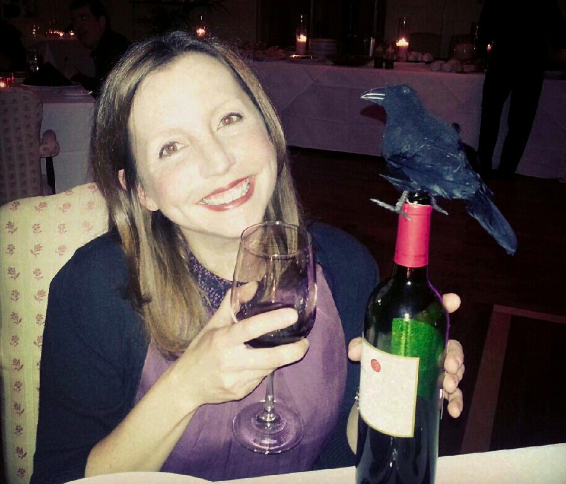
Quoth the raven, “Maybe next time.”

On Saturday, October 20, 2012, my friends and I attended the inaugural Halloween Spectacular at Salt Lake City’s Caterina, the current culinary venture of my not-so-secret French crush, Jean Louis. I had vowed to make myself indispensable to him in my New Year’s resolutions. Ten months later, I found the courage to make the first move.  We set off to Caterina so I could proposition Jean Louis about collaborating on a cookbook or memoir.

My friends and I hired a driver to deliver us from our hotel room to the restaurant.  Our driver seemed annoyed about his line of work. “You’re going where?” he asked, swerving in and out of lanes and fiddling with his GPS unit as we slid from one side of the backseat to the other. “That is much farther than I thought,” he said, glaring back at us without slowing down. (The restaurant was about 40 blocks away.) Our driver drove like multiple warrants had just been issued for his arrest, and he almost murdered two pedestrians who happened to be crossing an intersection at a red light.  He shook his fist at them and screamed, “Go on, then!  You are already dead!”  We chose to ignore this dark omen, tipping the driver to silence him and leaping from the still-moving vehicle once we arrived.

A skeleton wielding a cocktail glass greeted us in the lobby, as did a dapper courtesan in a vest and beribboned patent shoes.  The courtesan introduced himself as Martin Skupinski, and waved us into the spacious dining room, where more skeletons sat in various poses, their legs crossed and jaws dropped in toothy, lascivious grins.  Spider webs enshrouded the large chandelier and the room’s high windows.  Several of the other diners wore costumes or masquerade masks.  Pirates, gypsies, and zombies milled about as the wait staff cleared a space in the center of the wooden floor.

The spectacular began with a social dancing lesson, which, we quickly discerned, is a euphemism for “compulsory dancing with random strangers.”  Martin, a dashing emissary from the Land of Happy Dancers, led the exercise, pairing strangers with timely nods of his head.  I immediately started sweating.  I’m not a fan of formal dancing and I value my personal space; the thought of strange hands around my waist without a lubricating quaff of alcohol repelled me.  The shrieking in my mind only worsened when a woman named Cindy volunteered to be my “man.”

Cindy, a seasoned (and likely professional) dancer clad in a red tango gown, placed my left hand on her shoulder and her right hand on my waist, grasped my other hand in hers, and proceeded to box step her way right over my heart. Her heavily kohled eyes caught every misstep.  Skeleton feet prodded my rear end as she dragged me through the motions.  After three dances and at least one hundred iterations of “You walk the circle, you pause at three” and “Lower your arm to here,” Cindy dumped me on the dance floor, leaving me with nothing but a scornful assessment of my fox trotting abilities.

Freed from our bad romance, I seated myself at the table and tossed back an entire glass of wine in three deep gulps.  Then I drank another, whereupon I decided that it was high time to find mon cher, Jean Louis.  Busy with preparations and management of his wait staff, he greeted me in the lobby, though not as warmly as I had hoped.

I last saw Jean Louis about a year ago at his Park City restaurant, Jean Louis. The reception he gave me then would have tempted even the saintliest of women to abandon their husbands and abscond with him to his native Normandy.  My heart fell this time around.  His blue eyes didn’t twinkle in my direction.  He did not compliment my perfume, dimples, or sparkly eyes. My words evaporated.  No propositions were made.  I returned to the table and tried not to cry into my butternut squash soup.

*

I once knew someone who asserted that food quality corresponds directly to the cook’s mood.  I agree.  I also think a chef’s mood affects the dining experience, particularly when the chef prides himself on how he welcomes his customers.

Jean Louis worried me. Denim jeans hung loosely against his legs.  His eyes darted across the dance floor to assistants and the wait staff, transmitting instructions, prompting them to action.  He stalked between the serving station and the kitchen like a caged lion, carrying out tray after tray of food for each course of the night’s meals with the help of his staff.  He served the entire buffet alongside them.

I’d planned poorly, impetuously.  I was foolish.  It’s bad form to spring a proposition on an unsuspecting chef.  I’m sure there were many factors and circumstances beyond the glamour and glitz of the dining room. I would have liked to ask Jean Louis about them.  Productions of spectacular proportion require exhaustive planning and preparation.  A chef of Jean Louis’ reputation – he’s worked in a kitchen since he was twelve and has a distinguished professional pedigree – finds a way to pull it off without breaking the illusion of fluidity and ease.  I worried anyway.  The smile I’d hoped to see made far too few appearances that night.

*

Dazzling Martin tried valiantly to resuscitate my self-esteem during the dessert course.  With a mischievous smile, Martin twirled me around the dance floor, amiably bantering, for two pleasant minutes, and he, at least, dumped me with a flourish and a bow.  I was very grateful for his kindness.  Sadly, the internal wounds I had sustained earlier in the evening were too deep to overcome. Our driver’s prophecy proved true. Brutalized, beaten, and emotionally shanked, my self-esteem died shortly prior to midnight.

My crush on Jean Louis lingers, but it has been tempered by a splash of icy cream in the hot soup of my heart.  It will probably be another year until my friends and I save enough money to return to Caterina, but when we do, I hope that we’ll see a Jean Louis who smiles again.

***

The skinny:

Caterina is located at 2155 South Highland Drive in Salt Lake City, Utah. Private dining menus range from $35 – $65. The restaurant can be reached by phone at 1.801. 819. 7555 or found online at http://www.caterinaslc.com.

Though I was too distraught to register the quality of the prepared meals, my friends said they were very delicious.  They went back for seconds in many of the courses. Our waiters were courteous, and they provided meticulous service.  The $55 prix fixe menu, however, did not include water, for which they charged $8 per bottle. This seemed a bit excessive given that we were essentially serving our own food.

The restaurant’s décor was spirited and a little saucy – perfectly apropos to Halloween. My friends and I had a lot of fun taking pictures of skeletons, bottles of wine, and raven figurines.

I plan to return to Caterina on an ordinary night, perhaps one more auspicious for the making of propositions.

“Go on, then! You are already dead!”

Leave a comment

Filed under food, literature, travel, Jean Louis, Park City

Picture Perfect

Last Wednesday after work, I left the classroom, grabbed my camera, and drove up Power Plant Road into the mountains.  Power Plant Road is a common picnic location for town residents.  Giant evergreens flank the road, making it feel as if one has entered a fairy tale; rough, oversized picnic tables sprawl over lush grass, shaded by woodland.  Squirrels, conspicuously nonexistent in town, scamper from tree to tree, chattering and squealing.  Giant crested jays scissor through the pine trees; woodpeckers flit from branch to branch conducting their evolutionary carpentry.  Water rushes from the small, red brick power house that gives the road its name, filling the air with pleasant white noise, and a stream fed by last winter’s snow trickles just beyond the safety fence, winding through a grove of aspens.

For two or three fleeting autumn weeks, this place explodes with color. Aspen leaves flutter in syrupy gold; maples blush shocking crimson.  What once was green glitters like gems on nature’s shapely limbs. Acorns and snail shells litter the trails that lead into the mountains, where new snow has already fallen.  Cool air sweeps down the slopes.  A person has only to look around to realize that beauty exists in everything, from the smallest hat on an acorn’s head to the sweeping valley swathed in low clouds.

I went to Power Plant Road to photograph this beauty. I needed to remind myself that it is sometimes very pleasant to be alone; to drive the car in fits and starts, wheeling off the road with the blinkers flashing, stalking from one point of view to another trying to capture that perfect picture. Usually, I’m apologizing and begging to take just one more shot: perpetually the first person to enter the room and the last to leave, camera bag askew on my shoulder as I hastily put my camera away. My tiny digital SLR accompanies me everywhere.

My brother is the true photographer in the family.  I’m just an amateur enthusiast, but I find that photography helps me recollect the details I want to include in my writing.  It’s a hobby that costs practically nothing, but records the moments of my life in full, vivid detail, so that I can later accurately record them in my work.

Last Wednesday, the wind and the trees beckoned me.  I went gladly.  I stopped often.

Leave a comment

Filed under food, literature, travel

Eupepsia

“Food is a feminist issue – and not just because historically women have been the ones to cultivate it, harvest it, preserve it, can it, budget it, shop for it, cook it, serve it, clean up after it, and/or mass produce it in assembly-line work at the Frito Factory…”– Bonnie J. Morris

There are usually two publications I read immediately upon receiving: The Sun, a monthly magazine that celebrates the wide and varied spectrum of human narratives and experiences, and Gastronomica, a quarterly journal that celebrates the wide and varied spectrum of all things related to food and food culture.  I received the Fall 2012 issue of Gastronomica weeks ago, though I couldn’t say exactly when because during that time I started working as an instructor-in-training for a group of bright, sweet middle schoolers.  I spent those weeks training and training, and devoted what little time I had outside of training to planning and planning.  When I finally granted myself the permission to stop planning and read the current Gastronomica issue, I experienced a series of unsettling revelations.

In the issue, a writer named Paula M. Salvio presents her study of food blogs written by women and the commonalities that appear between them.  According to Salvio, the larger body of work written by female food bloggers can be distilled into two categories: 1) “narrative references to postwar cookery books with specific references to a discourse of comfort,” and 2) “narratives of domestic discomfort.”  Dyspepsia roiled as I read about the bloggers who apologize for their lapses in writing (I’ve totally done that before – in fact, I’m kind of doing it now) and bloggers who interweave autobiographical details, positive and negative, into their exploration of food (ditto).  She concludes with the uplifting suggestion that female food bloggers are actively creating a culture in which to connect and support one another as we face the stresses of challenges of work and domesticity.  This comforted me for about a minute, until I realized that not only was I a stereotype of both narrative categories, I had also forsaken my culture of food peers through an unintentional gap in my writing.

Panic whacked me upside the head.  Suddenly, I couldn’t recall the last time I cozied up with a recipe or made anything but the most perfunctory, quick fix meal.  When was the last time I lingered in the cookbook section at Barnes and Noble?  When was the last time I thought, I should cook something in beer today!  It’s been over five months since I opened my Google Reader, overflowing with posts from bloggers whose writing and photography have historically been my threads of inspiration.  When did I stop paying purposeful, measured attention to my central passions?

The middle school faculty met with parents a week prior to the start of school for orientation.  I found myself face to adolescent face with enormity of the responsibility of my new position.  I also caught a glimpse of its potential, and I liked what I saw.  I have the freedom to create my own curriculum, heavy on writing – to my good fortune.  I can use my talents to inspire young minds, something my grandfather urged me to do since I was a teenager. (My mother would have burst into proud tears to learn that I am finally pursuing the profession she urged throughout my life.)  Quirk and spunk are assets in an environment such as this… I only hope that students embrace this notion sooner rather than later.  But if my goal is to foster open creative expression among my students, then it must be something I practice too.   If I want to help them unlock the dynamics of style and prose, shouldn’t I commit to following a similar path of discovery?

Food is a feminist issue.  Everyday, I wake before dawn to squeeze in a run, then rush home to assemble school lunches, shower and get ready, ferret Kai out the door, and deliver Rory to her babysitter-du-jour, barely making it to work on time.  I duck out of meetings to retrieve Rory from the babysitter and transport her to afternoon kindergarten, only to return to classes and meetings that last until dinner.  What’re you making for dinner? I ask my husband, keenly aware that I will be preparing dinner myself and/or phoning in an order for take-out.   I’m not willing to concede to failure in any role.

And why the constant stress?  It was so freeing to read Peter Mayle’s honest assessment of a writer’s occupation in Toujours Provence.  “There is constant doubt that anyone will want to read what you’re writing, panic at missing deadlines that you have imposed on yourself, and the deflating realization that those deadlines couldn’t matter less to the rest of the world,” he writes.  “A thousand words a day, or nothing: it makes no difference to anyone else but you.”  Though Mayle is obviously not a female blogger, I think his notion of anxiety caused by self-imposed deadlines holds validity.  In an online sphere of such immediacy, we create constructs that spur us to produce more and with high frequency.  But, without an editor or a book deal, who’s really keeping track?  Who are we actually disappointing when inspiration wanes?  Does quality of work suffer? Mayle also points out the intense pleasure that a writer receives from having his/her thoughts and ideas heard (or read).  “What makes it worth living,” he writes, “is the happy shock of discovering that you have managed to give a few hours of entertainment to people you’ve never met.”  This is why we write, what we miss when we don’t write, and why we press ourselves: our urgent compulsion to produce and our need for validation are irrevocably intertwined.

A feminist issue and a labor of love: I skip meals, but wouldn’t dream of letting my children skip them.  I am their mother – and mothers mean comfort, often in the form of food.  In my case, food means creativity.  I lapse in my writing, but can’t fathom damming the flow of ideas for good.  I might divert a stream of creativity to the classroom for the sake of inspiring young minds, but I’m lost if I can’t find a tributary that reconnects me to that which gives me such vital sustenance.  I embrace the recent ebbs in the current of my days – and welcome an entirely new group of opportunities.  Maybe this isn’t an apology, but rather a joyful song.

I survived the first days of school.  I enjoyed them, in fact: hearing my students’ laughter as they used teamwork to unravel human knots or mused whether zombies actually exist in real life.  My return to the creative fold reassures me that my beloved trifecta of cooking, writing, and reading hasn’t died, as I silently feared; it was only taking an extended siesta as I diverted necessary energies to the demands of an exciting new beginning.  Slowly but surely, my appetite returns.  I made lasagna last weekend… with honest-to-goodness marinara sauce that I slow-cooked with a friend’s garden-grown tomatoes.  I read Gastronomica cover to cover, and, thanks be, I’m still writing.

Leave a comment

Filed under food, literature, travel

Cooking for Friends

House Rule #1: Maximum Fun!

One of the finest aspects of a work schedule structured around the academic school year is the three-month reprieve that marks summer vacation.  An educator devotes all of her year to working with students – long hours, wearying weeks and responsibilities that seem never to end, bewildering efforts that are seldom adequately compensated… at least, not by salary.  Boarding school life adds extra pounds to the professional weight, since school life is inseparable from home life.  A teacher or tutor remains a teacher or tutor, on-call even at 10 p.m. on a Saturday night.  This uninterrupted stress is relieved on the last, blessed day of the school year.

We seize upon the freedom of summer as hungrily as if we’ve been on a yearlong cleanse.  I untether myself from tutoring appointments, becoming a freewheeler who runs at six in the morning and stays out late with friends if she feels like it; released from his second home in the classroom, my husband stays up all night and sleeps until noon.  We use the humble savings we’ve accumulated throughout the year to travel: visiting family, camping, and making the annual pilgrimage to the cabin my grandfather built for my grandmother, nestled deep in the woods of central Idaho.  This year, we invited friends to join us.

I love working at a boarding school.  I love the high school students’ energy, I’ve met incredible faculty families from around the world, and I have never had so many engaging, quirky lunchtime conversations.  My friends are some of the hardest working teachers, counselors, tutors, and administrators I know.  My life is better for knowing them, which is why I thought it would be fun to invite them to my own private Idaho – to commune, cook for them, and laugh without reserve.

*

I’ve been coming to the log cabin since I was a baby.  I have pictures to prove it: a chunky toddler, all pudgy thighs and blond ringlets in a flowered swimsuit, wiggling her toes in the riverbank’s soft, white sand; a seven-year-old brunette in a short sleeved red dress, gazing out the window of a car into a swath of established, fragrant ponderosas, blurred olive and amber brown; a gawky teenager, outfitted in silver braces and a strange black skirt, caressing her aunt’s thick-haired Kairn Terriers; a bride on her wedding day, resting on a bed of pine needles outside the kitchen window.  I married at the little church in the wildwood.  I catered my own reception and held it at the cabin, where we blew bubbles over the river and partied long into the night at the town saloon.

Of all the places I’ve lived or travelled to, the cabin feels most like home.  I feel most like myself there.  I remember how much my grandfather enjoyed inviting guests to the cabin, particularly in autumn when the sycamore trees flared golden before browning and shedding their leaves in the river.  He flourished in the company.  He loved playing Scrabble late into the night (and he usually won – with triple word scores using the high-point letters).  I think he also savored his guests’ appreciation of the home he’d built in the woods, of the area’s raw scenic beauty. I hope to perpetuate my grandfather’s legacy of laughter and communion by sharing the cabin with friends.

*

On this trip, I cooked:

Kielbasa with wild rice, green beans, green salad
Penne alla vodka, garlic bread, crisp salad
Pulled pork in spicy chipotle sauce, jasmine rice, black beans with green chiles
Gruyere egg casserole with mushrooms and tomatoes, bacon, sausage, pancakes
Crème brulée bread pudding and margarita lime pie (a birthday celebration!)

My friends asked: “Are you sure you want to cook for us?” Unequivocally yes.  I would make a living out of it if I could.  The act of food preparation quiets my frenetic mind; sharing with others soothes my soul.  Their pleasure is my pleasure; their company, my extreme good fortune.  Cooking for them is an earnest gesture of appreciation.

While our children played in the river, riding its currents on ancient black rubber inner tubes and building castles in the sand, I held vigil in the kitchen, chopping, slicing, and sautéing.  My friends went on hikes, biked the area trails, tubed, read books, and sunbathed.  I registered their comings and goings as I cooked, smiling into the pans sizzling on the stove, and squeezed in pockets of time to run, read, and write as well. When we all sat down at the dining table, huddled together under the big brass lantern, the rugged outline of pine trees silhouetted in dwindling evening light, I watched my friends dig into what I’d made, delighted by their enjoyment and delighted to share this time with them.

Leave a comment

Filed under food, literature, travel