Category Archives: food, literature, travel

The Editorial Pages

Writing is hard work.

Dear One Particular Review Editor:
I’m interested in submitting my work to your review, but I have a question. “Previously unpublished in North America”: do personal blogs fall under this umbrella?

Dear Writer:
We prefer not to publish blogs that have already been “released” in the cyber world.

Dear One Particular Review Editor:
Thank you for your response.  I have been publishing my work on a blog for two years in the hope of generating enough material to embark on a career in writing.  As you and I both know, a writer must have work appear in journals and peer publications in order to garner the attention of industry professionals, who survey literary journals, magazines, and reviews for emerging voices.  It is extraordinarily challenging to break into the literary arena without an agent or backer of some sort.

Blogging for a wide audience can be very rewarding; the immediacy of response is a real rush.  But sharing a carefully crafted essay with a small, knowledgeable jury of one’s peers is also very rewarding.  In this instance, one approach seems to preclude the other.  Can’t they work together for mutual benefit?

I understand that it is important to support journals through readership and by paying fees to have one’s work evaluated.  How am I to support a journal that encourages serious writing in one medium, but does not extend welcome to serious writing that appears in another?  This reeks of gatekeeping.

*

Dear Editor:
Writers want to share their writing.  It’s a natural impulse common among many creative people.  Artists want to share their paintings; musicians want to share their songs; even cooks want to share their culinary creations.  Why?  Because we have just created something out of nothing and we feel like sharing some of the joy.  The trepidation and triumph are small thrills that quickly become addictive.  The shared interaction unites us as people.

Journals take months to read submissions and reply to writers, if they do at all.  Many do not, though their submission guidelines imply that they will. How hard is it to create a reusable email draft and copy it into one standard bulk acceptance/rejection message to send at the end of your shift?  Just populate the BCC: field with multiple applicant emails and hit ‘Send.’  You’re understaffed?  Staff me and I’ll send the damn email for you.

*

Dear Maybe/If Editors:
I am not a wealthy person, but would you like my support?  You can have everything in my wallet.  Anything to reward you for your “we will consider previously published work if it sufficiently enchants us or otherwise captures our imagination” policy.  Thank you for being open to differentiating between a blog post and a piece of literature as acknowledged and reprinted by an accredited third party.  I look forward to enchanting you.

*

Dear Very Admired Magazine Editors:
This page exists only to provide a point of clarification.  I placed it at the end of my essay, because, if the essay makes it this far without being tossed in file 13, you might want to know that:

“Words for Goodbye” has not been previously published by any accredited source.  I have, however, posted it on my personal blog, eaterprovocateur.com, which has a readership of about 2; this blog feeds into an associated Facebook page titled Eater Provocateur, which, despite its membership of 137, realistically experiences a much smaller active readership.   I am honestly not sure if a blog post is synonymous with “previously published” work – I’ll trust you with that judgment call.

P.S.: Thank you for clearly but gently stating your no reply policy.

P.P.S.: Thank you also for dispensing with query letters altogether.  Query letters have always made me feel uncomfortably self-aggrandizing.

*

Dear Editor:
Harriet Van Horne said: “Cooking is like love. It should be entered into with abandon or not at all.”  My blog is a labor of food love, wanton with abandon.  I enjoy the malleability and immediacy of the form.  I like including images of a relevant and sometimes humorous nature.  My blog does not ask me to cloister away writing of which I am usually fairly proud for months at a time with the seldom-delivered promise of response.  Like me, the blog is quirky, funny, smart, and – perhaps to its detriment – prone to sudden changes in mood.  Most critically, my blog is not the ruminative voice I choose for a particular essay, or my whimsical experience at the Farmer’s Market, or my fondness for cheese.  It is a composite whole, amplified.  I could stop contributing to it, but I really do not want to, nor do I accept the inference that it will hamper my professional written pursuits.

I remain cautiously optimistic that, one day several years down the road, a plucky agent with total disregard for industry norms will find my blog and experience a small but profound Eureka! moment.  If I must choose now, I choose my blog.

1 Comment

Filed under food, literature, travel

Words for Goodbye

Life isn't fair. Death is even less so.

Valentina

The NY1 headline on February 12, 2010, read: “Snow Plow Hits, Injures Woman.”  By the next day, the New York Post amended the headline to “Plow Tragedy.”  Both articles reported the seventy-year-old pedestrian who was struck in the head by a snowplow that had been clearing express bus stops along 23rd Street after a major snowstorm.  No one knew the woman’s name.  Her name was Valentina and she was my mother.

Recent coverage of Hurricane Irene reminded me of the power of these weighty strings of words called headlines.  Though I left New York in 1995, I have many friends who live in the city, and friends and family sprinkled all along the eastern coastline.  If mom still lived, she would have been among those I prayed for as I obsessively monitored Irene’s advance up the seaboard.  I wouldn’t relive those long, awful days that preceded mom’s death for anything.  But, just sometimes, I am thankful that mom isn’t alive to see what’s happening in the world.  Mom watched the news incessantly; her television blared news programming even when she wasn’t actively watching it.  She took news matters seriously, sometimes sickened herself with sadness and concern for those suffering, sniffling through tears or screaming at the images on the screen: You idiots!  How could you do this?  Is everyone crazy?

Here are some of the headlines that I am so thankful mom didn’t live to see:  Madman in Norway!  Earthquake, Tsunami Strike Japan!  Famine in East Africa!  Hurricane Irene on Path to Pummel NYC!

Stefan

Once upon a time, there was a retired Ukrainian repairman named Stefan who loved a retired Ukrainian administrative assistant named Valentina.  Stefan and Valentina shared a ‘friendship’ that Valentina refused to define.  They went for walks together along the streets of New York in the spring and the fall; when it was too hot or too cold outside, they met each other for meals, either in their separate apartments or in restaurants and diners in between.  They shared a fondness for McDonald’s coffee.  They loved to dance together at the senior center and they were both skillful dancers.  Sometimes Stefan grew overly possessive of Valentina and she declared, “He’s a pain in a neck!”  But, after a couple of days, Valentina’s temper waned and she began to miss dapper little Stefan with his tailored suits and full white mustache.  She’d see him again.  He held her hand like she was the princess of his magical Ukrainian kingdom.  In life, Stefan had already lost his wife of many years.  He’d also lost an adult son.  Stefan wailed loudly at Valentina’s funeral, spilled thick tears onto his dark grey suit.  He needed help standing at her gravesite, weeping.  He didn’t want to toss his handful of dirt onto her casket or relinquish the funeral’s last flower.  Stefan died shortly after Valentina.


Amberly

Amberly and I worked together at the local gourmet coffee shop while we attended college at Utah State University.  Am was tall and lean, with long yellow-blond hair, full lips, perfect straight teeth, and twinkling blue eyes.  I liked her instantly.

Am and I kept in touch throughout the years, living our lives on parallel tracks in neighboring towns.  Am’s last pregnancy coincided with my last pregnancy; she desperately wanted a daughter to balance out her three sons, and I desperately wanted another son because I was terrified of having a daughter.  Neither of us got what we wanted, but got instead the children we didn’t realize we desperately needed.

When doctors diagnosed Am with stage four pancreatic cancer, she refused to accept its grim ramifications.  She adopted a diet of raw foods and took up a stricter exercise routine.  She contacted a homeopathic nurse (her “witch doctor”) and began a course of vitamins and supplements that, coupled with her optimism and positivity, extended her life far longer than the $20,000/month treatments that her doctors originally proposed.  Am and I both silently elected to ignore the inevitable finality of her illness – that one day much too soon her children would face their lives without her, that her death was not an if, but a when.

When came in early spring.

Dylan

Dylan won my heart when, in reference to my husband, he pulled me aside and said, “But you’re so nice.  How’d you end up with him?”  Sixteen years old, with an intense gaze and a handsome face half-concealed by a dark fanning of spiked hair, Dylan attended the school where my husband teaches.  He was one of my husband’s advisees, so he spent a significant amount of time at our house after school and on weekends: hanging out, playing video games, talking, laughing, and quickly becoming more like a son than a contractual obligation.  Once, as my children and I left the school’s dining hall, my then-three year old daughter clutched my hand, looked up at me with her bewitching golden eyes, and exclaimed, “I wish I had a hundwed dowwars so I could go shopping!”  Dylan, in passing, flashed a crooked smile and quipped: “They grow up so quickly.”  I couldn’t wait to see what Dylan would do as he grew into adulthood – his intellect and potential so white hot.

People leave Dylan endearing messages on his Facebook page all the time.  At least, they had been leaving him messages, as I had been before recently unfriending him.  I just couldn’t bear to see his funny face anymore – to feel the continual smack of realization that he was really gone.  I couldn’t bear reading those raw, heartfelt messages written to the dead.  Sometimes I have to remind myself that even the smartest kids make stupid mistakes; that life isn’t fair, and death is even less so.


Marlene

I am seven years old, sitting on a cold oak pew in a small, cold church in the Idaho mountains.  Marlene, who is my friend Cindy’s mom, stands at the front of the church facing our Sunday school group.  Marlene is old – mom old – and she is dressed in a maroon sweatshirt, dark blue jeans, and plain white tennis shoes, faintly scuffed on the sides.  She holds an emptied bottle of laundry bleach in her right hand.  “This is how you cut off and discard the bottle’s label,” she says, her cheeks dimpling as she smiles and illustrates.  “Then, you draw an outline for a hand-sized hole on the top part but not too close to its mouth,” she says, pointing to a good spot, “and you cut around the outline, like so.”  We raise our blunted scissors and Marlene approaches us individually to help us stab into the emptied, cleaned, and dried bleach bottles scattered on the table in front of us.  Marlene smells of soap and hair spray.  Her hands are warm when she takes my bottle, jabs an entry hole for my scissors, then hands the bottle and scissors back to me, still smiling.  Sunlight rises in the church’s windows, casting small beams of color and light through the decals of stained glass.  I am thinking about how much I like the colors blue and purple when Marlene resumes.  “You cut out a small part of the handle, where it meets the bottle on the bottom side,” she says, pointing to the correct spot for our clarification.  “And there you go!  You can hang these anywhere to hold stuff, like clothespins, empty bags, rubber bands, golf balls…” The air fills with the sound of markers squishing against plastic.  I decorate my bottle with flowers; some of the other children draw aliens, dinosaurs, wild scribbles and swirls.  We stand and sing “Jesus Loves Me” before Marlene dismisses our class and church begins.

Twenty-six years later, Marlene invites my family to a barbeque at her house.  My children, age five and three, play games in the grass with her grandchildren.  They eat otter pops together in the shade.  When I learn of Marlene’s death in January, I think of grass stains and clothespins, bleach bottles, popsicle sticks, markers, scissors, and craft glue.


Donna

Marlene’s sister, Donna, spoke with me about angels and visions at Marlene’s barbeque last summer.  Donna saw her dead mother in a vision.  Her mother’s ghost smiled at her and quieted her soul, she said.  “She gave me that last gift of a smile so that I could reach peace with her passing,” said Donna, wiping tears from the deep creases of her grey eyes.  I told her about my grandmother’s bedside visitation when I was five, how I thought she was most certainly an angel in a blue polyester gown and matching turban.

Doctors diagnosed Donna with brain cancer in April.  They removed a good portion of the tumor in her head, but they couldn’t remove it all.  Cindy, who lost her mother only months before, confided that her Aunt Donna’s mind was deteriorating rapidly.  When, in June, my father sent me an email cryptically titled Featherville, an all-too-familiar leaden feeling descended on me.  Donna and Mae had both died, within a day of each other.  I received my father’s email on the same day the USU Alumni magazine informed me of Amberly’s death.

Mae

Mae preached at the Little Church in the Wildwood.  In my memory, she was always trim and put together – button-down shirts in floral patterns, straight leg slacks, handsome leather sandals – though most of the congregants to whom she ministered at the small, one-room church wore threadbare denim and plaid flannel.  She placed importance on decorum: powdering her face before services, spraying her short auburn bouffant tidily into place.  She refused to be seen without a swipe of bright pink lipstick on her thin lips, and she emanated a traveling cloud of Chanel No. 5 wherever she went.  These outward details helped to amplify her sermons, highlighting her natural eloquence and affirming her love for her work and her celestial employer.

I sat on her lap as a child.  When I grew up and fell in love, Mae eagerly offered to officiate my wedding.  She was the first to hug me as I left the church.

Perhaps I am being cynical to think it cruelly ironic that Mae, ever the one to put herself together, spent her last years tormented by acute dementia.  Long-term dementia just doesn’t seem an even-handed fate for a person who dedicated her life to the ministry of a compassionate, forgiving God.  Did Mae’s faith buoy her as her thoughts untethered themselves from reality?  Did she understand that she was dying when the moment came?  What frazzled threads unraveled the final seams of the tapestry of her life?

Valentina and Paulette, Susan and Julia

About halfway through my mom’s weeklong descent into death, my best friend, Susan, took me to a restaurant to make sure I was eating.  She sat across from me as I cried into my plate.  Her small children played in the kid’s corner.  Nothing made sense.  Mothers, daughters, life, death, ventilators, blood, and gauze bandages coalesced into one terrible seething mass that somehow affixed itself deep inside, waiting to grow fat on a diet of grief.

Last week, Susan and I traded places.

The message light beeps on my phone.  I know something is wrong when I hear Susan’s voice.  I don’t want to know what I worry she might say, but I call her back immediately, tasting metal.  Susan cries hoarsely into the phone.  “My mom died,” she says, her voice in a tremor.  “Daddy can’t stop sobbing… He keeps saying, ‘I want to die too!’  Jules, I don’t know what I’m gonna do if Daddy dies of a broken heart!”

My mind backpedals to the Bellevue SICU, where mom died.  She was the first death.  Susan’s mother, Paulette, is the eleventh to die in the last 18 months.  I have learned the vocabulary of incomprehensible grief from the previous ten.

“Don’t worry about Andrew and the kids,” I say to Susan, almost placidly, though my pulse is racing and Paulette is in my head, sitting sideways and cross-legged in her narrow kitchen, intently monitoring an everything bagel that is toasting in the oven.

I say: “Kids are resilient, and Andrew will be fine.”  My ears are ringing.  I sense the inception of Susan’s pain, so new and uninvited, coating the landscape of her life with its thick, sulfurous resin.

This year I have taken an exhausting deep immersion crash course in the language of loss.  Will it ever feel “normal” to be so conversant in it?

“You need to focus on you,” I say to her, while thinking of the numerous trips my sister and I made to the Goodwill on 23rd Street to dispose of mom’s belongings, each time treading over the exact location where her life began its conclusion.  I couldn’t focus on anything but the yellow police tape.

“Do what you need to do to survive this, and don’t be afraid to let your grief show.”  I’m like a death coach now: all bravado and empowerment. But I can’t forget lying down on my mother’s bed, weeping, staring out the window grates to see the clouds eclipsing the February sun.

“Go to your dad, be with your family.  Now is not the time you want to be alone…” I know the language but it doesn’t sever the associated images: My husband coming to my office at work, standing in the doorway, saying, “Honey, you need to come home now.  Your mother’s been in an accident.”  I never felt so alone as I did in the nine days that followed.

My best friend sobs into the telephone two thousand miles away.

4 Comments

Filed under food, literature, travel

Green Eggs

Go green.

A burly man with an impressive white beard and faded blue overalls greets me at the Farmer’s Market.  “Well, hello!” says the man, whose name I soon learn is Tennessee.  He extends a warm hand.  “Welcome to our market, young lady,” he says.  As I select my produce for the week, Tennessee pulls aside my 4-year-old daughter, Rory, and says, “Aren’t you a pretty one?  Would you like a plum?”  She accepts his plum with a toothy grin and seats herself on a nearby cooler, nibbling.  My son, Kai, joins Rory momentarily with a plum of his own. Over the tables piled high with peaches, tomatoes, apricots, corn, and berries, Tennessee asks how much I’d be willing to sell my children for.

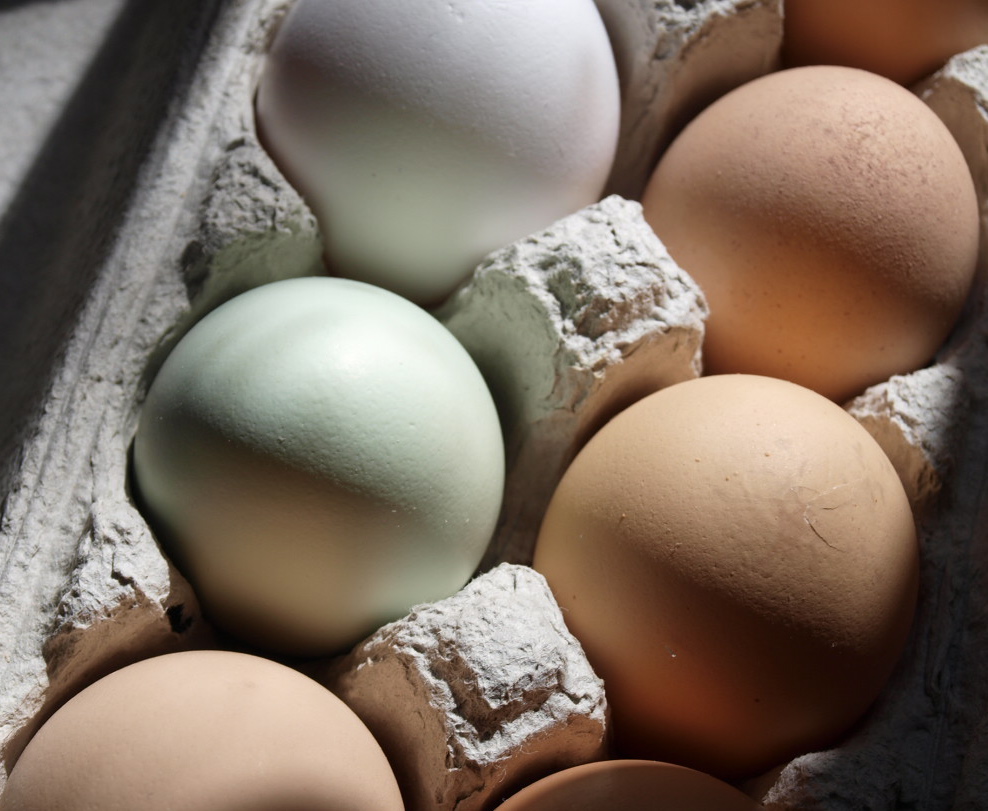
Kai and Rory, who agreed to accompany me because I bribed them with the prospect of freshly popped kettle corn, find Tennessee enthralling.  “Have you ever seen a green egg?” Tennessee asks.  Kai and Rory’s eyes widen.  “Like the book?” they say, pressing their little bodies forward.  Tennessee nods.  “Like the book,” he says, leaning in conspiratorially and flourishing his arm over a carton containing eggs in a spectrum of colors: white, beige, brown, pale green, pale blue.  “Whoa!” exclaims Rory.  “Cool!”

Tennessee encourages us to take home a dozen of his fine eggs.  I explain that I already have a dozen store-bought eggs at home and could never go through two dozen eggs in a week.  “Aw, those eggs are old,” he says, dismissing the eggs at home with a wave of his hands. “Here’s what you do with old eggs: hard-boil them.  That’s all they’re good for.  Be sure to make the water very salty.”  I pack up my purchases and thank Tennessee for his hard work.  “Not at all, my dear,” he says, smiling.  “Not at all…  And don’t forget to come back next week for some green eggs!”

*

Kai recently started reading Green Eggs and Ham aloud to me in the car, so green eggs have been on my mind.  My copy of The New Larousse Gastronomique lists several variations on green eggs, among them: Oeufs… en chartreuse (with carrots, turnips, French beans, green peas, and braised cabbage); à la chevreuse (with pureed French beans); à la chivry (with butter-fried asparagus tips and chivry sauce, consisting of white wine, shallot, chopped chervil and tarragon, velouté sauce, white stock, and butter); à la clamart (with peas à la francaise and green pea butter); and à la cressionère (with watercress puree). All of the green ingredients repeat themselves in respective recipes for hard-boiled, poached, scrambled, and omelet counterparts as well. Tarragon and other green herbs play supporting roles.  Larousse recommends boiling eggs in water with well-mashed spinach in order to attain green Easter eggs without the use of artificial dyes.

Tennessee’s green eggs result from genetics: a chicken’s breed determines the color of its eggshell.  I owe thanks to blue-shelled breeds like the Chilean Araucanas, who crossbred with brown-shelled chickens to create my beloved greens.  Leghorns comprise a majority of white shells available today, while Rhode Island Reds and Plymouth Rocks produce brown shells.  The Science of Good Food informs me that “the color of the shell has nothing to do with the nutritional quality of an egg, nor how it was processed.”  Nutritionally speaking, an egg is an egg regardless of differences in outward appearance, though there is some evidence that free-range chickens nourished on a varied diet produce eggs that are richer in flavor, as Larousse posits.

The egg salesman at the Farmer’s Market – a boy of about ten who I suspect is one of Tennessee’s grandchildren – confided that sometimes the green eggs have double yolks, which instantly elevated them to my favorite variety.  Though it may pain my physician to read this, the yolk is the jewel of my egg.  I adore a soft, creamy yolk with the white barely set, whether soft-boiled, poached, or fried.  Double yolks?  Sweeeeet.  Here is my perfect soft-cooked yolk formula for 6400 feet above sea level:  Place eggs in cold water, cover.  Bring to boil, remove cover, add salt, and quickly reduce heat to a gentle, almost non-simmer.  Simmer for 4 minutes only.  Empty pan of water and replace with lots of cold water to cool eggs.  Peel off shells, cut eggs in half, sprinkle with salt, and eat immediately.  You’ll lose some white if your eggs are fresh, but no matter.  In this preparation, whites are the readily discarded protective armor for the glorious yolks within.

“The egg is one of the kitchen’s marvels, and one of nature’s,” writes Harold McGee.  “Its simple, placid shape houses an everyday miracle: the transformation of a bland bag of nutrients into a living, breathing, vigorous creature…” A life-nurturing bundle of essential nutrients concentrated in one convenient package: shouldn’t it be celebrated as such in the kitchen?  Perhaps MFK Fisher, who clearly shares Tennessee’s egg opinion, puts it best when she writes: “I decided then, and I still hold on to it, that I would rather eat a good fresh egg only occasionally than have a whole cellarful of those dishonest old ones, which in spite of being ‘almost as good as new’ would not make omelets, even, but had to be used in cakes and cookies.”

Old age is the primary culprit in egg dishonesty.  As McGee explains, egg whites become “progressively more runny with time.”  Additionally, a slow influx of the water present in egg whites crosses into the yolk each day, causing “the yolk to swell, which stretches and weakens the yolk membrane,” thinning the yolks “dramatically.” Runny whites may be easier to separate from the yolks, rendering them optimum for baking, but most egg cooking methods benefit from the use of fresh, firm eggs.  Is there a good way to test an egg’s honesty?  Drop it into a pot of cold water.  A fresh egg will sink – and quickly, because it has less air and is dense.  The older the egg, the bigger the air pocket in its fat end, which causes the egg to rise/float in the water.  Several authors agree that an uncooked egg should be discarded if it fully floats on the water’s surface.  Fisher contends that “the finest way to know that the egg you plan to eat is a fresh one is to own the hen that makes it.” I would add that it is also very fine to know the farmer who owns the hen who makes it.

*

I boil my store-bought eggs as Tennessee suggested.  The following week, I buy Tennessee’s instead: $2.00 for one dozen, a price competitive with the grocery store.

Tennessee’s eyes twinkle as he gently opens a cardboard egg carton to reveal the small, pale celadon eggs that his chickens have laid.  “You won’t see eggs like these in your supermarket,” he says.  “Aren’t they beautiful?”  My eyes move from his weathered, bearded face to the delicately hued eggs he presents before me.  I also won’t find this sense of vitality in the supermarket, this realization that these eggs come from multiple breeds of chickens with distinct personalities who roam Tennessee’s yard plucking bugs from the soil.  I hadn’t really thought about it before, but something clicks into place as I lift my eyes once more to meet his intent gaze.  “Yes,” I tell him. “They are beautiful.”

14 Comments

Filed under food, literature, travel

Stefan

Once upon a time, there was a retired Ukrainian repairman named Stefan who loved a retired Ukrainian administrative assistant named Valentina.  Stefan and Valentina shared a ‘friendship’ that Valentina refused to define.  They went for walks together along the streets of New York in the spring and the fall; when it was too hot or too cold outside, they met each other for meals, either in their separate apartments or in restaurants and diners in between.  They shared a fondness for McDonald’s coffee.  They loved to dance together at the senior center and they were both skillful dancers.  Sometimes Stefan grew overly possessive of Valentina and she declared, “He’s a pain in a neck!”  But, after a couple of days, Valentina’s temper waned and she began to miss dapper little Stefan with his tailored suits and full white mustache.  She’d see him again.  He held her hand like she was the princess of his magical Ukrainian kingdom.  In life, Stefan had already lost his wife of many years.  He’d also lost an adult son.  Stefan wailed loudly at Valentina’s funeral, tears spilling thickly onto his dark grey suit.  He needed help standing at her gravesite, weeping; he didn’t want to toss in his handful of dirt and last flower.  Stefan died shortly after Valentina.  Not fair, not fair, not fair.

1 Comment

Filed under food, literature, travel

Eat With Care

Disclaimer: The opinions expressed in this book review are deeply personal and self-reflective, and, as such, are not intended to evoke or provoke offense.  I honor libertarianism in most circumstances.  I just have to get this out.

Disclaimer: I still eat meat and poultry, albeit very rarely these days. Trying to eliminate meat from my diet – or at least severely restrict it – has made me even more grateful for it.

Disclaimer: I am entirely in the Bourdain camp of Using and Eating All The Animal Parts.  I can’t personally attest to the flavor of some delicacies with any authority because I have yet to sample them, but if an animal must be killed for consumption, it only seems like common sense not to waste any of it, for goodness sake.

Disclaimer: I would also consider eating alternative proteins, such as insects or invasive species.  A recent Atlantic article featured a Netherlands company called Bugs Originals that is perfecting the culinary science of bug cuisine with notably flavorful success.

Disclaimer: Sometimes I make myself physically and existentially ill worrying about the world.  Global meat-consumption is skyrocketing and its effects on the environment are evident.  What’s it going to take for the world to rethink and revise the ‘traditional’ Western diet?  America created it – can’t America re-create it?  Who do I contact to start seriously lobbying?

Disclaimer: Jonathan Safran Foer wrote one of my very favorite books, Everything is Illuminated.  His non-fiction prose is as engaging as his fiction.  He is, coincidentally, married to Nicole Krauss, who wrote one of my other very favorite books, The History of Love.

*          *          *

“The eat with care ethic didn’t become obsolete over time, but died suddenly.  It was killed, actually.” – Jonathan Safran Foer

Jonathan Safran Foer’s scalding treatise against factory farms, Eating Animals, is worthy of attention even if it fails to convert readers to vegetarianism.  Eating Animals contains interviews with a wide variety of farmers, ranchers, butchers, and animal rights activists, and it documents in graphic, unrelenting detail the “farming” of agriculture today. Foer’s compelling research lends gravitas to the proposal that adopting a vegetarian diet is ultimately a more sustainable and ecologically ethical alternative to the Western diet.  I earnestly wish that I could share a copy of Foer’s book with everyone in the world, because maybe that would promote change to current practices.  But I recognize, as does Foer, that readers have to want to change and effect change.  I could in theory buy copies of Eating Animals for everyone I know, but I can’t make them read it, though I wish with all my heart that they would.  As a poultry farmer named Frank Reese confided to Foer: “People care about animals.  I believe that.  They just don’t want to know or to pay… It’s wrong, and people know it’s wrong.  They don’t have to be convinced.  They just have to eat differently.”  I get that.

Eating Animals is not an enjoyable book.  It is a train wreck from which this reader could not break her compulsion.  Foer’s book explicitly details some of the least palatable, most depressing, and most diabolically concealed realities of modern meat and poultry factory farming.  Pages 175-180 are ecologically terrifying.  I forced myself to finish the book, however, because the author did his research well and because I write about food, so I’d better know my stuff.  Barbara Kingsolver had nudged me, Michael Pollan pushed me several feet towards the edge, and Eric Schlosser brought me directly to the mouth of the abyss.  But it was Foer who finally and successfully thrust me into radical dietary change.  Foer convinced me to rethink my diet and adopt a new, almost exclusively vegetarian stance.  Not an easy decision for an enthusiastic omnivore.

“So the question is not whether we forget but what, or whom, we forget – not whether our diets change, but how…  I love sushi, I love fried chicken, I love a good steak,” writes Foer, who is now an ardent vegetarian.  “But there is a limit to my love.”  The essential kernel of insight I took from his book, along with a colossal hell bummer of an education, is that it is possible and, indeed, necessary to choose to change my diet as a statement of concern for the environment as well as the ethical treatment of the animals we eat.  “Ranchers can be vegetarians, vegans can build slaughterhouses, and I can be a vegetarian who supports the best of animal agriculture,” he writes.  I would add that his book gave me the notion that I can be an omnivore who supports the best of animal agriculture and who makes the conscious choice to spread information in order to educate others.  Though our proposed diets are fundamentally different, I profoundly appreciate the influence of Foer’s research on my own worldview.  I’m a masochist like that.

Foer’s work should be recognized for its skillful scrutiny of the worst cankers of the factory farming industry.  “Just how destructive does a culinary preference have to be before we decide to eat something else?” writes Foer.  “If being the number one contributor to the most serious threat facing the planet (global warming) isn’t enough, what is?  And if you are tempted to put off these questions of conscience, to say not now, then when?”  Central to his (very direct) entreaty is the fact that diet is a decision – something to be made and, moreover, something that can change.  People adopt dietary change all the time for their own health, as in the case of diabetes, high cholesterol, or heart disease.  After reading Eating Animals, I decided to change my diet for the health of an entity whose health is so very much more important: the planet.

I elect to eat with care.  I can’t un-know what I learned from Foer.  But I believe that openly and objectively addressing the uncomfortable has the potential to promote positive change.  And that is why I wholly recommend his book to anyone brave enough to read it.

Leave a comment

Filed under food, literature, travel

Bittersweet

I wrote this essay in 2007.  It was chosen for inclusion in an anthology called Blank: Begins at Conception, a collection featuring about 30 other authors discussing all aspects of human reproduction: fertility, conception, adoption, motherhood, the desire to remain childless, loss – you name it.  The anthology earned interest from several publishers, but due to the economic downturn the project didn’t get picked up for print.  In the interim, my mother died and I realized that death is a highly skilled editor: encouraging sharp revisions in point of view and perspective, deftly calling for updated editions, bleeding red tracking over the page.  I also adopted the philosophy that life is very short, so, though I stubbornly held out hope that the anthology would get picked up, I think it’s time to let go.  This essay is for my son, Kai.  It was originally called “Mother, Saboteur.”

*          *          *

When Kai comes into the bedroom, I am still thick with sleep.  My eyelids have matted together, and my breath burns.  I pull him up and into the bed, whispering Come to me.  For a minute, he obliges, climbing under the quilt with me and placing his head in the crook of my arm, singing Mama mama mamamama.  I breathe in the syrupy musk of his hair.  The flowered quilt enfolds us with the promise of more sleep.

Then, Kai is up and out of my arms.  I will my eyes open to watch him.  He stands on top of the bed and flings himself forward on the mattress, crashing with the vigor of two years, seven months, and four days.  “Wall dow!” he shrieks.  The cat, who has been sleeping by my feet, yelps.  “Kee!” Kai says, and lurches sideways to hug the cat.  “Moww,” he sighs sweetly into her inky fur, “Moww.”  Her tail twitches; she endures his hug just long enough and then bounds off the bed.  Kai is undeterred.   He wiggles his feet at me, beckoning tickles.  When I do tickle him, he giggles and says, “Kull nose.”

“No, honey,” I say, “I’m tickling your feet.”

“Kull nose!”

“Feet!”

“Nose!” he shoots back, sitting up in the space the cat left behind.  He’s quiet for a moment, gone to the place I call Planet Kai, and then he asks, “Warcar?”  I feign ignorance.

“Warcar?” he asks again, a little louder.  War because he’s still working on his f sounds, car because every wheeled vehicle is a car.  What he’s really asking for is his little fire truck, a gift from my sister, with which he eats all his meals and takes his baths.  Fire truck, who he “feeds” and kisses goodnight.  Fire truck, who is sitting on the top shelf of Kai’s bookcase, all the way on the other side of the house.  I look at the window.  From between the slats of the blinds, the faint possibility of sunshine lightens the night sky. All hope of going back to sleep slips away.

“Warcar?” he says, a small panic forming.  If I acknowledge Kai’s request, I will definitely have to get out of bed.  “Warcar?” he asks again, tiny crystals forming in the corners of his eyes.  Something inside me pinches.

“Would you like to get your fire truck?” I ask.  Kai deflates with relief: “Yesyesyes.”  He eases himself off the edge of the bed, his stomach down and feet dangling towards the floor.  When he stands up, he reaches to me and says, “Hand?”  I give him my hand.  I stare wistfully at the warm indentation that I’m leaving behind.

Our day begins.

*

Since Kai was born, I’ve often wondered what it must be to feel so consummately loved.  To have every inch scrutinized, every bump worried over, every runny nose tenderly wiped away (often with the hems of shirts that I once treasured).  To flatten and awe with a single smile.  To have a big person ache at the sight of my tears, and who would do anything, almost even give up her brain, just to make them stop.  This love is not rational.  It’s a stinging pain that won’t dull.

Yet I have offended my fair share of other mothers when I tell people that my mother is my greatest unwitting saboteur, as if perhaps this acknowledgement flaws me in my role as mother.  In my mind, being a daughter is a totally separate thing from being a mother – different roles, different expectations – so I don’t feel like it’s a crime to be direct about her.  Just one disparaging comment from her propels me back into early, petulant adolescence.  When, after the birth of my daughter, Aurora, I decide to grow out my bangs and my hair, my mother says, “But without bangs your face is so long.”  While shopping for clothing, I pick out a shirt in a size that I know fits me (because I have an identical one at home already), she says, “That’s too small. You need at least one size larger.”  Just before Christmas dinner, she casually mentions that after I moved away from New York, I “plumped up a lot.”  And, though I tell myself that she means well and that her criticisms spring from a misguided sense of motherly helpfulness, I can almost feel a tiny piece of myself crumble.  Is my mother ever awed when I say something bright and witty?  Does she ever want to leap to the moon for me?  She’s got a hell of a way of showing it.

*

On Sundays, we go to the beach.  As soon as we arrive, Kai is a blur, stopping only to nosh on watermelon chunks.  My husband, Brandon, an avid and experienced hole-digger who missed his funerary calling, immediately sets in on Kai’s “pool” in the sand.  Kai employs my assistance in fetching endless buckets of water for his pool.  Rory, who is still at the age where it’s Zen to hang around like a lump, relaxes contentedly in her car seat on the sand.

Kai flings himself into my arms, coating me with wet sand, his breath tropical against my cheek.  He drops mighty hunks of sand into the shallow pool, drenching my husband, who is folded in on himself, digging away.  “San woks!  Ka boom!” Kai shrieks.  Kai’s confidence singes me.

As Brandon hacks into the sand, wielding his stainless steel, garden-grade spade, my mother’s voice comes on in my head.  “You shouldn’t dig holes in the sand,” she warns.  “Someone could get hurt.”

Kai leaps into the pool, falling backwards, small driblets of watermelon on his chin.

“Well,” I retort in my head, “Hopefully they’d be able to see a hole as big as this one.”

“But what if they’re walking at night?” she imaginarily persists.

Kai careens down the shoreline chasing a hapless sandpiper.

I snap back, “The tide will have filled the hole in by then.”

“But what if they’re blind?”

By the time we pack up to leave, we’ve dug a formidable rift in the sand.  I stare back at the constellation of sand clumps that we abandon – an archipelago of sand islands, abutting the skyline of our small city by the sea.  Kai is humming, Rory snoring, and all I want to do is get my mom out of my head.

*

The Florida shoreline just recovered from a red tide.  I find the red tide fascinating, both because of its suddenness and its entirety: the ocean’s fine and lovely and then, abruptly, it’s not.  Acres of red algae bloom, suffusing the coastal region with toxic emissions and suffocating the shore for weeks.  These toxins make it very difficult to breathe, cause skin irritations for swimmers (although, it’s hard to imagine that anyone would want to swim if they couldn’t breathe properly), and kill off local sea life.  The suddenness of the red tide is jarring and immediate, and it’s a palpable relief when it recedes.

During this last red tide, we visited a friend who lived along the beach.  As soon as we got out of the car, our eyes stung and we began coughing and gagging for air.  Inside the house, we breathed freely again, but it was strange to look through the window, knowing that just on the other side was something so menacing and so entirely beyond control.  Sometimes when I speak with my mom, I feel as if I’m looking through the window at something so fond and familiar, but can’t grasp it because of the toxicity just on the other side.

*

With two little ones, a parent is forced to become a master of logistics. Between the tangled straps of the car seats and the whining about who wants to sit where and who wants to buckle themselves in, even a simple trip to the grocery store requires strategy and patience. Weekends, when Kai does not attend his daycare, require marathon planning and at least a gallon of coffee.  The kids get bored and invent new forms of torture with each other.  Kai delights in standing inches before Rory and blocking her every move as she shuffles around on the floor.  Rory steals Kai’s water when he isn’t looking, only to hear the inevitable reproach: “No, Wowy, my water!”  But there are also other moments, like when Rory falls down and starts to cry, and Kai rushes to her, gives her a hug, and says, “No cry, Wowy, I sorry,” even though he didn’t do anything wrong.

I think that my mother could have benefited from bearing her children closer together (this wasn’t in her cards and I don’t fault her for it; it’s just an observation).  Perhaps if she had, she might be better attuned, more sensitive, to what she says and how she says it.  She wouldn’t compare me to her dead, alcoholic friend (who died a long, protracted death from cancer) when I have a glass of wine with dinner.

I do have a sister.  She’s ten years older than me.  Because of our age difference, I have few childhood recollections of her.  My sister worked incessantly when she wasn’t in school.  We had our first memorable conversation when I was eighteen.  Our only similarity is in how we evade our mother, though even there we splinter: she becomes haughty and snappish and then she avoids mom for a few weeks, until her temper has receded, while I try to erase myself, searching for an exit in a house without doors.

*

If the adage is true and I am to become my mother (dear God, please let it not be true), then I can not decide the safest course of action for raising my children.  Should I endear my children to patterns wholly unlike those I grew up with, or should I mold their childhoods from memories of my own?  Or should I adopt a unilateral approach to mom’s old age and my children’s youth: ignorance coupled with hope (and possibly lobotomy)?  What level of futility must I reach in trying to ensure that my own children might want to live in the same state as me?

*

When I found out I was pregnant with a girl, I experienced terrors.  It wasn’t that way with Kai.  Aside from the usual first-time parent neuroses, I felt completely comfortable with having a boy baby.  I suppose I believed that my son would be made of tougher stuff—and to some degree he is—although he’s also quite sensitive.  I was certain that my second child would be a boy too, because somehow my body would know that I would never want to repeat the seemingly female-based pattern that I have with mom, that I love her but that I can’t be around her without either withdrawing into myself, saying something regrettable, or hating myself for another little thing.  But I had a girl, and she turned out to be preternaturally sweet.  My mother reminds me that at one point I used to be unabashedly sweet to her.  She blames the change in our relationship on “the hormones.”  If, by hormones she means puberty, then perhaps she is correct, because that was when I learned to think.  It’s a skill I prefer to keep.

*

Kai developed a terrible ear infection sometime in his second year.  He woke up especially early one morning, banging the bedroom door against the wall in his customary fashion.  He even cuddled customarily.  I stroked his cheek and felt hard, dried something.  He shrugged my hand away in the dark, whining.  When Brandon and I brought him into the light, we found that the hard, dried something hadn’t come out of his nose (my assumption, owing to three preceding weeks of allergies and croup) but rather his right ear.  We knew how to contend with croup, fevers, overactive sinuses, and disgruntled personalities.  But how to handle this?

We dealt with it as calmly as we could, though we were terrified.  I brought out my essential Guide to Raising a Toddler (Volume: Most Recent), while Brandon scoured the Internet for the search terms “pus ear toddler.”  We both arrived at the same diagnosis, an outer ear infection, so we nixed the trip to the ER.  Later that day, after timely administration of children’s pain reliever, we put Rory to bed and Kai returned to practically the same lightning bolt he always is, I sat back with Brandon wondering, How the hell did we survive this one?

It turns out we didn’t.  The next morning, Kai woke up whimpering.  I sat down on the floor and he folded himself into my lap, twisting and scrunching until he became a pathetic origami tree frog, his heartbeat like thunder.  For the next six months, Kai awoke well before dawn, fussing and irascible, no longer a toddler but a grumpy and annoyed patient grown skillful at evading medical care.  We made numerous trips to specialists and the prospect of surgery on Kai’s ears materialized.  One year later, Kai’s eardrums have been surgically perforated and he’s an entirely different (and amazing) child, but I can’t do it.  I just can’t raise any more children, or a mother for that matter.  I don’t know how to repair the rift between my family’s generations.

*

Parenting is about damn hard work, then eventually releasing your child into the world and hoping that the choices you made were the exact right ones to help your child thrive on its own.  Being a child is about getting all your needs met with the barest of returns or contributions, then skipping out and doing a lot of crazy things until you get tired of it and becoming the person you’re meant to become.  But there are children who return the collateral, who give back to their parents even after they’ve moved out.  It’s not as if my mother physically abused me or lent me out to a pimp.  Why am I such a disloyal daughter?  I haven’t even given my mom my cell phone number.

*

In 2005, a large dog bit me on the face.  Because the attack coincided with my mother’s birthday, I waited several days before telling her what had happened.  I wasn’t going to drop a bomb like that on her birthday.  When I finally told her, I fuzzed the dates, because I wasn’t sure whether she’d be more upset by the incident or by my deliberate lapse in communication, despite all good intentions.

I credit my mother with superhuman restraint.  She expressed great sympathy over my face for almost a minute before saying, “What did you do to that dog?”

How about: I petted a leashed dog who, like his owner, seemed perfectly friendly?  How about: I spent three hours in the emergency room getting my nasal passage reassembled – four heavy sutures to the cartilage; thirty-three stitches spanning the widest part of my nose; and countless shots of lidocaine, seeping down my sinuses and bitterly burning my throat?  How about: Mom, I’m just happy he didn’t take the rest of my face or, even better, I’m just happy it was me and not Kai?   I bit my tongue till it bled.

I have since struggled with my own culpability in the incident, as well as that of the dog owner.  I still envision that morning – the closet-small ER room, door shut, lights off except for the magnifying light over my head, Brandon sitting nearby (facing the wall because I couldn’t bear him to look at me) – settling down on the crinkly paper and snapping my eyes shut tight.  For a brief while the doctor had no idea which way the skin should be put back, shuffling and muttering and moving flaps of tissue this way and that, and I just lay there, willing my eyes to stay shut.  I don’t know what haunts me more – remembering that split second when I looked into the dog’s eyes just before he lashed out at me (I knew better than to do that) or the fact that my mother – my own mother – took the dog’s side.

*

My mother visits a few times a year, mainly to see Kai and Rory.  She stays in our house for about a week and takes pains to make her presence undisruptive, tucking her small suitcase into an unused corner and folding her bedding into a neat pile each morning before we all wake up.  She always brings presents – Ukrainian sausages, nuts and dried fruits, chocolate, and clothing for the kids – and often she finds surreptitious reasons to slip me $50 or $100 (which I accept, but then send back to her under the guise of helping to offset her travel costs).  When her train arrives (she refuses to fly), we meet her at the station and gamely stop at the farmer’s market for produce and boiled peanuts, a delicacy that doesn’t sound nearly as delicious as it tastes and for which mom, Brandon, and I share a fondness.

It’s always a surprise when the insult comes.  During a recent visit, the critical moment didn’t happen until the last day, a Sunday.  On the weekends, frankly, Kai gets bored, so sometimes he expends energy by “interacting” with Rory.  My mother plainly favors Rory, which is great for Rory but makes me sad for Kai.  I prepared dinner in the kitchen.  Brandon sat at the computer in the office.  My mother had been following Rory around the house, engaging her and talking sweetly, but she shifted her attention briefly to the television.  During that brief moment, Kai presumably interacted with Rory in a way that made her cry.  But we all missed it.  No one saw anything.  My mother yelled out to Kai: “Kai, you are a bad boy!  What did you do to your sister?  She’s just a baby!  You are very naughty!”

I could have ignored the outburst if she’d left it at that – fighting her required more energy than it was worth.  I could have absorbed how she accused Kai without merit, assuming the worst of him.  But she didn’t leave it.  An hour later, as we ate dinner, she sulked at the table.  She again told Kai what a bad boy he was.  When Kai finished his food – not much appetite, imagine – and got down from his booster chair, she lingered at the table and reiterated his badness to me at a volume that he could hear in the other room.  I asked her to lower her voice and explained that if she hadn’t seen him do something to Rory, she shouldn’t assume he’d done something.

“But he did.  I know it,” she snapped, loudly.  I then explained that it’s important to scold toddlers once with immediacy and move on, because of development and self-esteem, et cetera.  This failed to placate her.  She ignored Kai for the rest of the night.

*

My relationship with mom has direct parallels to the red tide: everything is fine and nice, and then suddenly it’s toxic.  Even my response is the same – I recede inside.  As I see it, my role as a mother is to encourage my children to be good citizens, show moxie, and not hate me.  What I can’t see is how to successfully accomplish that last bit.  I don’t want to dampen Kai or Rory’s development with sudden noxious blooms of vitriol.  I want so badly to be their recovering shore, their retreat amidst abrupt changes in the landscapes of their lives.  My mother doesn’t erupt with negativity on purpose; she just doesn’t have any thought-to-mouth filter and she’s had enough in life to warrant a few unchecked moments of outburst.  Things would be so much better if she learned to say sorry.

When my mother’s visit ends, the house breathes a palpable sigh of relief.  Rory cries less, Kai’s mood and appetite improve, and Brandon and I laugh again.  “It’s like you’re a ghost when she’s here,” Brandon says.  “Why do we keep inviting her?  It’d be one thing if you enjoyed having her here, but you’re miserable. Everyone is miserable.”  She’s my mother.  She gave birth to me.  How can I tell her not to visit?

*

When the red tide dissipates, I’m compelled to go to the beach (as if I need an excuse).  The dunes crackle, the sea beckons.  Kai and I kneel in the tidal pools searching for hermit crabs and colorful shells.  Rory plunges her hands into the wet sand.  Brandon wades into the shallow waves and squeals, then says, “This water is great!”  I’m so grateful to feel the blueness of the sky on my skin.

My mother and I used to love going to the beach at Coney Island.  We lived half a block away; our bedroom window had a full ocean view.  We’d go really early in the morning and leave by ten, just when the beach started filling up with people and boom boxes.  My mother and I luxuriated in the sun like a pair of seals.  When we came home, we ate watermelon.

3 Comments

Filed under food, literature, travel

Chef Rory

Chef Rory's ensalada

Rory roams the playground wearing a green polo-style dress, purple sandals, and a white paper bag on her head. She stole the paper bag from the doughnut section in the town’s grocery store.  Ruth, a tall, white-haired clerk who always calls me ‘kid,’ eyed the bag in Rory’s tiny hands.  I think Ruth wondered if Rory was stealing donuts.  But then Rory, with great panache and immaculate timing, loosened the bag’s creases and popped the bag on top of her head.  “Rory, you look just like a chef,” I said and Rory smiled.

We come to the playground after Rory’s grocery store performance.  Rory is in full chef mode when we arrive.  She starts taking “orders” from the others at the playground as she wanders through the grass and sand.  “I am Chef Rory,” she says.  “May I take your order?”  The bag slips jauntily against her silken golden hair, forcing her to keep pushing it out of her eyes.

“Egg soup?” she says to a confused toddler by the short slides. “Calamari?” she asks a freckled boy by the water fountain.  “I am an excellent cook-ah,” she pronounces, which is helpful because everyone needs to show credentials in life.  Once she has taken the orders of everyone at the playground, she marches towards the bench where I’m sitting, sits down next to me on the bench (plops, really), taps my shoulder – I am reading a book – and asks, “And what can I make for you, lovely lady?”

Rory is the byproduct of my not-so-small obsession with cooking and food writing.  “Can I help you cook, mommy?  Let me go get my stool!”  Before I can answer, she runs to the bathroom, picks up a large blue plastic stool, and places it on the floor near where I’m working.  She climbs the stool, peers up at me expectantly.  I can feel the heat of her skin against mine.  “So, what are we cookin’, mom?” she asks.  At age four, there’s not much she can actually help me with in the kitchen, but I try to include her in the process of making meals: she does a lot of stirring, dumping, and taste-testing.  I didn’t discover my passion for cooking until well after college; I don’t remember ever helping my mother make a meal in my youth.  It might have been a space issue –kitchens in New York City apartments tend to be small – or perhaps it just wasn’t something mom thought to do, because she learned to cook for herself at age 14 while enrolled at one of the Ukraine’s then-ubiquitous polytechnical colleges.  I obviously didn’t think to ask.

It’s important to me that I let Rory participate in the kitchen.  Thus far, she loves food, so it only seems logical that she gains insight about its production and maybe accumulates some serviceable skills in the process.  As we work, I think about the moment in the hospitalwhen the midwife placed Rory, still coated with afterbirth and blood, onto my chest and something inside me flooded with joy.  I remember how dark her hair was, how she gradually wore away a long horizontal patch on the back of her head while sleeping in her crib; I remember blearily breast-feeding her, sitting in the sturdy rocking chair in the middle of the night.  I look at her now, all bird legs and wild hair, and think, God, she’s growing so fast!  And then I pretend that I’m crying because I’m chopping onions.

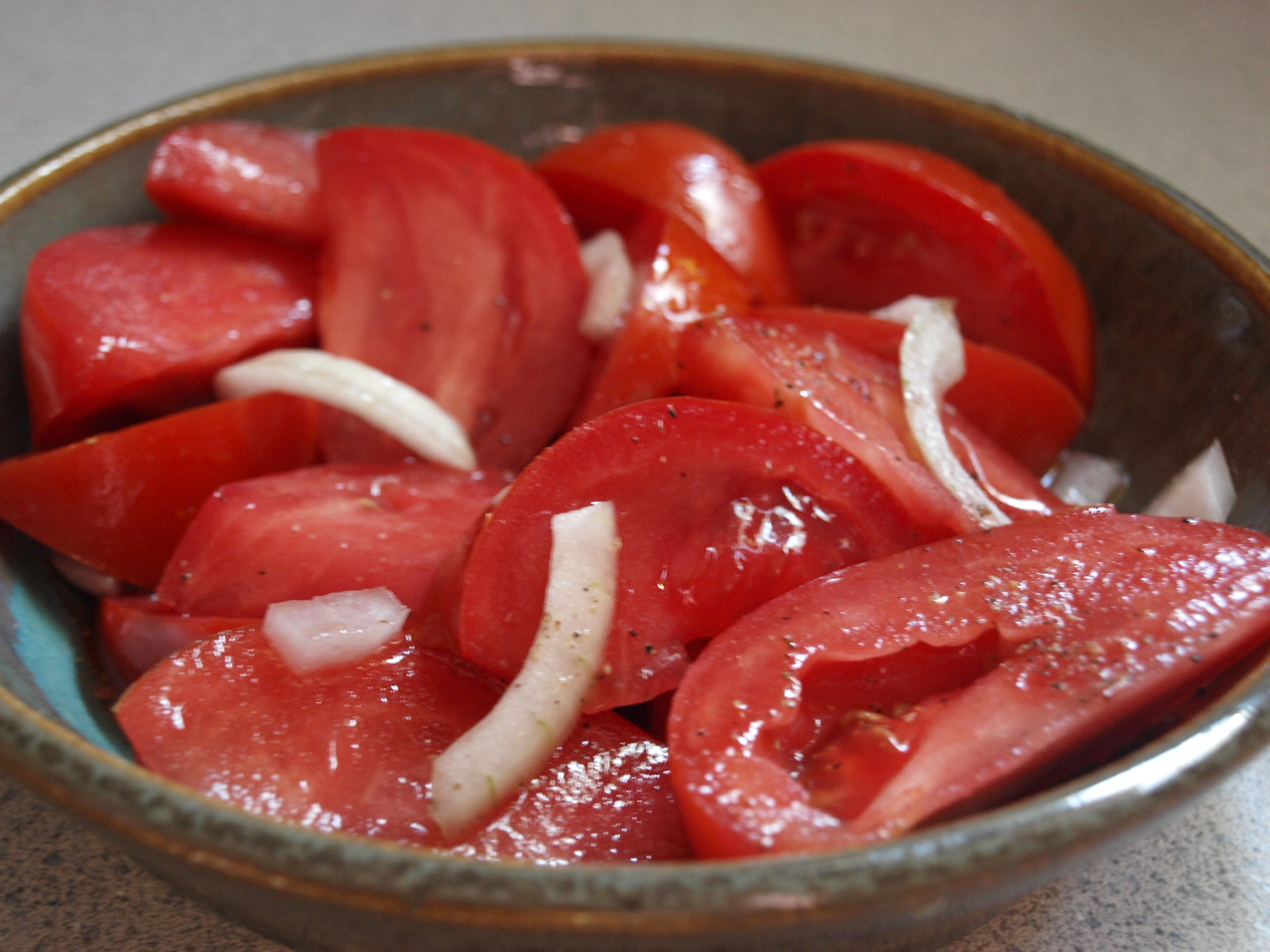
Today at the playground I order Elizabeth David’s ensalada from Chef Rory; I have been craving it ever since I read her collected essays in An Omelette and a Glass of Wine.  Rory’s golden green eyes widen and she says, “En-saw-whatta?”

“It’s a simple salad with tomato wedges, raw onions, salt, olive oil, and vinegar,” I say.

“Ohhhh,” she says, her head bobbling underneath the white bag.  “Now I get it!  I wove tomatoes!”  She takes a few steps away from me, then stops and turns.  “You got it, Toots,” she adds, her hands cupped against her lips, suppressing a giggle.  When we go home, we make ensalada for lunch.

1 Comment

Filed under food, literature, travel

Uh oh, mom’s hittin’ the sauce again…

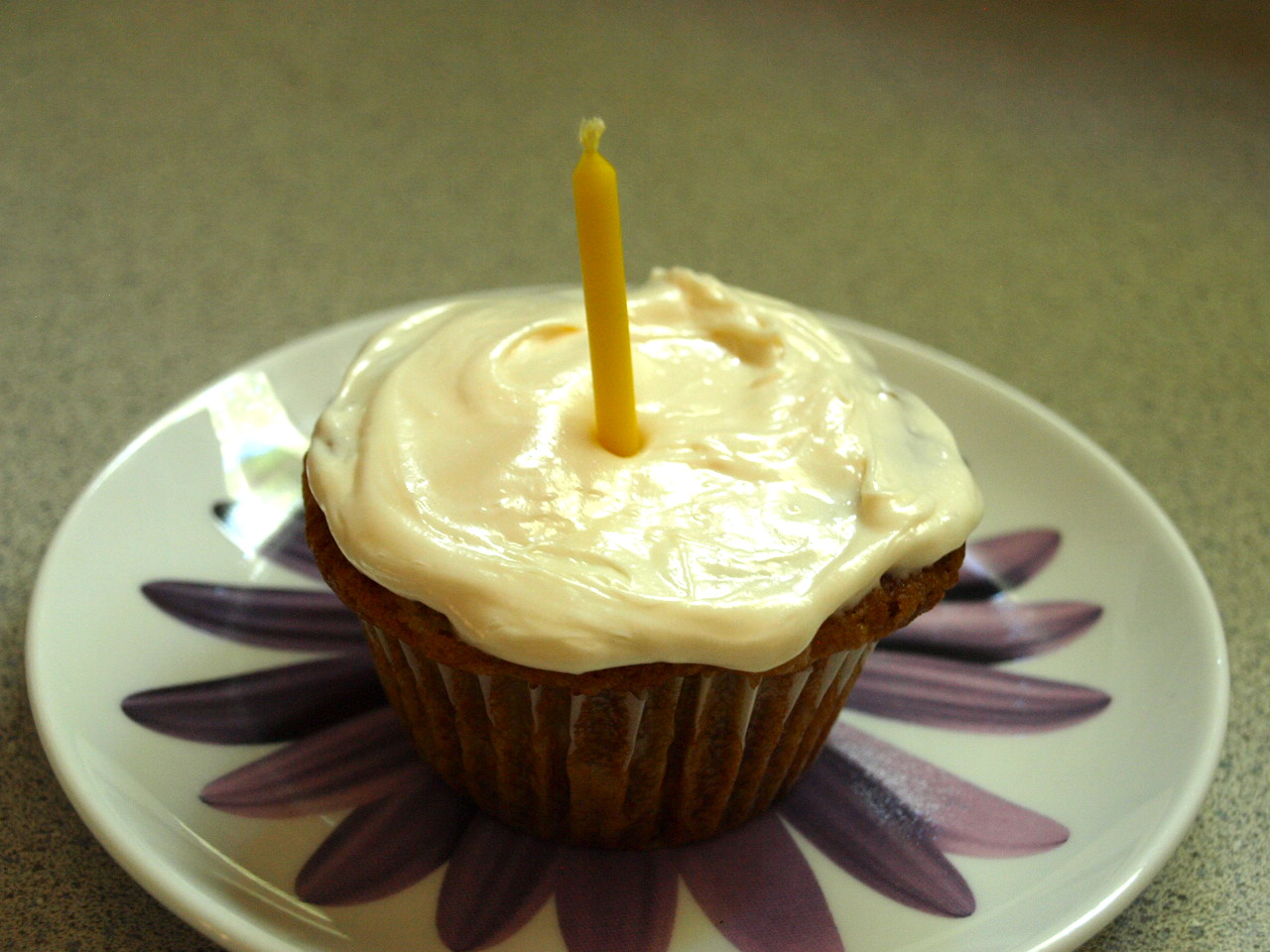
Did I feel a little guilty adapting aunt Cappy’s celestial spiced pear cake – moist, scrumptious, and straight-up delicious – into little, rum-spiked cupcakes for a friend’s birthday?  The licentious crack of the rum bottle’s black lid as I opened it, the wickedly sensuous way the amber rum spilled over the pale butter cream frosting… Sure.  I was naughty.  But sometimes you have to be willing to take a good, pure recipe and muss it up a little.  Sometimes, when you’re getting ready to make dinner in honor of your sauciest friend, you’ve got to take one for the team and be a little bad.

You know you want me.

Aunt Cappy’s Spiced Pear Cake

Cake:
1 1/4 c. vegetable oil
2 c. sugar
3 eggs
3 c. all-purpose flour
1 tsp. salt
1 tsp. baking soda
1 tsp. cinnamon
1 tsp. vanilla extract
2 c. chopped canned pears (reserve syrup for glaze)
1 c. chopped pecans

Glaze:
1 tbsp. butter, room temperature
1 ½ c. confectioner’s sugar
2-3 tbsp. syrup from canned pears

Preheat oven to 325 F. In a mixing bowl, combine oil, sugar, and eggs, and beat well. Sift together flour, salt, baking soda, and cinnamon.  Add this to the creamed mixture and stir until blended.  Add vanilla.  Fold in pears and pecans.  Grease and flour a 10” tube or Bundt pan, and spoon in the batter.  Bake for 1 hour and 20 minutes, or until cake tests done.  Let cake cool 20 minutes, then turn it onto a cake rack to cool completely.  While the cake cools make the glaze.  Blend the butter and confectioner’s sugar with enough syrup to make a smooth, slightly runny glaze.  Drizzle glaze over the top of the cake, letting some run down the sides.

(The corrupted cupcakes took about 25 minutes.  The remaining rum didn’t last long.)

4 Comments

Filed under food, literature, travel

Summer’s Bounty

Summer’s bounty brings with it some of my favorite foods to eat: sweet corn on the cob; globular peaches with tender, dripping flesh; tomatoes fresh from the garden; and watermelon – beautiful watermelon bursting from its hull, golden where it has rested on its place in the soil in the hot summer sun.

I do very little to prepare these seasonal treasures, the lack of preparation itself a secondary, but no less important gift from summer.  I eat tomatoes like apples, except sprinkled judiciously with salt.  If the peaches are ripe, I dispense with napkins altogether and slurp their juices on the back steps with no condiment save for the grin on my face. Corn is boiled in water seasoned with equal amounts of salt and sugar. (My grandmother believed sugar was essential to cooking corn, and I am disinclined to disagree.)  I love to eat the cooked corn with salted butter, salt, and pepper, as does my family, whose sighs of appreciation I savor.

To me, watermelon is a luxury, money well spent… and sometimes a meal unto itself.  My husband, who grew up in Florida, where watermelon is as ubiquitous as barbeque sauce and collard greens, disagrees.  I look for watermelons with golden bottoms and a hollow sound when tapped, feeling a rush like the Sweeney Todd of produce each time my knife slices into that first inch of watermelon rind.  I cut off the root end, which gives me a flat surface from which to work, then I ease my knife down along the round periphery, cutting the rind away in pretty arcs.  Slice the meat into quarters, the quarters into flat slices that are easy to hold and devour, and voila!  Instant dinner.

Summer reminds me to appreciate my food.  Due to a long, wet winter, I didn’t start the family garden until July this year.  My tomato plant, with its aphrodisiacal leaves and fuzzy stem so full of promise, took that month to slowly pale and shrivel in its plot, despite the water and attention we gave it.  Now it is too late in an already-short growing season to start another plant.  I am heartbroken for the ghosts of those homegrown garden tomatoes.  The Farmer’s Market helps, but only a little (it only lasts as long as the growing season).  For the rest of the long year, I’ll have to rely on the grainy, cardboard-like shams of tomatoes sold in the supermarket.  The prospect makes me very sad.

*

The Unprejudiced Palate is a post-WWII food treatise written by noted culinarian Angelo Pellegrini. “…The average American enjoys inexhaustible abundance,” observes Pellegrini. “His means are not adequate to satisfy the needs which a prodigal environment has made habitually extravagant, while even during those annoying periods of economic recession… he has infrequently known the meaning of real scarcity.  He is not impressed by the assurance that, compared with the starving millions in Europe and Asia [and Africa, I would add], his pantry is a gourmet’s paradise.  He appraises his stock of worldly goods in terms of America’s fantastic wealth, and he is not satisfied with less than what he considers his proper share.”

Pellegrini immigrated to the US from Italy as a child in 1913.  In the Italy of Pellegrini’s youth, luxuries were dear: sugar scarce, coffee hoarded.  Children roamed farms and fields in search of cow patties – precious for fueling stoves.  “I had known scarcity, had lived on intimate terms with its agonizing reality,” he writes.  “The discovery of its opposite, its annihilator, was an experience so maddening with joy, so awful and bewildering, that I am not yet fully recovered from the initial shock.”  The Unprejudiced Palate, first published in 1948, was, I imagine, Pellegrini’s coping mechanism – an affirmation of his frugality and the sense of purpose derived from toiling in the earth, a celebration and true appreciation of good food shared with good company.  Pellegrini gathered his own wood, cultivated a formidable garden, and scavenged and hunted the things that grew and lived in the forests around his home (he once lost a potential paramour after hunting, preparing, and consuming a plateful of “succulent meadow larks” at a family dinner).  He kept a cellar full of wine that he made and bottled himself.  He was a man who believed in complete self-sufficiency and bully to anyone foolish enough to disagree.  (In the book, he tempers this occasional bristle with otherwise delightful prose and lovely, evocative recipes and descriptions of meals past.)

As an adult, Pellegrini witnessed firsthand the suburban swell that followed WWII, and the rise of the supermarket as we know it today.  This critical shift gave Americans access to a higher level of variety in foodstuffs than they had known before, bringing with it the gradual demise of ‘mom and pop’ shops and specialty grocers, like the green grocer and the butcher.  According to The 1950s by William and Nancy Young, the post-war surge of rising incomes encouraged consumers to raise their food budgets.  “To accommodate this increased spending for food – and to adapt to changing demographic patterns, especially the growth of suburbs – new, more modern supermarkets sprang up across the land,” write the Youngs. “By 1959, they [suburban supermarkets] claimed roughly 70 percent of all sales, and yet still comprised only 11 percent of all grocery stores.”  The level of abundance that awed Pellegrini, then, was relatively new to the American lifestyle, though it quickly became the standard and, Pellegrini argues, the expectation.  With this new consumerism came ‘easy-prep’ foods, a phenomenon that immediately and irrevocably changed the American diet and presented a culinary alternative that stood in direct contradiction to Pellegrini’s farm-to-table philosophy.  The smug consumerism of the American psyche perplexed him.  I would argue that this is human nature – it is easy to take the status quo for granted during times of plenty – but, since I am an immigrant’s daughter, I understand his frustration.

*

My mother grew up in the Ukraine during WWII, so she, like Pellegrini, was well acquainted with scarcity and real hunger.  She immigrated to the States in her late 30s in order to give her daughters a better life, earning US citizenship at age 40.  In many ways, reading Pellegrini evoked memories of my mother and helped me truly understand some of the behaviors that I thought were so weird with mom.  She never went so far as to hunt a common pigeon in the park, pluck it, roast it, and call it dinner, but she lived very frugally: saving and reusing things that others would discard; savoring every last morsel on her plate, bones, giblets, and all.  Mom ate simple breads and soups, unadorned vegetables and fruits, and seafood only rarely.  She seldom purchased “bigger” meats like pork or beef, and she knew how to make a boiled chicken last all week.  Mom expressed an immigrant’s appreciation for the well-stocked shelves of the American grocery store, but she never forgot the reason that she immigrated either, living resourcefully within (if not below) her means and favoring a diet that she could procure somewhat reliably – primarily fruits and vegetables.  I am what results from this dichotomy.

I have been intensively studying texts about food and food production for the last few years and I am only just beginning to understand how modern food systems work, particularly in regard to the damage they do to the environment.  I’m trying to become more mindful about where my food comes from, who makes it, how it is grown, and where I choose to make purchases with money that is hard-earned.  I try to remember that I am blessed to have year-round access to cardboard sham tomatoes.  I owe at least that much to my upbringing and my mother’s resourceful frugality.  I owe at least that much to my children.

In the meantime, we all have to eat to live and it is summer, that most bountiful of seasons.  So tonight, I’ll raise a phantom glass to the spirit of Angelo Pellegrini, pull some veggies from the garden for a nice salad – and maybe a hunk of bread and a small piece of good, stinky cheese, and embrace his most essential philosophy: appreciate and enjoy the food before you, savor every bite, and share the meal with those you love best.

Leave a comment

Filed under food, literature, travel

What’s going on in your kitchen tonight?

It’s Friday night (at least where I am).  I should be out gallivanting with a bunch of sexy, young things, but here I am, glued to my computer, sucking down glasses of cheap red wine and wishing for a man named Jean Louis to bust through my front door and whisk me away to his private corner of France.  (Dreams are free, right?)  I ate a cheese quesadilla from the local Mexican joint and three tortilla chips for dinner tonight.  I had to nuke the quesadilla to reconstitute the coagulated cheese, but otherwise it was as advertised: hot cheese between a large tortilla, folded upon itself. Sound sexy yet?  That’s because it wasn’t.  But at least it wasn’t fried to a burnt crisp, as is the house specialty.  (The waitress no doubt heard my voice in the background shrieking,”NOT FRIED!  NOT FRIED!”  I apologize to you, waitress, whoever you were.)  I’d spent all day trying to wipe a certain miniature music player of all its music, then reloading said music.  I was done.  We called the Mexican place, put in an order, and dinner transported to our plates at home.  Like magic, only way more delicious.

Have I mentioned that Hot Cheese is my stripper name?

I can’t help but wonder what’s going on in kitchens around the States (at least) right now.  Many of my foreign counterparts are stuffed thickly into bars or fast asleep at this moment, but in America, it’s Friday night and TG for I.  What’re you cookin’ up?


Leave a comment

Filed under food, literature, travel